The inverse femtobarn (fb⁻¹) is the standard unit of integrated luminosity in particle physics, particularly at colliders like the Large Hadron Collider (LHC). It quantifies the total number of particle collisions that have occurred over a given period, normalized by the cross-section of the processes being studied. One inverse femtobarn corresponds to one collision event per femtobarn of cross-section, where a femtobarn is 10⁻⁴³ square meters — an area roughly the size of a single atomic nucleus. This unit allows physicists to compare the statistical power of different datasets and to calculate expected event rates for rare processes.
History
The term 'barn' was coined during World War II by physicists at Purdue University, who joked that a cross-section of 10⁻²⁸ m² was 'as big as a barn' compared to typical nuclear sizes. The femtobarn (10⁻¹⁵ barns) and its inverse became standard with the advent of high-luminositycolliders in the 1980s–1990s, though the exact origin of the inverse femtobarn as a unit is not precisely documented.
How it works
Luminosity measures how many particles pass through each other per unit area per second, and integrating it over time gives the total collision count. When multiplied by the cross-section of a specific process (e.g., Higgs boson production), the result is the expected number of such events. For example, if a process has a cross-section of 10 picobarns and the dataset is 100 fb⁻¹, one expects 1,000,000 events. The unit is practical because cross-sections in particle physics span many orders of magnitude, and using inverse femtobarns keeps the numbers manageable.
In practice
Used to report the size of datasets at the LHC and other colliders; for instance, the discovery of the Higgs boson in 2012 was based on about 5 fb⁻¹ of data at 7–8 TeV, while the full Run 2 dataset reached 140 fb⁻¹.
Fun fact
The total integrated luminosity of the LHC's Run 2 (2015–2018) was about 140 fb⁻¹, meaning that if you scaled the collision area to a barn, you would have filled it 140 times over — yet the Higgs boson was produced only about 3 million times in that entire dataset.
Systems:SIOne inverse femtobarn is equal to 10^42 per square meter, representing the integrated luminosity corresponding to a cross-section of one femtobarn.
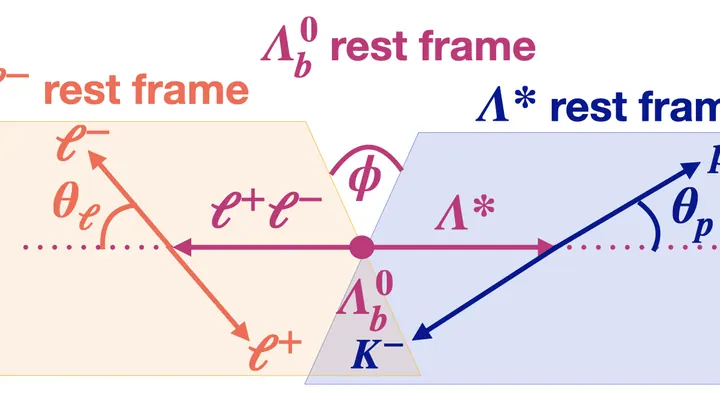
At the Large Hadron Collider, protons are smashed together, and among the debris, a heavyweight particle, the lambda baryon, sometimes appears. It lives for a tiny fraction of a second before decaying into other particles.
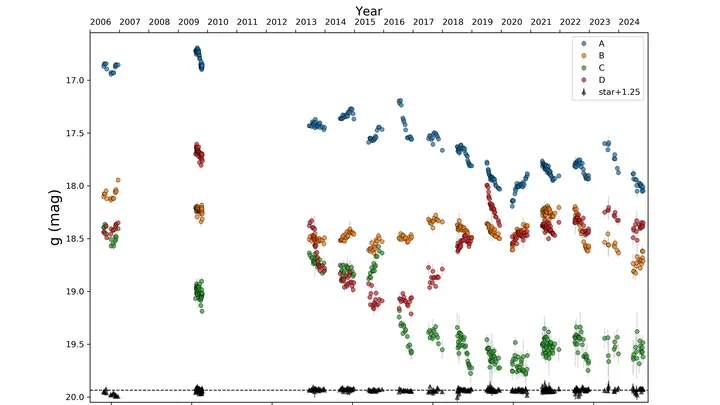
A distant quasar appears as four points of light arranged in a cross. This is how the gravity of a galaxy lying along our line of sight distorts the view: it acts like imperfect glass, multiplying the image. Each point is the same object, but its light travels different paths.
Imagine a balance scale with identical weights, yet one pan always tips lower. In the world of elementary particles, this imbalance is called CP violation: particles and their mirror twins (antiparticles) behave slightly differently.
In a dark cloud where no star has yet ignited, gas begins to pull together toward a common center. This is how the most massive stars in the Galaxy are born: those tens of times heavier than the Sun. Astronomers pointed radio telescopes at the cloud SDC335.579-0.292 and saw gas molecules lining up into streams falling inward.
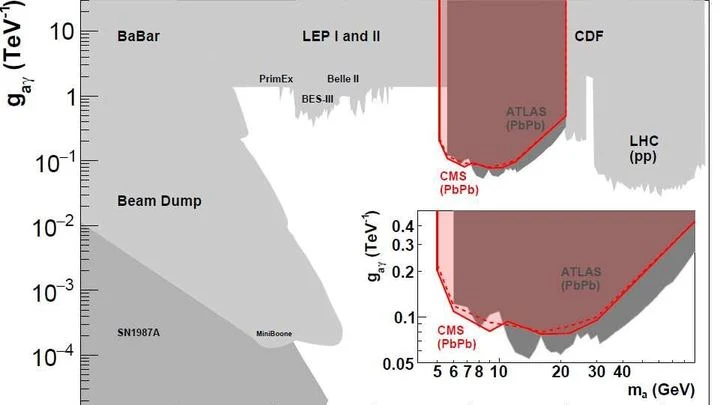
In the kitchen, two flashlight beams pass through each other without noticing. Light barely interacts with light. But if you accelerate particles to enormous energies, two photons can collide and give birth to something new.
In 2017, protons at the Large Hadron Collider collided with an energy of 5.02 TeV. The CMS detector recorded these collisions, and among billions of events, physicists hunted for a rare occurrence: the production of a single top quark without its antiparticle.
Inside the Large Hadron Collider, protons are accelerated to nearly the speed of light and smashed head-on. At the collision point, a burst of energy is born for an instant, from which new particles can emerge. One of the heaviest is the top quark.
At the Large Hadron Collider, physicists accelerate protons to nearly the speed of light and smash them together. Usually, the protons themselves take part in such collisions, but sometimes they pass close by without touching, and it is their electric fields that interact.
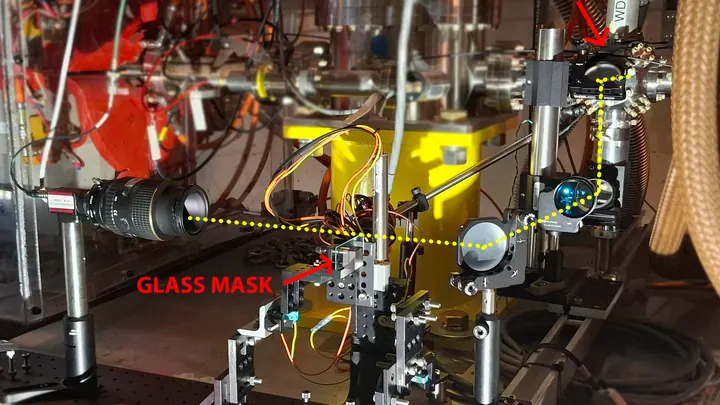
In giant particle accelerators, particles fly at nearly the speed of light and smash head-on. But sometimes one beam is slightly denser than the other, like someone stepping onto a packed escalator the wrong way. Then collisions become uneven, and detectors start 'flickering,' throwing off measurements.
At the Large Hadron Collider, protons smash into each other like two trucks full of confetti. The debris, dozens of new particles, scatters in all directions. The detector records their tracks, and then the real work begins: piecing together a complete picture of the collision from those tracks.
Previously, this was done by a set of rules devised by physicists.
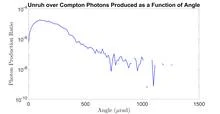
In 1976, Canadian physicist Bill Unruh asked a simple question: what does an observer see when accelerating through empty space? The answer turned out to be strange: emptiness ceases to be empty. An accelerating observer bathes in thermal radiation with a temperature proportional to the acceleration.