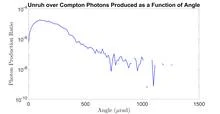
Infrared divergence is a mathematical blow-up in quantum field theory that occurs when massless particles (like photons) are emitted with arbitrarily low energy. These divergences appear in calculations of scattering processes, threatening to make predictions infinite and meaningless. However, they are not physical catastrophes — they reflect the impossibility of detecting perfectly zero-energy particles and are resolved by summing over all possible undetectable emissions.
History
Infrared divergences were first identified in quantum electrodynamics in the 1930s by Felix Bloch and Arnold Nordsieck, who showed they cancel when accounting for soft photonemission. The full treatment was refined by others in the 1950s.
How it works
When a charged particle accelerates, it emits photons. In quantum calculations, you must sum over all possible photon emissions, including those with vanishingly small energy. The sum diverges logarithmically as photon energy approaches zero. The resolution, developed in the 1930s-50s, involves recognizing that any real detector has finite energy resolution, so you must include all emissions below that threshold. When done correctly, the divergences cancel, yielding finite, measurable predictions.
In practice
Understanding infrared divergences is essential for precise calculations in particle physics, such as predicting the properties of jets in collider experiments at CERN.
Fun fact
Infrared divergences are intimately connected to the fact that photons are massless — if photons had even a tiny mass, these infinities would vanish, but then the speed of light would depend on wavelength, contradicting observations.
The quantum vacuum is not empty: it is permeated by entanglement linking distant regions. But when physicists tried to compute this entanglement, it turned out to be infinite. The culprit: particles with very low energy that can smear out over arbitrarily large volumes. They are like waves with no shores to contain them.
In quantum field theory, there is a long-standing mystery: infrared divergences. Usually they are seen as an annoying technical nuisance that must be carefully 'papered over' in calculations. But what if this is not a bug, but a feature?
In the microcosm, long-range forces, gravity or electricity, do not switch off even at enormous distances. Therefore, any particle drags behind it a trail of soft (i.e., very low-energy) photons or gravitons. This trail is called the "dress"; without it, calculations fall apart and infinities appear.
A lightning strike splits the sky in a fraction of a second, leaving a branched trail. At the same moment, in a tiny superconducting crystal cooled to near absolute zero, an avalanche of magnetic field rushes through — thin fingers of magnetization piercing the material.
In 1976, Canadian physicist Bill Unruh asked a simple question: what does an observer see when accelerating through empty space? The answer turned out to be strange: emptiness ceases to be empty. An accelerating observer bathes in thermal radiation with a temperature proportional to the acceleration.