Thermal Noise of the Vacuum: How to Catch Unruh Radiation in a Laser Beam ✛
Context
The Unruh effect is one of the most elusive predictions of quantum field theory in curved spacetime: a uniformly accelerating observer should perceive the vacuum as a thermal medium with a temperature proportional to the acceleration. The problem is that noticeable temperatures require accelerations on the order of $10^{20}$ g, which are unattainable under ordinary conditions. Alongside this work lie proposals to detect the effect in storage rings, media with varying refractive indices, Penning traps, and waveguides, but all face the same difficulty: distinguishing the weak Unruh signal from intense classical radiation. This article follows the line of attempts to use ultra-strong laser fields to generate the required accelerations, but it differs by being the first to include realistic beam geometry and full three-dimensional modeling of both processes, Unruh and Compton scattering.
Methods
The authors built a fully three-dimensional model of an electron beam colliding with a tightly focused, circularly polarized laser pulse. The electrons propagated in a field described by the analytical Richards–Wolf approximation, and for each macroparticle the local normalized vector potential a0 and Lorentz factor γ were computed. Unruh radiation was modeled as scattering on a thermal spectrum in the electron rest frame using the Klein–Nishina cross section averaged over the thermal distribution; Compton radiation was calculated from differential probabilities for all harmonics, including photon recoil. To improve sampling efficiency for rare high-energy events, log-shifted sampling with Jacobian correction was used, and the relative error in the integral photon number was kept below 2%. Beam parameters corresponded to FACET-II (a0=5, energy 10 GeV) and LUXE phase 1 (a0=23.6, energy 16.5 GeV).
Results
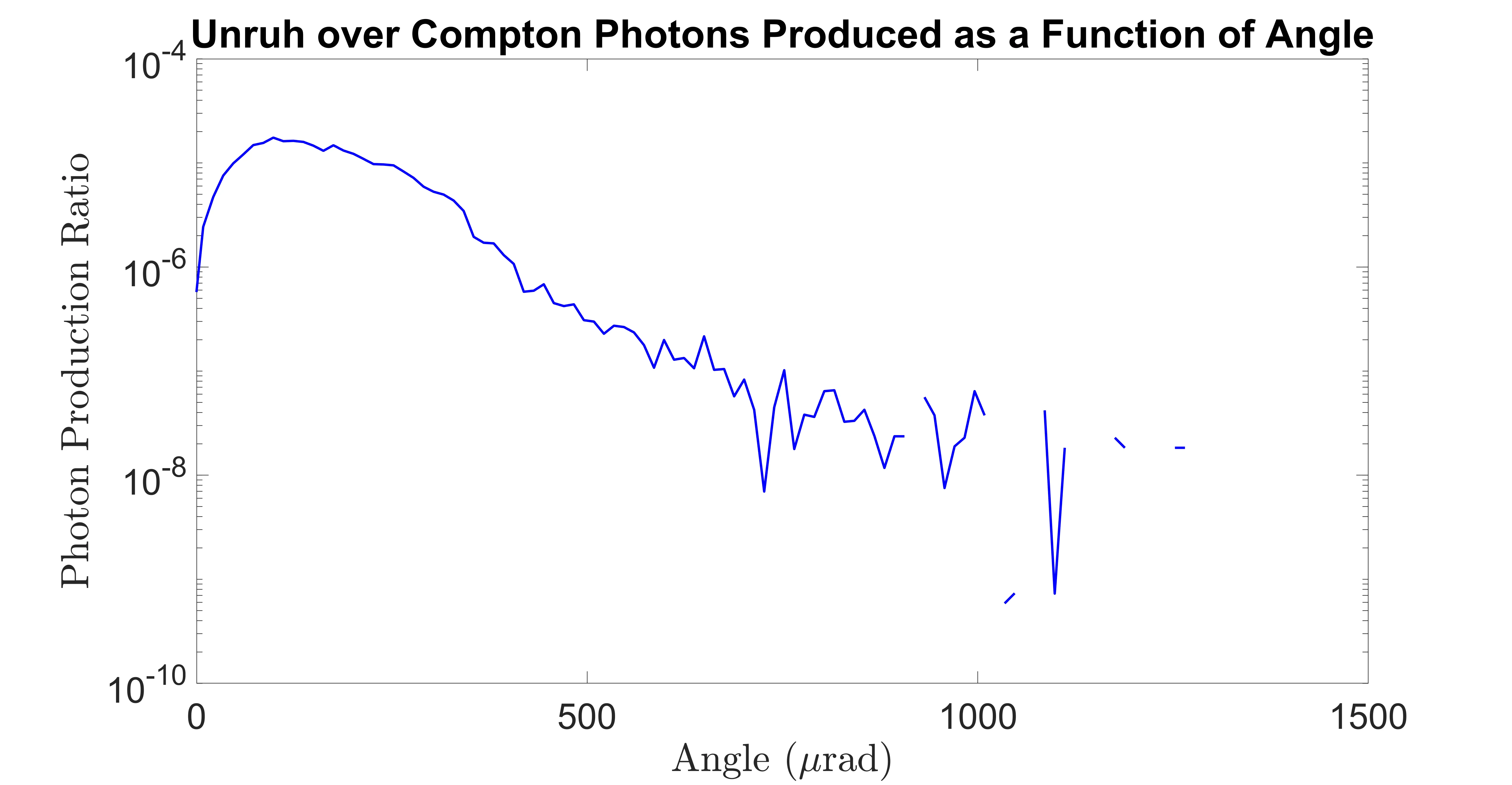
For FACET-II parameters (a0=5), the ratio of Unruh photon density to Compton background reaches a maximum of about $10^{-5}$ in the angular range 150–400 microradians, but the absolute signal remains extremely small. The most favorable window is energies of 2–3 GeV and angles of 200–400 microradians, where the background is minimal. For LUXE (a0=23.6), the ratio increases by more than two orders of magnitude, exceeding $10^{-3}$, with a peak around 800 microradians and in the energy range 2–6 GeV. The increase is explained by the faster growth of the Unruh photon production rate with the quantum parameter χ compared to Compton radiation. The authors also considered collective effects in dense beams using the Vlasov equation and found that at densities above $10^{21}$ cm^-3, the plasma frequency exceeds the laser frequency, enhancing the total field and the Unruh temperature.
Implications
This work differs from neighboring studies in that it is the first to combine realistic three-dimensional beam geometry, the full Klein–Nishina cross section instead of the Thomson approximation, and simultaneous calculation of the Compton background. This allows not just an estimate of the principal possibility of detection, but also the identification of specific phase-space regions where the Unruh signal stands out. Such an approach turns the search for the Unruh effect from a theoretical problem into a practical program for existing and upcoming facilities. Furthermore, the analysis of collective effects in dense plasma opens a new direction not previously considered.
Future development
The immediate next step is experimental verification of the predicted windows at FACET-II and LUXE using angular collimation and energy filtering. Further development may include incorporating collective effects into full simulations for dense beams, as well as exploring higher intensities where the Unruh temperature approaches the electron mass and the model requires refinement. Machine learning methods might also be applied to extract the weak signal from the background.
Impact
The results could stimulate experiments testing quantum field theory in strong fields, and may also find applications in accelerator physics and diagnostics of ultra-intense laser pulses.
Next steps
Conduct measurements at FACET-II and LUXE in the specified angular and energy windows; develop detectors with high angular resolution to suppress the Compton background.
Key open problems
For high-energy physics and accelerator physics, a key unresolved problem is the experimental confirmation of the Unruh effect, which would test the foundations of quantum field theory in non-inertial frames. This work links that fundamental challenge to the practical capabilities of modern laser–plasma accelerators, offering specific parameters for the search.
The knowledge machine's view
This section is addressed to the author of the paper and their colleagues. Neighbouring works were found by meaning-based search across our archive, not by word overlap. We do not review: we show the field around the work.
What the work does
The authors built a three-dimensional model of the collision between an electron beam and a tightly focused laser pulse, calculating the Unruh radiation and the Compton background for the FACET-II and LUXE parameters. They identified windows in phase space where the Unruh signal stands out from the background, and showed that for LUXE the signal-to-background ratio increases by two orders of magnitude.
Where its strength is
This work is the first to include realistic beam geometry and full three-dimensional modeling of both processes, which allows concrete experimental recommendations for testing the Unruh effect.
Where it could go next
- It might be interesting to compare the proposed scheme with approaches that use superconducting circuits to detect the Unruh effect: comparing sensitivity and systematic limitations could reveal complementary parameter windows.based on: How to Catch the Heat of Emptiness with a Superconducting Circuit arXiv:2607.24836
- Closely related is the analysis of the Unruh effect in the context of quantum communication: perhaps considering the influence of acceleration on quantum channels could extend the applicability of the model or suggest new observables.based on: Acceleration rescues quantum communication arXiv:2607.17216
- In our archive there is a paper on how acceleration turns the vacuum into a hot bath; comparing its theoretical methods could help refine the Klein–Nishina cross section used for the thermal spectrum.based on: Quantum Mpemba Effect in Unruh Thermalization arXiv:2509.05756
Worth trying
- Check how the detection window changes when taking into account the finite duration of the laser pulse and the shape of the envelope.
- Estimate the contribution of polarization effects to the background Compton scattering for circular polarization.
Why this may matter
If the proposed windows are confirmed experimentally, this would be the first direct observation of the Unruh effect and would open the way to studying quantum field theory in accelerated reference frames.
Nearby works in our archive
- Heat from the Void: How to Catch the Glow of Accelerationsimilarity 0.61
- How to Catch the Heat of Emptiness with a Superconducting Circuitsimilarity 0.58
- How to Catch the Thermal Glow of Emptinesssimilarity 0.57
- How to Hear the Warmth of the Voidsimilarity 0.57
- Heat from the void: how to catch the Unruh effectsimilarity 0.52
- Motion as Fuel: A Quantum Engine Beats Carnotsimilarity 0.51
- Quantum Mpemba Effect in Unruh Thermalizationsimilarity 0.51
- Acceleration rescues quantum communicationsimilarity 0.51
The archive is sparse around this work: the closest review is only 0.61, against a usual 0.64. It looks like few have drilled nearby.
The Unruh temperature for an acceleration of $10^{20}$ g is about 4000 K, like the surface of a red star, but it arises from pure vacuum.
In Stanislaw Lem's novel "Fiasco," astronauts accelerating to relativistic speeds encounter unexpected thermal radiation, an echo of the Unruh effect that researchers here are trying to catch in the lab.
Key numbers
- signal-to-background ratio at a0=5: 10-5
- signal-to-background ratio at a0=23.6: >10-3
- peak Unruh temperature in LUXE: 0.534 MeV
- optimal angle in LUXE: 800 microradians
- beam energy in LUXE: 16.5 GeV