Topological Physics at Room Temperature Using Light ✛
Thermal noise is the eternal nemesis of quantum experiments. Atoms jitter randomly, like musicians trying to play in a bustling market. Until now, only extreme cold could help — fridge-sized setups filled with liquid helium.
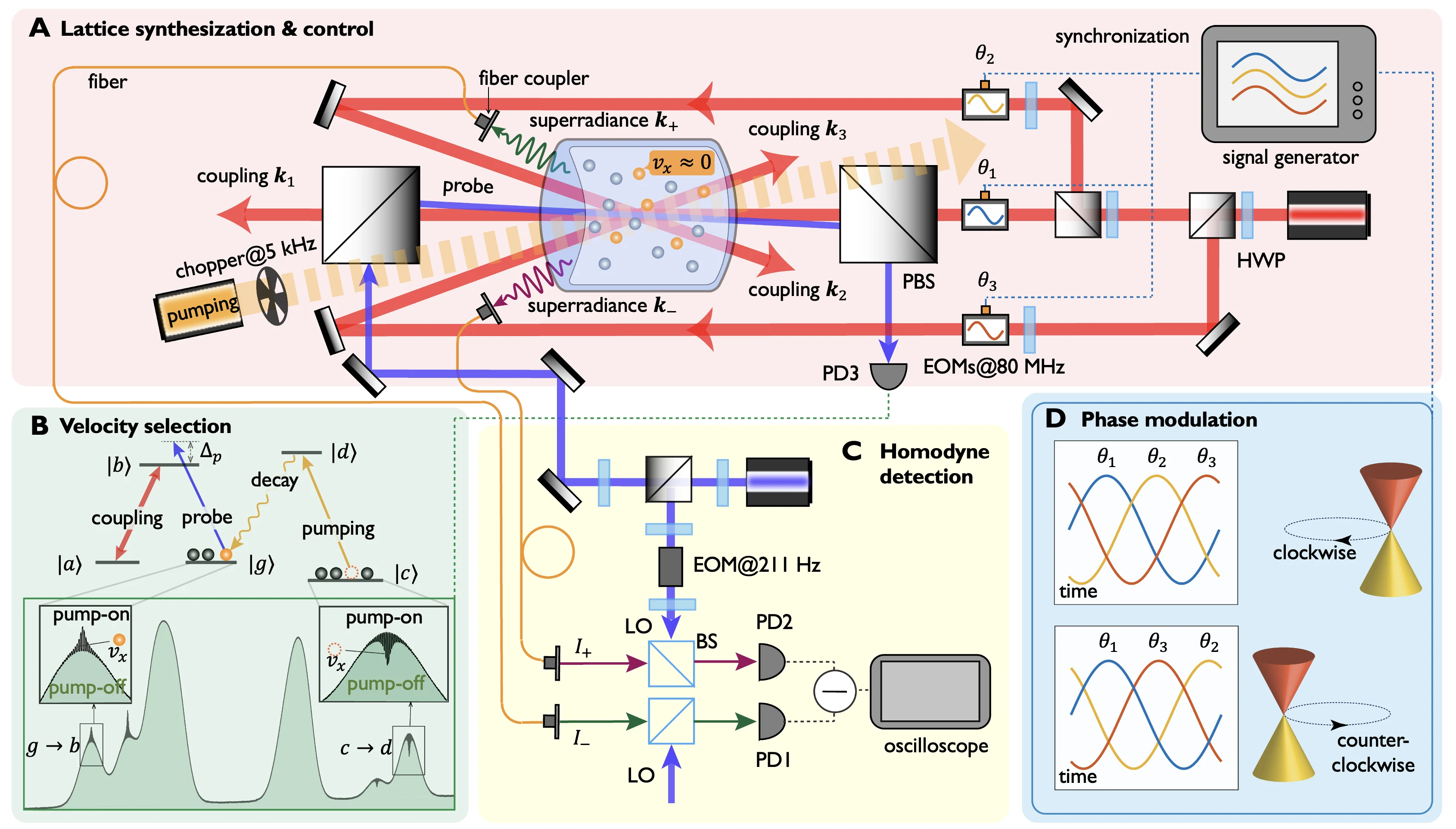
In this new experiment, physicists gave the atoms an orchestra with no conductor. A laser created a periodic lattice where particles emit light in harmony — thermal noise literally drowns in the collective chorus. A simple brightness measurement captured the shift between stable quantum phases. The approach is as straightforward as comparing the volume of two notes.
But the biggest surprise? The system isn't just noise-proof: it's far more intricate. With stronger modulation, multilayered structures emerged (phases with high Chern numbers) that are normally out of reach. Each layer plays its own part without interfering with the rest. The platform works at room temperature on an ordinary table, promising quantum devices outside the lab.
The most complex states observed, with high Chern numbers, are like a multi-layered musical score, each part playing independently.