Honeycombs of Light: Topology at Room Temperature ✛
Topological phases usually hide inside cryostats. Superconducting circuits, ultracold atoms, laser pulses: all of them shield quantum order from thermal noise. But in the laboratory at Zhejiang University, topology has come in from the cold: the Haldane model, the benchmark topological insulator, has been realized in rubidium vapor at room temperature.
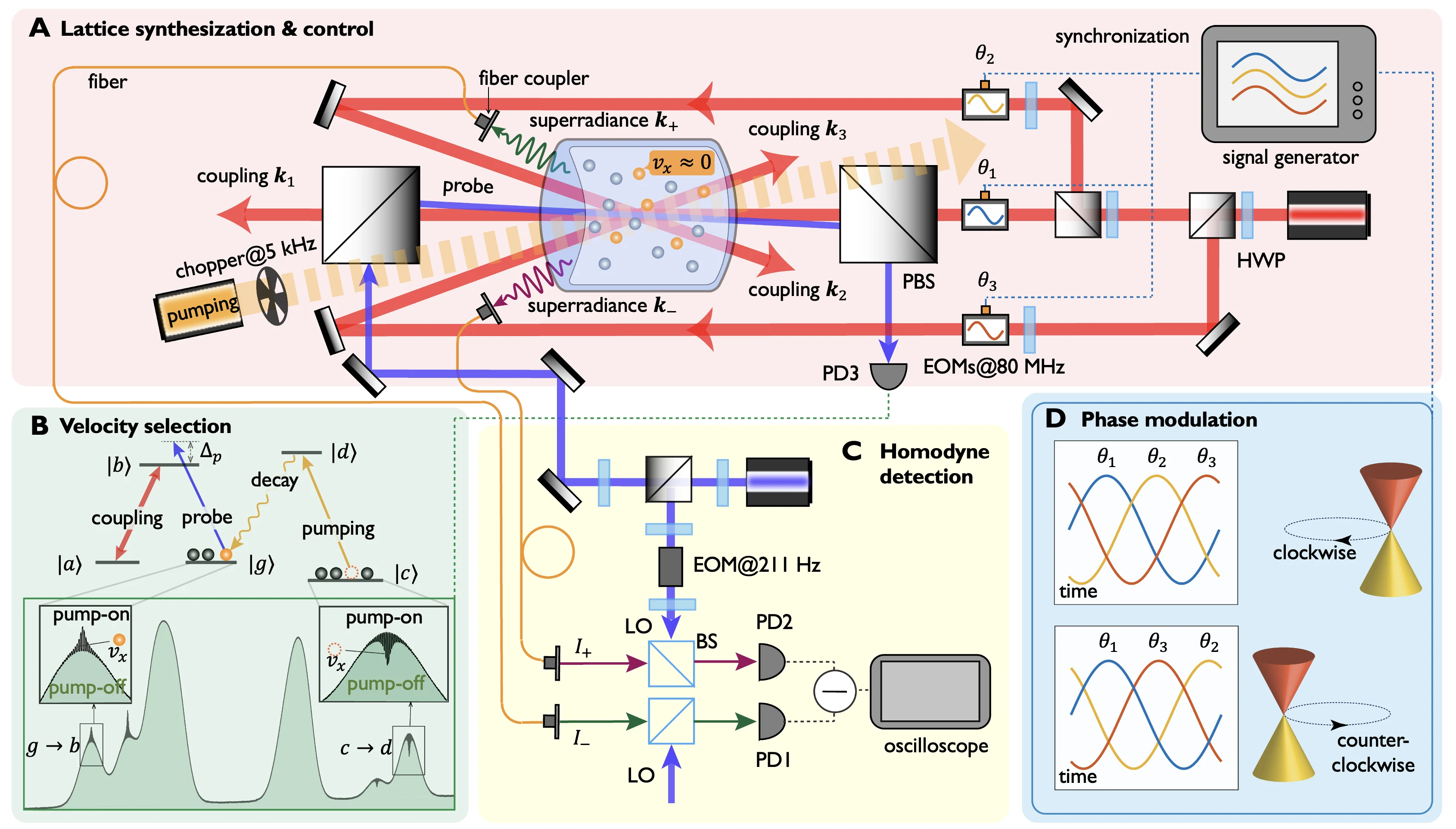
The superradiant lattice is a honeycomb of light in which atoms perform a collective dance, unafraid of thermal noise. Three laser fields with wave vectors k1, k2, k3 couple atomic levels, and their phases are modulated according to θj(t) = f sin(δt + φj) at a frequency of 80 MHz. This modulation makes the Dirac points move along a circle, accumulating a Berry phase of π per period. A topological gap opens, and the hopping amplitudes between lattice sites become complex, just as in the original Haldane model, but without a magnetic field.
The key result is the observation of the topological transition through the sign of the superradiance contrast η = (|ck+|² − |ck−|²)/(|ck+|² + |ck−|²). At a small modulation depth f = 1.0, the phase diagram is divided by the diagonal φ2 = φ3 into two regions with Chern numbers C = −1 and C = +1. The sign of η changes when crossing the boundary, directly reflecting the sign change of the topological invariant. At a large depth f = 3.2, islands of the opposite phase appear in the phase diagram, resembling the yin-yang symbol, due to the contribution of transitions between non-adjacent Floquet zones.
Strong modulation opened the door to higher Chern numbers. At f = 2.6, three satellite points with opposite chirality emerge around each original Dirac point, changing the Chern number from 1 to −2, a high-order phase unattainable in the standard Haldane model. Absorption spectra show band flattening near f = 2.6 and f = 5.7, associated with the competition between hoppings of different ranges.
This work is not just a beautiful experiment. It shows that topological protection can work at finite temperature, where thermal noise usually destroys coherence. The platform based on thermal atoms demonstrates, for the first time, a topological transition at room temperature with controllable sign and magnitude of the topological invariant. Already today, it can serve for testing topological quantum devices at room temperature, for example, sensors based on phase transitions.
The cell with rubidium vapor is only 2 centimeters long, and the temperature inside is about 300 kelvins: it is like a cup of hot tea in which quantum order suddenly emerges, an order that usually requires millikelvins.
In the series "The Expanse," quantum computers aboard ships operate without bulky cryostats: this work brings that scenario a little closer to reality.