Haldane Model in a Hot Atomic Vapor ✛
Context
The Haldane model is a cornerstone of topological physics: it showed that the quantum Hall effect can arise without an external magnetic field, solely from the structure of energy bands. Experimental realizations so far have required either ultralow temperatures (ultracold atoms, superconducting circuits) or ultrafast laser pulses (graphene, boron nitride), and all were limited to weak modulation, yielding only Chern numbers of ±1. Several neighboring research directions surround this work: superconducting kitchens made of light and atoms, spin-flavor topology, superconducting thermometers, crystal birth from heat, noise as a source of quantum order, glowing atoms as a nearly perfect engine, a black hole on a chip, and a chip-piano of light and sound. All of them touch on quantum phases and platforms for simulating them, but none solved the Haldane problem at room temperature.
Methods
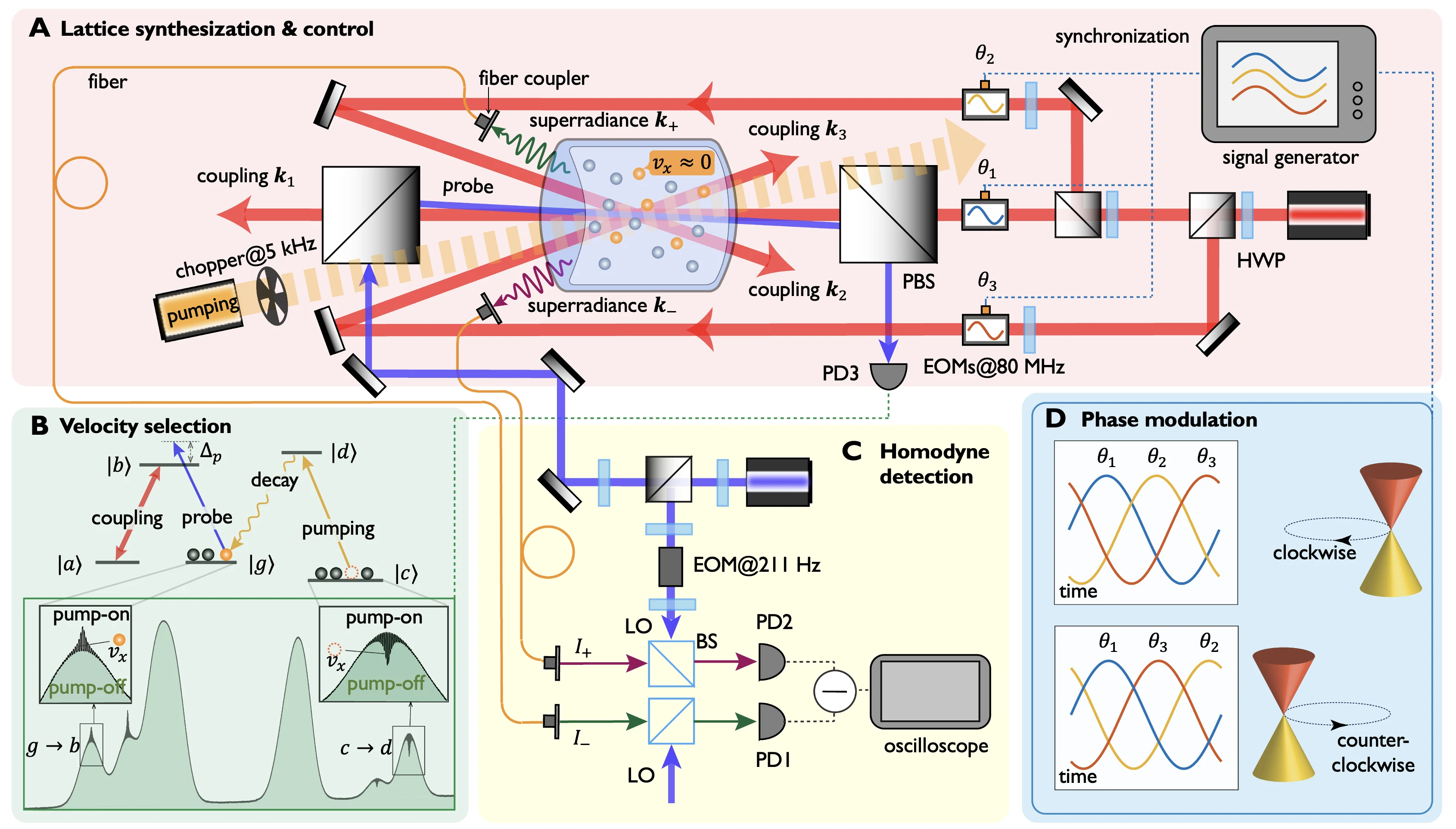
The experiment was conducted in a glass cell 2 cm long containing natural rubidium vapor at room temperature. The superradiant lattice was built on an electromagnetically induced transparency (EIT) configuration with three levels of 87Rb: ground state |g⟩, excited state |b⟩, and a second ground state |a⟩. Three plane-wave pump fields with wave vectors k1, k2, k3 couple the |a⟩–|b⟩ transition, while a weak probe field excites atoms from |g⟩ to |b⟩. In momentum space, this system is equivalent to a honeycomb lattice with nodes being collective Dicke states. The phases of the three pump fields were modulated according to θj(t) = f sin(δt + φj) with frequency δ = 80 MHz and modulation depth f. This modulation makes the Dirac points move along a circle, accumulating a Berry phase of π per period, which opens a gap and introduces complex next-nearest-neighbor hoppings. To isolate the contribution of atoms with zero velocity, velocity-selective tomography (VST) was used: an additional pump laser selectively transferred such atoms from an auxiliary state |c⟩ to |d⟩, followed by decay to |g⟩. The superradiance signal was detected by homodyne detection with a local oscillator modulated at 211 Hz, allowing extraction of field amplitudes before background subtraction.
Results
At small modulation depth f = 1.0, the phase diagram in (φ2, φ3) coordinates is divided by the diagonal φ2 = φ3 into two regions with Chern numbers C = −1 and C = +1. The sign of the superradiance contrast η = (|ck+|² − |ck−|²)/(|ck+|² + |ck−|²) changes when crossing the boundary, directly reflecting the sign change of the Chern number. Measurements of η from five independent data sets showed a clear transition consistent with numerical calculation. At large depth f = 3.2, islands of opposite topological phase appear in the phase diagram, resembling a yin-yang symbol, due to contributions from interband transitions between non-adjacent Floquet zones. The contrast η remains a reliable indicator in this regime as well. At f = 2.6, three satellite points with opposite chirality emerge around each original Dirac point, changing the Chern number from 1 to −2, a high-order phase unattainable in the standard Haldane model. Absorption spectra show band flattening near f = 2.6 and f = 5.7, associated with competition between hoppings of different ranges.
Implications
This work stands apart from its neighbors: unlike superconducting circuits and ultracold atoms, it requires no cryogenics, and unlike solid-state implementations with laser pumping, it achieves strong modulation, opening phases with Chern numbers greater than one. The thermal-atom platform demonstrates for the first time a topological transition at room temperature with controllable sign and magnitude of the topological invariant. This expands the class of systems where topological protection can operate in realistic conditions, not just in idealized laboratory setups.
Future development
A natural next step is to measure the exact value of the Chern number via a Wilson loop and Zak phase, which would distinguish phases with |C| > 1, where the sign of η gives only the sign of the invariant. Adding magnetic sublevels to encode spin would open the way to the quantum spin Hall effect as two copies of the Haldane model with opposite Chern numbers. Incorporating additional pump fields and Rydberg interactions promises access to higher dimensions and the study of many-body topological phases at room temperature.
Impact
The result directly impacts quantum simulation, topological photonics, and the development of quantum devices operating at room temperature: sensors based on phase transitions and routers that direct excitations according to the topological invariant.
Next steps
Immediate next steps are extracting precise Chern numbers via Wilson loops and testing the scalability of the scheme to more levels and fields for simulating the quantum spin Hall effect.
Key open problems
For quantum simulation physics, an open question remains: how far can topological protection be pushed at finite temperature, where thermal noise usually destroys coherence. This work shows that superradiant lattices in momentum space circumvent this limitation, but the universality of the approach for other topological classes remains to be proven.
The knowledge machine's view
This section is addressed to the author of the paper and their colleagues. Neighbouring works were found by meaning-based search across our archive, not by word overlap. We do not review: we show the field around the work.
What the work does
The paper presents a Haldane model implemented on a superradiant lattice in momentum space using hot rubidium atoms. Periodic modulation of the phases of three laser fields breaks time-reversal symmetry and opens a topological gap; the transition between phases with different Chern numbers is detected via the sign of the superradiance contrast. The platform allows strong modulation, which grants access to phases with high Chern numbers.
Where its strength is
Room-temperature operation and robustness to strong modulation set this implementation apart: it lifts the limitations of previous platforms and paves the way for topological devices without cryogenics.
Where it could go next
- The velocity-scanning tomography technique used to isolate atoms with zero velocity could be useful for directly observing phase coherence in superradiant lattices; in our archive, there is a related approach to imaging atomic phases in a lattice.based on: Quantum Coherence Microscope: Seeing the Phase of Atoms in a Lattice arXiv:2608.09924v1
- Building superradiant lattices via electromagnetically induced transparency resembles recipes for creating superconducting systems from light and atoms; these techniques might be transferable to the realm of topological phases.based on: The Superconductor Kitchen: A Recipe of Light and Atoms arXiv:2604.22955
- The strong modulation that enabled high Chern numbers could be interesting for studying topological transitions in systems where order emerges from thermal motion; the archive contains examples of heat-induced ordering.based on: Order from Chaos: How Heat Gives Birth to a Crystal arXiv:2603.07121
Worth trying
- Test whether topological protection of edge states persists at room temperature on this platform.
- Use velocity-scanning tomography to measure the local Berry curvature in the Brillouin zone.
- Adapt the phase-modulation scheme to realize other topological insulator models, such as the Hatsugai model.
Why this may matter
Realizing the Haldane model at room temperature in atomic vapors could provide a foundation for practical topological devices that work without cryogenic cooling, and it opens a route to studying topological phases under conditions close to everyday environments.
Nearby works in our archive
- Cold from a Quantum Tunnelsimilarity 0.50
- Lone Electrons and Pairs with a Twist: A New Look at Superconductorssimilarity 0.50
- Superfluid helium in nanochannels: rotons decidesimilarity 0.50
- Heat Turns into Electricity Even in Ordinary Glasssimilarity 0.50
- Quantum Coherence Microscope: Seeing the Phase of Atoms in a Latticesimilarity 0.50
- The Superconductor Kitchen: A Recipe of Light and Atomssimilarity 0.49
- Order from Chaos: How Heat Gives Birth to a Crystalsimilarity 0.49
The archive is sparse around this work: the closest review is only 0.50, against a usual 0.64. It looks like few have drilled nearby.
The rubidium vapor cell is only 2 centimeters long, and the temperature inside is about 300 kelvins: it's like a glass of hot tea in which quantum order suddenly emerges, typically requiring millikelvins.
In the series 'The Expanse', quantum computers aboard ships operate without bulky cryostats, and this work brings that scenario a bit closer to reality.
Key numbers
- temperature: 300 K (room)
- cell length: 2 cm
- modulation frequency: 80 MHz
- modulation depth: 1.0 and 3.2
- Chern numbers: -2, -1, +1