Invisible Lighthouse: Magnetar Pulse in a Gamma-Ray Burst ✛ ✎
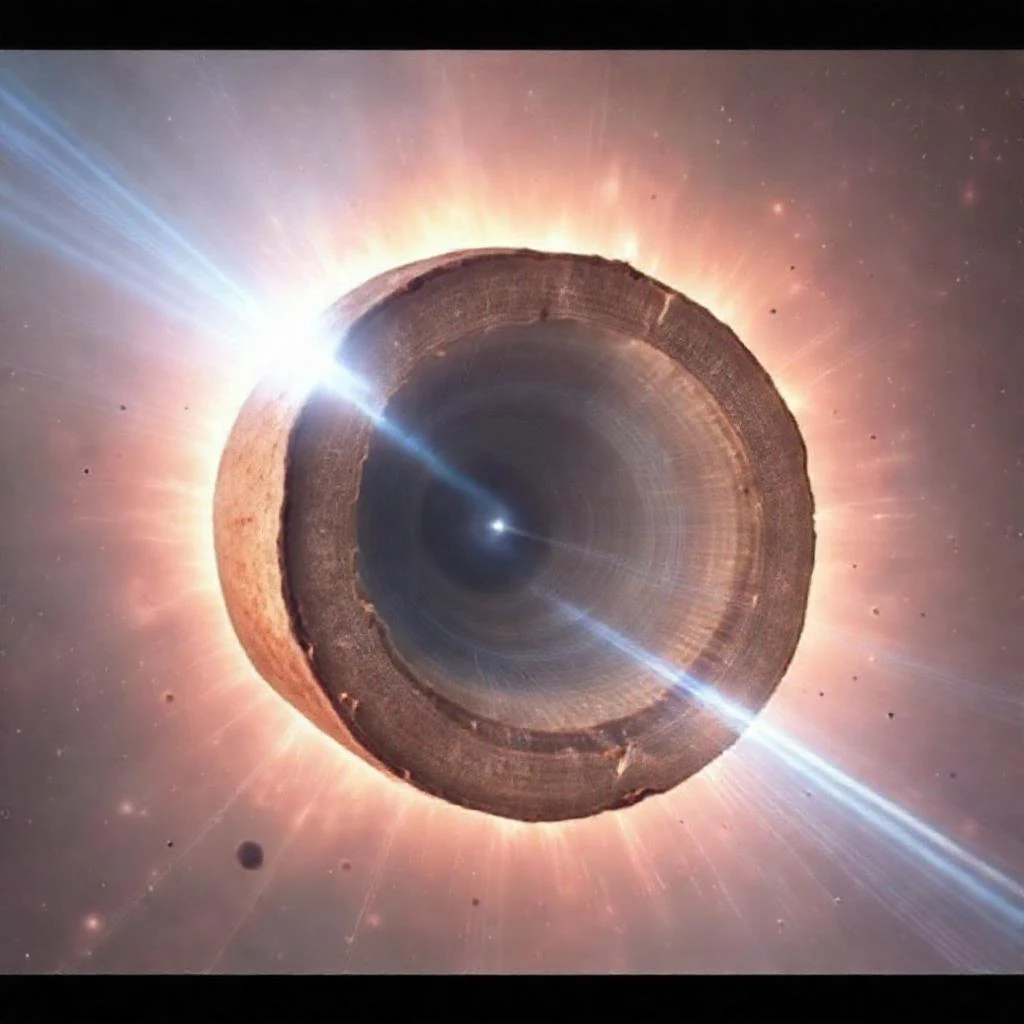
Some cosmic explosions, gamma-ray bursts, last just a couple of seconds, but GRB 230307A glowed for several minutes. Usually such an explosion gives birth to a black hole, but the prolonged glow hinted at a different outcome: perhaps a magnetar emerged — a hyper-magnetized neutron star spinning at a furious rate.
Telescopes caught a fleeting rhythmic signal in this burst, like the beam of a distant lighthouse momentarily sweeping over Earth. The frequency of 909 hertz means 909 rotations per second: a typical tempo for a newborn pulsar. The signal lasted just 160 milliseconds, shorter than a blink, but in that time the magnetar released as much energy as the Sun does in a million years.
This ‘lighthouse’ signal confirms for the first time that it is a neutron star, not a black hole, that can power long gamma-ray bursts. Such observations will help unravel how the most extreme engines in the Universe work.
A neutron star is the core of a dead star, compressed to the size of a city: a teaspoon of its material would weigh billions of tons.
In the novel 'Dragon's Egg', Robert Forward imagined life on the surface of a neutron star, where monstrous gravity speeds up time thousands of times.