Sulfur in the Sky of a Warm Neptune: Sulfur Dioxide in the Atmosphere of HAT-P-26 b ✛
Context
Until recently, the atmospheres of Neptune-like planets remained poorly studied: observations from Hubble and Spitzer provided only scattered data, and sulfur dioxide had been reliably detected only in hot Jupiters. The study of HAT-P-26 b stands alongside recent works on exoplanet atmospheres, from hot Jupiters to sub-Neptunes, but fills a gap for masses around 20 Earth masses. This planet became only the second Neptune studied in transit with JWST and the first super-Neptune in its range of radii and temperatures.
Methods
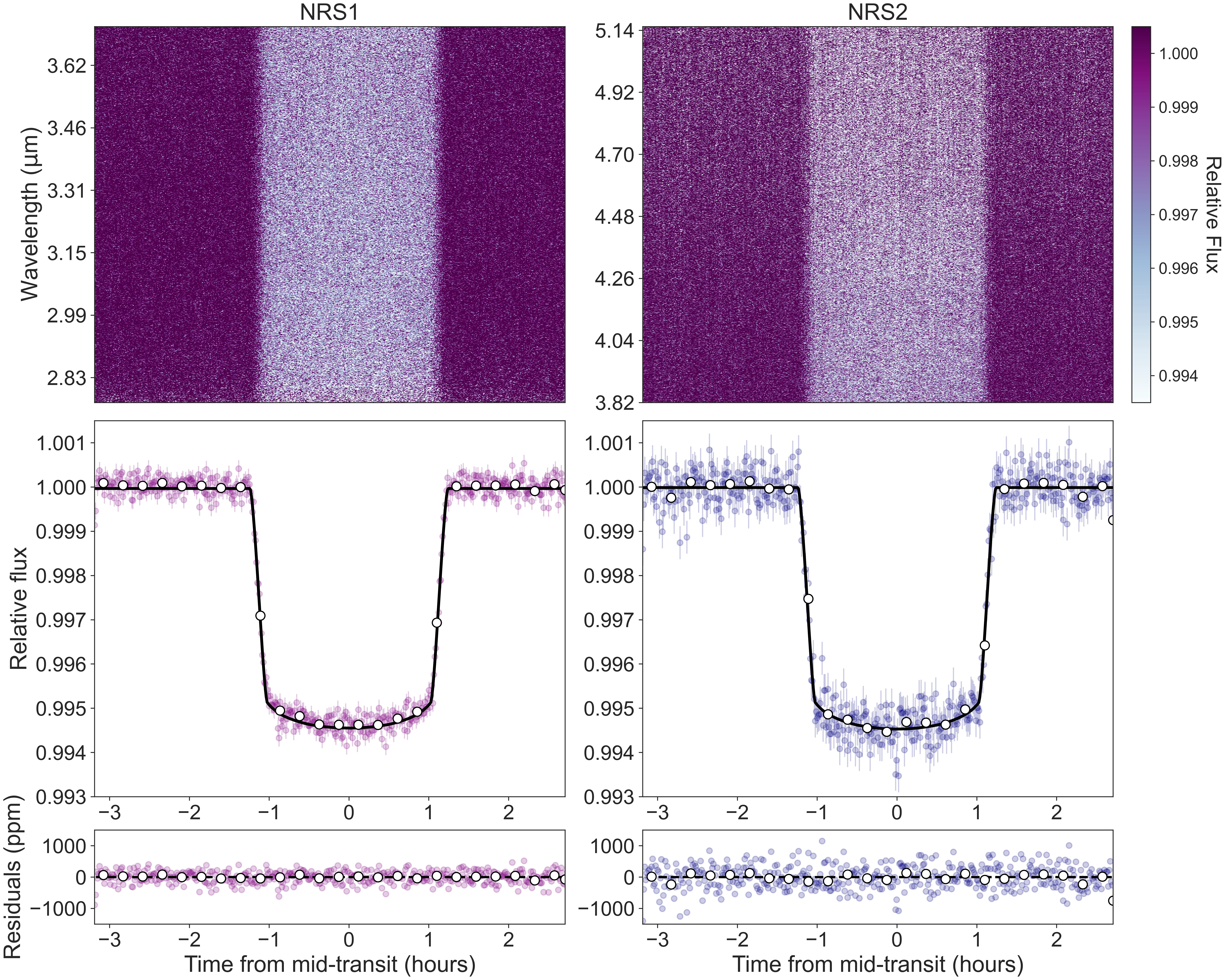
Observations were conducted on June 15, 2023, using the NIRSpec Bright Object Time Series mode with the G395H grating, covering the 2.8–5.1 μm range. The transit lasted 2.5 hours, with a total observation duration of nearly 8 hours. Data were processed by two independent pipelines: transitspectroscopy and ExoTiC-JEDI. The spectra were then analyzed using Bayesian retrievals (TauREx, POSEIDON) and self-consistent models (PICASO with Photochem photochemistry). This dual approach allowed cross-checking of results and assessment of systematic uncertainties.
Results
The spectrum clearly shows absorption bands of water (log Bayesian factor lnB=4.1), carbon dioxide (lnB=85.6), and sulfur dioxide (lnB=13.5). The SO₂ abundance is about 10⁻⁴ by volume, consistent with photochemical models. Retrievals yield an atmospheric metallicity of 3 to 25 times solar and a carbon-to-oxygen ratio C/O = 0.14 (+0.21/−0.08), which is below solar. The atmospheric temperature is estimated at 667 (+64/−58) K, notably cooler than the equilibrium temperature (~1000 K), and suggests possible terminator asymmetry. Comparison with ten other planets observed by JWST shows a correlation between SO₂ abundance and metallicity: a sharp rise at low metallicities and a plateau above 30×solar.
Implications
The work extends the known boundaries of sulfur photochemistry to planets with temperatures below 1000 K and masses around 20 Earth masses. Unlike neighboring studies, it is the first to link SO₂ detection to metallicity for a warm Neptune, rather than a hot Jupiter or sub-Neptune. This confirms the universality of the sulfur dioxide formation mechanism via photolysis of water and oxidation of hydrogen sulfide, previously proposed for WASP-39 b. Additionally, the data suggest the possible presence of clouds and non-equilibrium processes such as vertical mixing.
Future development
Further observations in a broader wavelength range (NIRISS SOSS and MIRI LRS) will refine the abundances of oxygen-bearing molecules and metallicity. A joint analysis of all transits of HAT-P-26 b will provide tighter constraints on the C/O ratio and planet formation pathways. The development of photochemical models for Neptunes, accounting for terminator asymmetry and inhomogeneous clouds, will help explain discrepancies between retrievals and self-consistent models.
Impact
The results will influence models of formation and evolution of Neptune-like planets, as well as the interpretation of exoplanet spectra in general.
Next steps
Analysis of NIRISS SOSS and MIRI LRS data for HAT-P-26 b, as well as joint processing of all available transits.
Key open problems
The work is directly related to the unresolved problem of the formation of Neptune-like planets: how they acquire their atmospheres and why their metallicities vary. The detection of SO₂ provides a new observational key to the chemical evolution of such atmospheres, but questions remain about the exact accretion pathways (pebbles or planetesimals) and the role of non-equilibrium processes.
The knowledge machine's view
This section is addressed to the author of the paper and their colleagues. Neighbouring works were found by meaning-based search across our archive, not by word overlap. We do not review: we show the field around the work.
What the work does
We present the transmission spectrum of the warm Neptune HAT-P-26 b obtained with JWST/NIRSpec G395H. Using two independent pipelines and retrieval codes (TauREx, POSEIDON), we confidently detect H₂O, CO₂, and, for the first time for a planet of this class, SO₂. The metallicity is estimated at 3–25 times solar, C/O = 0.14, and the temperature is about 667 K, which is below the equilibrium temperature. We also note a correlation between SO₂ abundance and metallicity.
Where its strength is
This is the first robust detection of SO₂ in a warm Neptune with a mass of about 20 M⊕, confirming that disequilibrium photochemistry operates at T < 1000 K and linking sulfur abundance to metallicity. The dual-pipeline processing and self-consistent models with photochemistry set a high standard for future studies.
Where it could go next
- Comparison with the atmosphere of the hot Jupiter WASP-39 b, where SO₂ was first detected, could help clarify the universality of sulfur photochemical pathways at different temperatures and irradiation levels. Our archive includes an analysis of that planet with detailed sulfur chemistry modeling.based on: Sodium in the Sky of a Distant Planet arXiv:2602.19986
- To test the influence of metallicity on SO₂ formation over a wider parameter range, it may be useful to compare with the atmospheric analysis of a warm mini-Neptune, where composition and possible photochemistry were also studied.based on: Unexpected Atmosphere Composition of a Warm Mini-Neptune arXiv:2605.02036
- Given the possible terminator asymmetry noted in the paper, it would be interesting to compare with a study of a hot Jupiter atmosphere that modeled three-dimensional structure and chemical inhomogeneity, to assess the impact of dynamics on spectral interpretation.based on: Titanate Clouds Above a Scorching Giant arXiv:2508.20022
Worth trying
- Perform a joint retrieval with a model that includes vertical mixing and sulfur photochemistry, adapted to HAT-P-26 b conditions.
- Assess the sensitivity of SO₂ detection to cloud parameters using a grid of models with varying cloud height and optical thickness.
- Compare the derived C/O ratio with predictions from formation models for planets with masses around 20 M⊕ to constrain accretion scenarios.
Why this may matter
Expanding the sample of planets with measured SO₂ and metallicity will help identify the threshold for sulfur photochemistry activation and use it as a tracer of atmospheric composition. For warm Neptunes, this opens the way to statistical studies of the relationship between metallicity, C/O, and formation processes.
Nearby works in our archive
- Sodium in the Sky of a Distant Planetsimilarity 0.59
- Smoldering Giant: Methane and Haze over a Dead Starsimilarity 0.54
- A Carbon Forge on a Windy Planet Around a Pulsarsimilarity 0.54
- Titanate Clouds Above a Scorching Giantsimilarity 0.53
- Chemical Portrait of an Invisible Worldsimilarity 0.53
- The Glow of an Escaping Atmospheresimilarity 0.53
- Unexpected Atmosphere Composition of a Warm Mini-Neptunesimilarity 0.53
The archive is sparse around this work: the closest review is only 0.59, against a usual 0.64. It looks like few have drilled nearby.
Sulfur dioxide in the atmosphere of HAT-P-26 b forms through the same pathway as in the famous hot Jupiter WASP-39 b: hydrogen sulfide from the interior is oxidized by water vapor under the influence of the star's ultraviolet radiation. But here the temperature is almost half as low, about 700 K instead of 1200 K.
Key numbers
- planet mass: 18.6 Earth masses
- planet radius: 6.33 Earth radii
- atmospheric temperature: 667 K (approximately 394°C)
- metallicity: 3–25 times solar
- SO₂ abundance: about 10⁻⁴ by volume