Carbon Atmosphere of a Windy Planet Around a Pulsar ✛
Context
Among the roughly fifty known 'black widow' systems, which are close pairs of a millisecond pulsar and a low-mass companion that the pulsar gradually evaporates, only PSR J2322-2650b has mass, density, and temperature close to those of hot Jupiters around ordinary stars. Its minimum density is 1.8 g/cm³, and its equilibrium temperature is about 1900 K. Previous ground-based observations studied denser and more massive analogs whose spectra resemble stellar ones, but the atmosphere of this particular object remained unknown. This work stands apart: neighboring studies in the archive either concern denser 'black widows' or exoplanet atmospheres around main-sequence stars, whereas here, for the first time, a planet-like object heated by pulsar gamma-ray radiation is investigated.
Methods
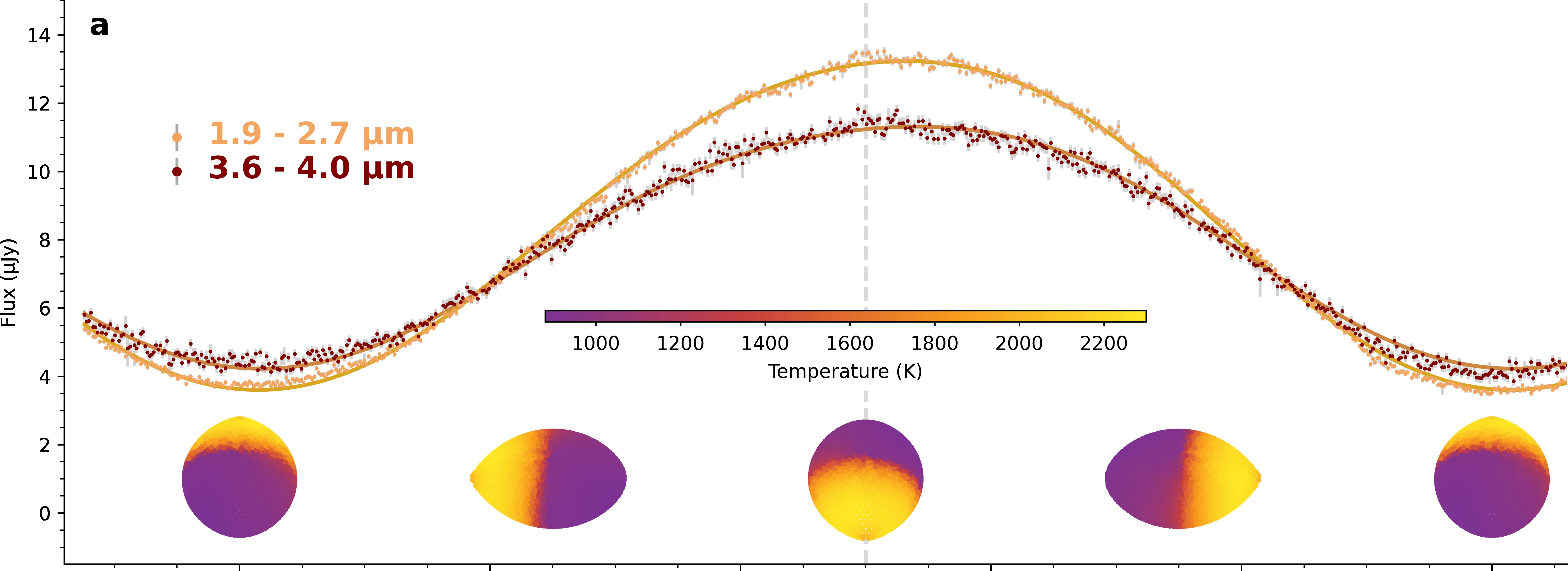
Observations were made with the James Webb Space Telescope on November 8 and 10, 2024. The NIRSpec/PRISM spectrometer recorded the object's emission over 0.6–5.3 μm throughout a full orbital cycle (7.8 hours), while the G235H grating (1.7–3.1 μm) captured the dayside at higher resolution. Data were processed with a specially built pipeline that suppressed correlated 1/f noise and improved the signal-to-noise ratio compared to standard processing. For molecular identification, spectra were compared with absorption line databases, and cross-correlation with opacity templates was used to measure radial velocities. Additionally, one-dimensional HELIOS radiative transfer models and three-dimensional MITgcm general circulation models were constructed.
Results
The dayside spectrum shows clear absorption bands identified as C3 and C2 molecules. The sharp C3 opacity edge at 3.014 μm coincides with a flux drop in the data, and the sawtooth structure in the 2.45–2.85 μm range matches a series of C2 bands. Cross-correlation with a C2 template yielded a detection at 21σ, while CO, CN, H2O, CH4, and other molecules were not detected. From the absence of CO and CN, lower limits were derived: C2/CO > 0.17 and C2/CN > 32, which, at temperatures below 2300 K, require C/O > 100 and C/N > 10,000. Phase curve analysis showed that the thermal emission peak is shifted by 12° west of the sub-pulsar point, indicating strong westward winds. The measured projected orbital velocity of the companion, Kp = 190 ± 2 km/s, corresponds to an orbital inclination of about 31° and a pulsar mass of about 2.0 M⊙.
Implications
This work demonstrates for the first time an atmosphere composed predominantly of molecular carbon around a planetary-mass object. Unlike neighboring studies that examined denser companions with stellar spectra or exoplanet atmospheres around ordinary stars, here a new chemical regime with extreme carbon enrichment is discovered. The derived constraints on C/O and C/N challenge black widow formation models, which predict a more diverse elemental composition. The observed westward shift of the thermal maximum serves as the first observational confirmation of the dynamical regime predicted for rapidly rotating planets with external heating.
Future development
To determine whether PSR J2322-2650b's composition is unique or typical of the class of ultra-light pulsar companions, spectroscopic observations of other similar objects are needed, especially PSR J1719-1438, which has a similar mass but much higher density. Improved line lists for C2H and C3H molecules, as well as for larger carbon clusters C4 and C5, will allow more accurate spectral modeling. Further development of three-dimensional circulation models accounting for deep gamma-ray heating will help explain the observed atmospheric dynamics.
Impact
The results will impact models of formation and evolution of close binary systems with neutron stars, as well as understanding of carbon atmospheric chemistry in extreme conditions.
Next steps
The next step will be to obtain spectra of other ultra-light pulsar companions and to develop more complete radiative transfer models that account for surface inhomogeneity and the object's non-sphericity.
Key open problems
This work directly relates to the unresolved problem of the origin of ultra-light pulsar companions: the standard envelope-stripping scenario does not explain the observed extreme carbon enrichment. Furthermore, the mechanism that keeps hydrogen at such a low level, preventing molecular carbon from turning into hydrocarbons, remains unclear.
The knowledge machine's view
This section is addressed to the author of the paper and their colleagues. Neighbouring works were found by meaning-based search across our archive, not by word overlap. We do not review: we show the field around the work.
What the work does
The authors studied the spectrum of the companion of pulsar PSR J2322-2650b using JWST, detecting C3 and C2 molecules, which indicates an extremely high C/O and C/N ratio. Analysis of the phase curve revealed a westward shift in the peak of thermal emission, interpreted as strong westward winds. This work is the first to investigate the atmosphere of a planet-like object heated by the pulsar's gamma-ray emission.
Where its strength is
The authors obtained, for the first time, a detailed spectrum of the atmosphere of an object with mass and temperature close to those of hot Jupiters, but in the extreme environment of a pulsar. The detection of carbon molecules and the measurement of winds opens a new field for comparative atmospheric studies.
Where it could go next
- It might be interesting to compare the obtained results with the atmosphere of an object orbiting a white dwarf: that work investigates chemistry and haze in the atmosphere of a planet around a dead star, which could provide context for understanding the influence of radiation type on composition.based on: Smoldering Giant: Methane and Haze over a Dead Star arXiv:2607.01316v1
- A related study is the JWST investigation of a super-Neptune's atmosphere, analyzing clouds and sulfur; comparing it with the carbon-rich atmosphere of PSR J2322-2650b could help identify common patterns in exoplanet atmospheric chemistry.based on: Sulfur in the Sky of a Warm Neptune: Sulfur Dioxide in the Atmosphere of HAT-P-26 b arXiv:2509.16082
- One might also look at the work on polarimetric observations of Venus, where methods for analyzing atmospheric dynamics were developed; these techniques could be adapted to study winds in the pulsar companion's atmosphere.based on: How Polarizing Sunglasses Unveiled the Invisible Waves of Venus arXiv:2607.16557v1
Worth trying
- Test whether atmospheric models with carbon chemistry from the study of a planet around a white dwarf can be applied to the PSR J2322-2650b data to refine its composition.
- Use cross-correlation methods similar to those applied in the super-Neptune study to search for other molecules in the spectrum of PSR J2322-2650b.
- Consider the possibility of polarimetric observations to independently measure winds and atmospheric structure.
Why this may matter
This study expands our understanding of the atmospheres of planet-like objects under extreme conditions, which could shed light on the evolution of pulsar systems and on the general principles of atmospheric dynamics and chemistry.
Nearby works in our archive
- Smoldering Giant: Methane and Haze over a Dead Starsimilarity 0.62
- The Heat Memory of a Planet Orbiting a Dead Starsimilarity 0.61
- Sulfur in the Sky of a Warm Neptune: Sulfur Dioxide in the Atmosphere of HAT-P-26 bsimilarity 0.55
- How to Hear a Planet Near a Dead Starsimilarity 0.55
- A Baby Hot Jupiter: Atmosphere, Winds, and a Hint of Heavy Watersimilarity 0.55
- The Glow of an Escaping Atmospheresimilarity 0.54
- How Polarizing Sunglasses Unveiled the Invisible Waves of Venussimilarity 0.53
The closest work in the archive sits at 0.62 by meaning — the usual level for our corpus.
The temperature of the hottest spots on the dayside reaches 2300 K, which is hotter than a blast furnace used to melt steel.
A planet with a carbon atmosphere around a pulsar evokes worlds from Anne McCaffrey's novel 'Dragonsdawn', where humans colonize a planet periodically subjected to deadly stellar flares.
Key numbers
- C/O ratio: >100
- C/N ratio: >10 000
- Kp (projected orbital velocity): 190 ± 2 km/s
- Westward shift of thermal maximum: 12°
- Orbital inclination: ~31°