Sulfur in the Sky of a Warm Neptune: Sulfur Dioxide in the Atmosphere of HAT-P-26 b ✛
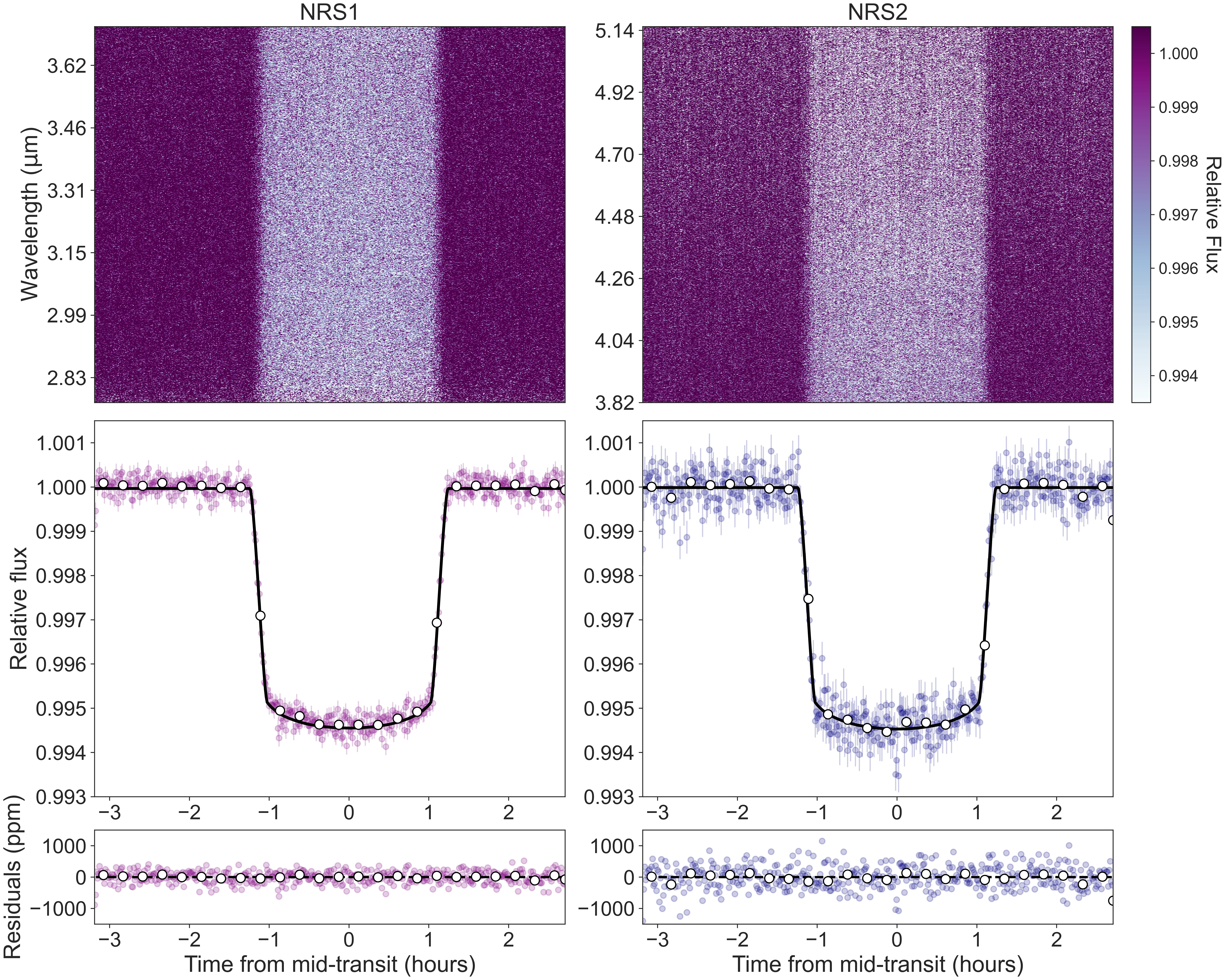
In 2023, the James Webb Space Telescope turned its gaze toward a distant star in the constellation Virgo. Orbiting it is HAT-P-26 b, a warm Neptune, a world with a mass of 18.6 Earths and a radius of 6.33 Earths. The planet transited across the star's disk, and at that moment its atmosphere became briefly visible. Starlight, filtered through the gaseous envelope, revealed what is hidden from view: water vapor, carbon dioxide, and, for the first time for such a class of planets, sulfur dioxide.
This discovery is not just another line in the catalog of molecules. It shows that the chemical kitchen under stellar ultraviolet works at lower temperatures than previously thought. Sulfur dioxide here is a product of non-equilibrium photochemistry, that is, chemistry driven by starlight. The astronomers recovered the atmospheric parameters using Bayesian retrievals, methods that allow extracting temperature, composition, and metallicity (the fraction of elements heavier than helium) from the spectrum. They found that the metallicity of HAT-P-26 b's atmosphere is between 3 and 25 times solar, and the temperature is about 667 K, notably cooler than the planet's equilibrium temperature.
Comparison with ten other planets observed by Webb revealed a clear trend: the abundance of sulfur dioxide rises sharply at low metallicities and plateaus above 30 solar. This means that sulfur photochemistry is a universal process that can be used as a thermometer and an indicator of chemical evolution of atmospheres. Previously, this was seen only in hot Jupiters and sub-Neptunes, but now the gap for masses around 20 Earth masses is filled.
What does this mean for science? Until now, it was unclear whether sulfur photochemistry operates in the atmospheres of warm Neptunes and how SO₂ abundance relates to metallicity. Now, for the first time, sulfur dioxide has been robustly detected in such a world, and a correlation with metallicity has been shown. The method will serve as a benchmark for interpreting future spectra of Neptune-like exoplanets and refining models of their formation. Further observations over a broader wavelength range will allow refining the carbon-to-oxygen ratio and shedding light on how such planets acquire their atmospheres.
Sulfur dioxide in the atmosphere of HAT-P-26 b forms through the same pathway as in the famous hot Jupiter WASP-39 b: hydrogen sulfide from the interior is oxidized by water vapor under the influence of the star's ultraviolet radiation. But here the temperature is almost half as low, about 700 K instead of 1200 K.