Sodium is a chemical element with the symbol Na and atomic number 11, an alkali metal that is highly reactive and never found free in nature. In planetary science, sodium is notable for its presence in the atmospheres of some planets and moons, where it is often detected as a bright yellow emission line. For example, sodium has been observed in the atmosphere of Mercury, the Moon, and several exoplanets, where it is released from surface rocks by processes like meteoroid impacts, solar wind sputtering, or thermal evaporation. The presence of sodium in an exoplanet's atmosphere can reveal information about the planet's composition, temperature, and the dynamics of its upper atmosphere, as well as the intensity of stellar radiation it receives.
History
Sodium was first isolated by Humphry Davy in 1807 through the electrolysis of sodium hydroxide. Its presence in planetary atmospheres was first detected on Mercury in the 1980s, and the first detection of sodium in an exoplanet atmosphere was made in 2002 for the hot Jupiter HD 209458b.
How it works
Sodium atoms are released from a planet's surface or from incoming meteoroids into the atmosphere, where they can be excited by sunlight and emit characteristic yellow-orange light at a wavelength of about 589 nanometers. This emission is easily detectable from Earth using spectroscopy, making sodium a convenient tracer for atmospheric processes. In exoplanet observations, sodium is often seen as an absorption feature in the planet's transmission spectrum — when the planet passes in front of its star, the sodium in its atmosphere absorbs a small fraction of the starlight at specific wavelengths, revealing its presence. The strength and shape of this absorption line can indicate the temperature, density, and even the presence of high-altitude winds in the exoplanet's atmosphere.
In practice
Sodium is used as a tracer in studies of planetary atmospheres, helping scientists understand atmospheric escape, circulation, and the interaction between a planet and its host star, as well as in the calibration of astronomical spectrographs.
Fun fact
The yellow glow of sodium vapor lamps, commonly used in streetlights, is the same emission line that astronomers use to detect sodium in the atmospheres of distant exoplanets.
An extra electron in a molecule is like a passenger barely hanging onto the step of a departing train. Such a 'passenger' turns the particle into an anion — a negative ion. Studying it is tough: the bond is weak, the electron cloud is diffuse, and any jolt can knock the electron off.
The star AB Aur is young, about 4 million years old. Around it swirls a dense disk of gas and dust. Recently, a long gas stream, a flow of material from the surrounding cloud, crashed into it.
Water comes in different varieties. Not just fresh or salty, but also "heavy"—when one of its hydrogen atoms is replaced by deuterium, its heavier cousin. Such water is called HDO, and it's a true cosmic passport: the amount of deuterium in water reveals where and when that water was born.
When the JWST telescope breaks the light of a distant exoplanet into a spectrum, it reads a chemical chronicle. But this chronicle is not a monolithic truth; it's an atmosphere constantly rewritten by the star's radiation.
In 2024, the team led by David Charbonneau pointed the Magellan telescope with the WINERED spectrograph at LHS 1140. During transit, high-resolution spectroscopy caught the absorption line of metastable helium at 10833 Å.
Massive stars are cosmic titans, living under the sign of indomitable energy. When such a star enters the B[e] supergiant phase, its radiation is so powerful that it would seemingly pulverize any molecule into atoms. The spectral lines, once systematized by Johann Balmer, blaze here with particular fury.
Some 158 light-years away, around the dim star TOI-6894, a red dwarf, a planet moves leisurely. Its year lasts less than two Earth days, yet it is a cool world with an equilibrium temperature around 420 K, just a bit warmer than a sauna.
The young super-Jupiter TWA5B, a scorching ball 25 times Jupiter's mass, floats just fifty light-years away. Its faint infrared glow long hid its chemical makeup. Now, high-resolution spectroscopy with CRIRES+ has registered the ghostly trace of SiO — silicon monoxide.
A kindergarten where some kids are busy making sandcastles while others are already assembling building blocks. That's roughly what the V1298 Tau system looks like: it's only 20 million years old — by cosmic standards, it just left the nursery. Several planets orbit it, and two of them, b and e, turned out to be surprisingly different.
Light from a distant star seeps through a planet's gaseous envelope, and astronomers try to guess what that envelope is made of. That's how we study the atmospheres of worlds we can never touch. When a planet passes in front of its sun's disk, its gaseous veil briefly intercepts some of the rays.
A world that for years refused to show its face. Planet GJ 1214 b is exactly such a case. It is larger than Earth but smaller than Neptune, and its dense envelope made the atmosphere invisible to telescopes: starlight passed through it without leaving clear traces. But astronomers' persistence and a new sensitive instrument provided the first clue.
Around young stars, flat clouds of gas and dust swirl, like pizza dough from which planets will eventually be shaped. This cloud contains various chemical elements, and sulfur is one of the most elusive: it's hard to catch with telescopes because it hides in solid grains or escapes as gas.
Light from a distant star, passing through the atmosphere of planet K2-18b, left unusual "fingerprints" in its spectrum. Astronomers spent 420 hours collecting this light with the James Webb Space Telescope and split it into colors, like a rainbow.
Comet 3I/ATLAS was spotted when it entered the Solar System from interstellar space. The James Webb Telescope split the light from its gas cloud into a rainbow, a spectrum, and in this pattern, the lines of rare molecules with deuterium (heavy hydrogen) appeared.
Around the star Epsilon Indi, visible to the naked eye from the Southern Hemisphere, orbits a planet the size of Jupiter. The temperature there is like a good freezer: minus 200 degrees Celsius. The James Webb Space Telescope has for the first time directly imaged it and measured the light the planet emits in the thermal range.
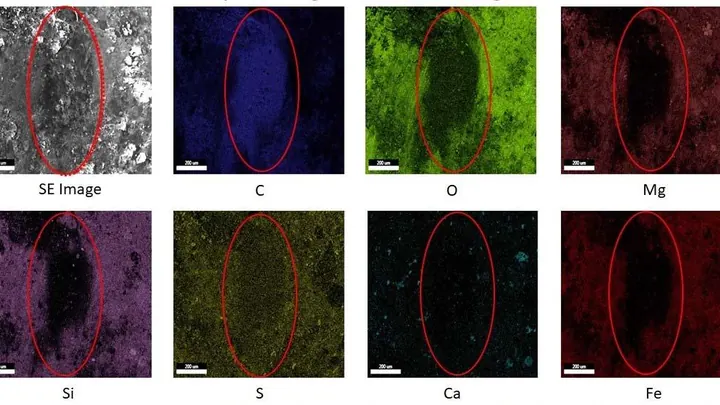
In 2017, a stone fell from the sky in the Indian village of Mukhundpura. It was a rare carbonaceous meteorite — a chunk of ancient cosmic material that preserves traces of the birth of the solar system. Locals quickly gathered the fragments, and they ended up in a laboratory.
When a chef prepares a dish, not only the proportions of ingredients matter but also their total amount. Two pies with the same sugar-to-flour ratio but made from different batch sizes will turn out differently. So it is with disks around young stars: carbon and oxygen are the key 'spices,' and their absolute amounts change the look of the cosmic 'kitchen' no less than their ratio.
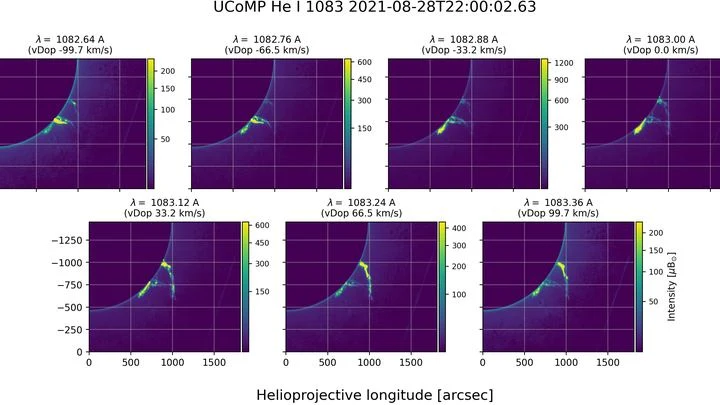
The Sun occasionally hurls enormous clouds of plasma into space — coronal mass ejections. Often tangled within these clouds are prominences: cooler, denser clumps of material. These contain plenty of neutral atoms that shine brightly in specific spectral lines.
The second interstellar guest, comet 3I/ATLAS, shines unusually due to rusting metal grains in its icy core. As it gets closer to the Sun, it behaves like an old tin can tossed into a fire: the heat melts the ice, water seeps into the metal, and vigorous corrosion begins.
In 2023, the James Webb Space Telescope turned its gaze toward a distant star in the constellation Virgo. Orbiting it is HAT-P-26 b, a warm Neptune, a world with a mass of 18.6 Earths and a radius of 6.33 Earths. The planet transited across the star's disk, and at that moment its atmosphere became briefly visible.