Quantum Lidar Catches the Glint of Ice Crystals ✛
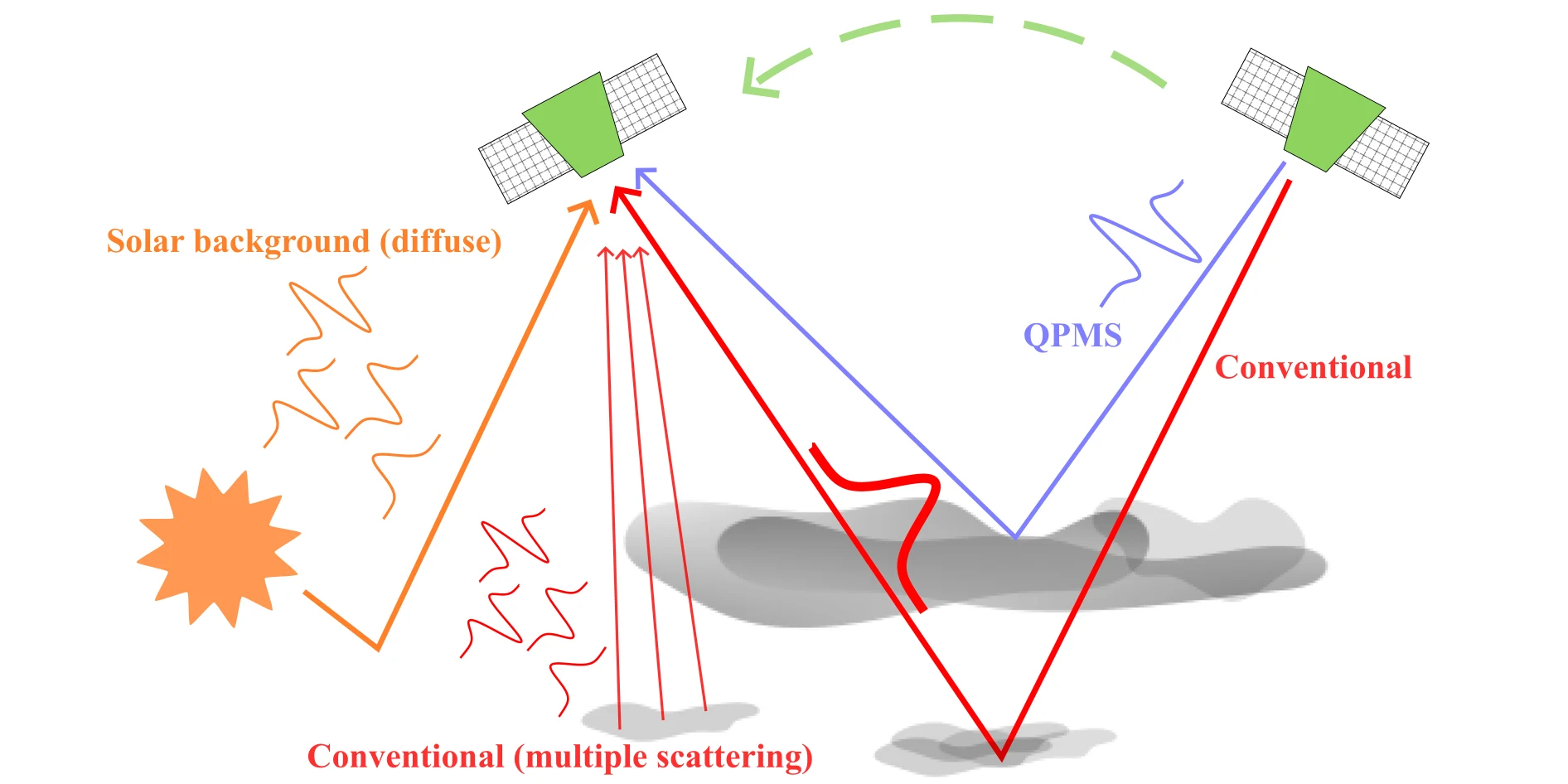
Ice clouds can masquerade as water clouds. A satellite lidar sends a short laser pulse downward and catches the reflection. If flat ice plates hang horizontally in the cloud, they act like tiny mirrors: light bounces back almost without loss. To the instrument, such a flash looks just like a reflection from water droplets. Cloud phase classification, ice or water, gets thrown off.
The quantum lidar here works like a tuner that hears only the pure note amid the orchestra's noise. A conventional receiver collects all the light returning from the cloud: the specular response from crystals, diffuse scattering from droplets, and multiply re-reflected background. A quantum parametric mode sorter (QPMS) works differently. In a waveguide with a nonlinear crystal, the signal photon merges with a pump photon to produce a photon at twice the frequency. This process is efficient only for one spatiotemporal mode, the one corresponding to a single specular reflection. Everything else is discarded. Thus, from the cacophony, the single needed note is extracted.
Calculations show that for confident detection (standardized mean difference, SSMD, equal to 2), the quantum lidar requires lower power than a conventional one if the reflector is larger than about 50 μm. At that size, the advantage becomes tangible. Multiple scattering hampers a conventional lidar more than its own specular signal, because it smears across many modes. Atmospheric dispersion for 200 ps pulses is almost fully compensated by accounting for group delay, meaning the short pulse does not spread into mush on its way to the cloud and back.
Previously, satellite lidars confused ice clouds with water clouds, and algorithms only statistically corrected the result. Now it is shown that a quantum lidar with mode selection can isolate the specular component of the signal at lower power than a conventional lidar. This was achieved with a theoretical model of quantum frequency conversion including atmospheric dispersion and noise, followed by detection statistics calculations. Such a system could be used to calibrate spaceborne lidar data for cloud phase determination, especially in mixed and multilayer scenes where conventional methods fall short.
Next up is a laboratory experiment with a QPMS waveguide and a model target mimicking specular reflection from ice crystals. Then the influence of turbulence and polarization on selection efficiency needs to be assessed. If the concept holds, a tool will emerge for directly estimating the fraction of horizontally oriented crystals. That is a step toward more accurate climate models and precision altimetry in turbid media, where filtering out multiple scattering is crucial. The tuner takes the stage.
Horizontally oriented ice crystals in cirrus clouds can reflect light like a host of tiny mirrors, creating bright flashes visible even from Earth.