Quantum Lidar Catches the Glint of Ice Crystals ✛
Context
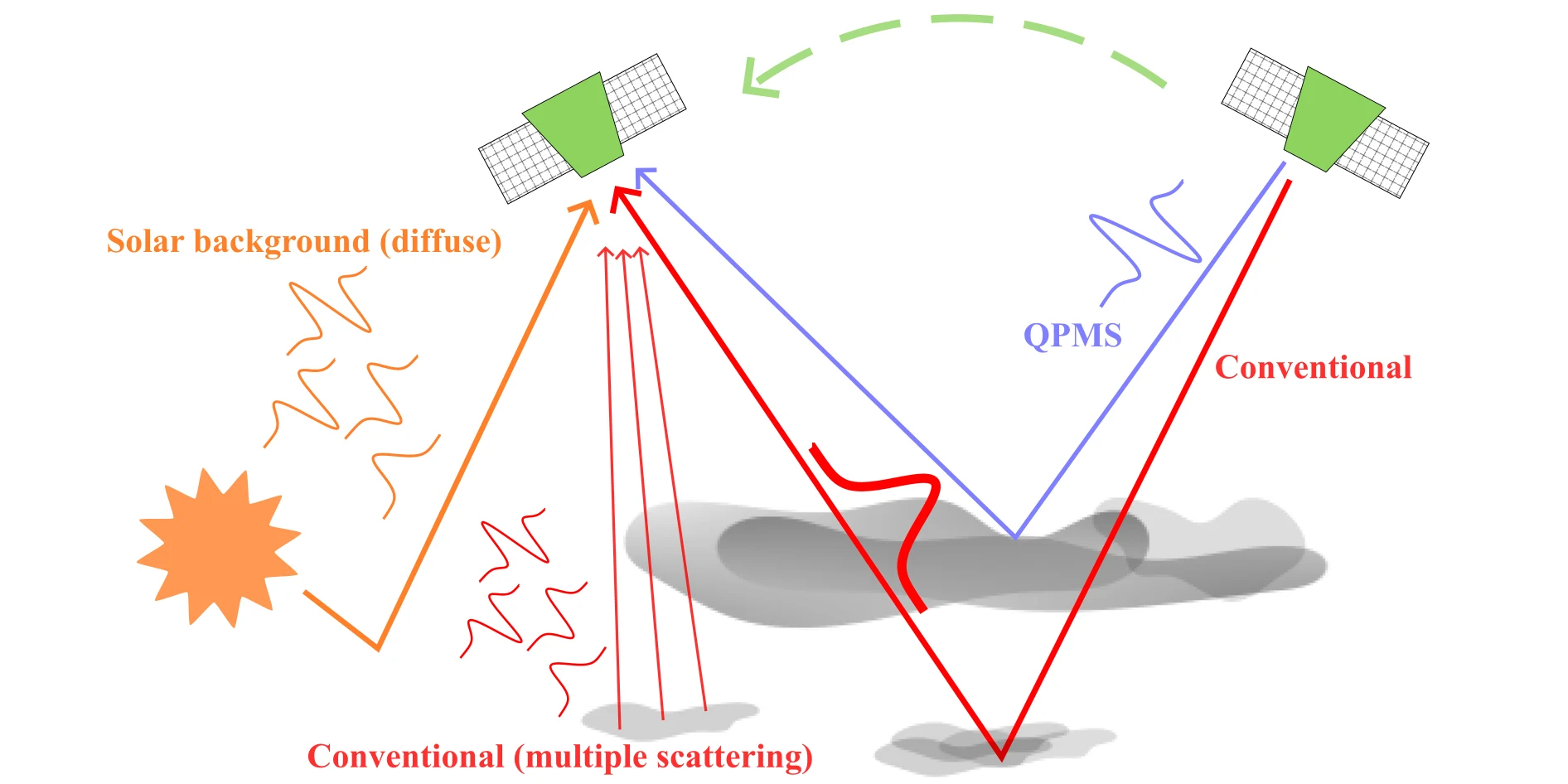
Determining cloud phase (ice or water) from spaceborne lidar data hits a snag: horizontally oriented ice crystals (HOIC) reflect light specularly, mimicking the signature of water droplets. Existing algorithms, such as those in CALIPSO, use spatial tests and ancillary data but remain statistical corrections. This work sits apart from neighboring studies in laser physics and optical microscopy, which tackle noise filtering and precise measurements; here, the need is selective reception of the specular component.
Methods
A theoretical model of a quantum parametric mode sorter (QPMS) is built on nonlinear sum-frequency generation in a waveguide with χ(2) nonlinearity. Signal and pump beams at 1064 nm are fed into the waveguide, where sum-frequency generation produces a signal at 532 nm. Selectivity over spatiotemporal modes allows rejection of multiply scattered light and solar background. Atmospheric propagation is modeled layer by layer, accounting for dispersion, while reflection from crystals is modeled as from a circular flat mirror with radius up to 100 μm.
Results
For reliable detection (SSMD=2), the quantum lidar requires a signal power that remains below that of a conventional lidar when the reflector radius exceeds about 50 μm. At a radius of 50 μm, the signal-to-noise ratio reaches 5782 for the specular component compared to the diffuse one. Multiple scattering from a conventional lidar interferes more than its specular signal because it spreads over many modes. The model shows that atmospheric dispersion for 200 ps pulses is almost fully compensated by accounting for group delay and group velocity dispersion.
Implications
This work differs from archive neighbors by proposing not to improve data processing algorithms but to physically isolate the desired signal component at the reception stage. It is the first theoretical test of a QPMS lidar for cloud phase calibration, whereas neighboring works develop noise filtering and precise measurement methods in other contexts. If the concept is confirmed, a tool will emerge for directly estimating the fraction of horizontally oriented crystals.
Future development
Turbulence, which will degrade spatial mode matching, must be accounted for, and the simple reflector model replaced with a full scattering calculation for an ensemble of ice crystals. A separate task is to include polarization, critical for HOIC recognition, which will require a two-channel scheme with parallel and perpendicular polarizations.
Impact
The method could improve the accuracy of climate models through more reliable classification of ice clouds. It is also applicable to precision altimetry in turbid media, where rejecting multiple scattering is important.
Next steps
Conduct a laboratory experiment with a QPMS waveguide and a model target mimicking specular reflection from ice crystals. Then assess the impact of turbulence and polarization on selection efficiency.
Key open problems
For laser remote sensing, the problem of separating single and multiple scattering contributions in the return signal remains unsolved. This work shows that quantum mode selection can solve this problem without increasing radiation power.
The knowledge machine's view
This section is addressed to the author of the paper and their colleagues. Neighbouring works were found by meaning-based search across our archive, not by word overlap. We do not review: we show the field around the work.
What the work does
The authors developed a theoretical model of a quantum lidar based on a parametric mode sorter (QPMS) that selectively detects singly reflected light from ice crystals, suppressing multiple scattering and solar background. Simulations showed that for reflector radii above 50 μm, the system reliably isolates the specular signal (SSMD=2) at lower power than conventional lidar, with a high signal-to-noise ratio.
Where its strength is
The strength of the work lies in physically isolating the specular component at the detection stage rather than applying statistical corrections in post-processing, providing a direct tool for estimating the fraction of horizontally oriented crystals.
Where it could go next
- It might be interesting to compare the proposed method with noise filtering approaches in laser radars developed for vibration sensing: there, the task is also to extract a weak coherent signal against a noisy background, and some techniques may be transferable to atmospheric measurements.based on: Laser Radar Hears Vibrations Through Noise arXiv:2601.13703
- Closely related is work on using quantum 'hearing' to distinguish topological phases: there, a hybrid scheme combines quantum and classical components to enhance sensitivity, which may suggest ways to optimize QPMS lidar for finer discrimination of cloud phases.based on: Hybrid Intelligence: Quantum Hearing Distinguishes Topological Phases arXiv:2606.28199
- It is worth examining experience in amplifying weak optical signals in nonlinear media: perhaps similar mechanisms could improve upconversion efficiency in the proposed scheme and broaden the range of operating conditions.based on: Light Amplifier Sees What Is Hidden arXiv:2607.17023
Worth trying
- Test whether interference suppression methods from laser vibrometry can be adapted to improve specular component extraction under real atmospheric conditions.
- Consider a hybrid scheme with quantum and classical channels to enhance sensitivity to low concentrations of oriented crystals.
- Evaluate the applicability of nonlinear amplifiers to increase frequency conversion efficiency in QPMS at low signal powers.
Why this may matter
If the concept is confirmed, it will provide a tool for direct, rather than statistical, estimation of the fraction of horizontally oriented ice crystals, which could improve cloud phase classification and possibly climate models.
Nearby works in our archive
- How to Catch Light Dark Matter with Quantum Sensorssimilarity 0.52
- Polar Vision: How to Unfold a Gravitational Lens and Find Traces of Dark Mattersimilarity 0.52
- Cosmic Masquerade: How a Neural Network Unmasks Gravitational Lensessimilarity 0.52
- Laser Radar Hears Vibrations Through Noisesimilarity 0.52
- Polarization of Light in Telescopes: A Hidden Twistsimilarity 0.52
- Gamma Sky as an Orchestra: Weak Supervision Catches Anomaliessimilarity 0.52
- Light Amplifier Sees What Is Hiddensimilarity 0.51
- Hybrid Intelligence: Quantum Hearing Distinguishes Topological Phasessimilarity 0.51
The archive is sparse around this work: the closest review is only 0.52, against a usual 0.64. It looks like few have drilled nearby.
Horizontally oriented ice crystals in cirrus clouds can reflect light like countless tiny mirrors, creating bright glints visible even from Earth.
Key numbers
- specular-to-diffuse signal ratio: 5782 at a reflector radius of 50 μm
- signal wavelength: 1064 nm
- pulse duration: 200 ps
- threshold reflector radius: about 50 μm
- QPMS filtering advantage: 11.3 dB over an ideal filter