Gravitational Ringing Unveils Neutron Star Mysteries ✛
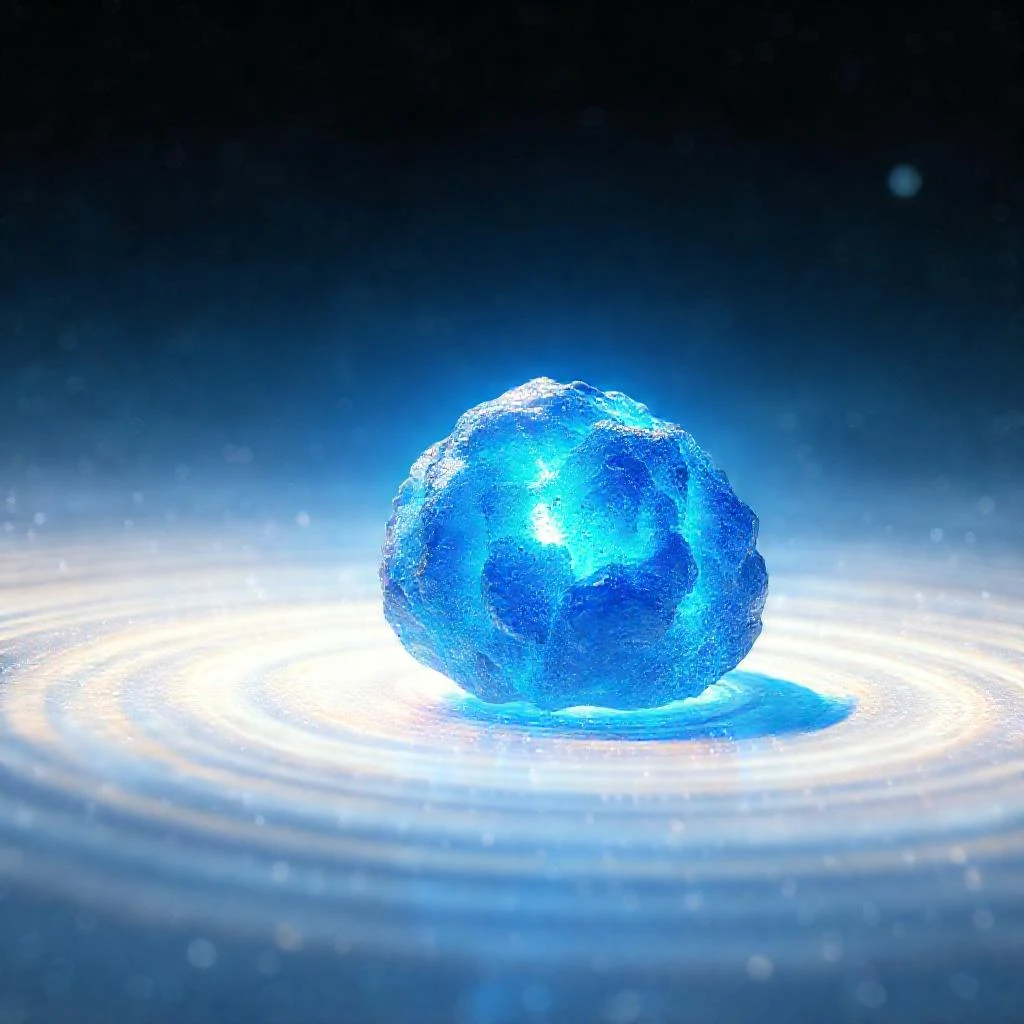
When a pair of neutron stars merge, gamma rays flash and ripples spread through spacetime, like striking a deep, resonant gong. The remnant keeps vibrating, emitting a fading gravitational ring.
Researchers simulated hundreds of these cataclysms, tweaking the elasticity of ultra-dense matter. It turned out that the ratio of lost energy to the drop in rotation speed uniquely determines how pliable the stuff is: rapid damping of the ring at the same spin-down rate signals a soft interior, much like a bell made of clay falls silent faster than a steel one. Funny thing, but at the star’s center matter is simultaneously superfluid and billions of times stiffer than any metal: this paradox makes the ringing even more revealing.
Peering into such depths used to be impossible. Now, by catching the gravitational echo with detectors pioneered by Rainer Weiss, we can directly learn what hides inside the most extreme "building blocks" of the cosmos. It will also hint whether black holes are born in these mergers and where Earth’s gold and platinum came from. By the way, the first neutron star as a pulsar was discovered by Jocelyn Bell Burnell in 1967—her find still springs surprises.
Some neutron stars spin at 716 times per second — faster than a kitchen blender.