The r-process, or rapid neutron-capture process, is the astrophysical mechanism responsible for creating about half of all elements heavier than iron, including gold, platinum, and uranium. It occurs in extreme environments where atomic nuclei are bombarded with neutrons so quickly that they are absorbed before the resulting unstable nucleus has time to decay. This process builds up heavy elements step by step, each neutron capture pushing the nucleus further up the periodic table.
History
The r-process was first proposed in 1957 by Margaret Burbidge, Geoffrey Burbidge, William Fowler, and Fred Hoyle in their landmark paper on stellar nucleosynthesis, with independent contributions from Alastair Cameron the same year.
How it works
In a dense neutron-rich environment, a seed nucleus (like iron) captures neutrons in rapid succession, becoming heavier and more neutron-rich. These neutron-rich nuclei are unstable and undergo beta decay, converting a neutron into a proton and emitting an electron. This increases the atomic number, creating a new element. The cycle repeats, climbing the periodic table until fission limits halt further growth. The required conditions—enormous neutron fluxes—are found in neutron star mergers and certain supernovae.
In practice
Understanding the r-process helps astronomers interpret elemental abundances in old stars and galaxies, and guides searches for gravitational wave counterparts like kilonovae.
Fun fact
The gold in your jewelry was likely forged in the collision of two neutron stars billions of years ago.
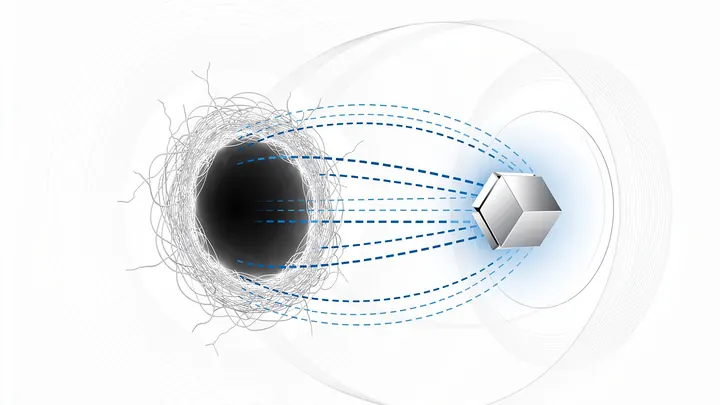
Turn off the stove, and water stops boiling almost instantly. In the world of catalysis, researchers expected a similar picture: stop the reaction, and all intermediate particles vanish right away. But fresh observations of platinum nanoparticles tell a different story.
At the center of every atom lies a nucleus — a dense ball of protons and neutrons. These particles don't just crowd together randomly; they fill strict energy levels, much like floors in a skyscraper. When a floor is completely filled, the nucleus becomes especially stable — physicists call this a magic number.
When two neutron stars, the ultra-dense cores of dead stars, collide, a kilonova is born: an explosion a thousand times brighter than a typical nova. This is the universe's true smelting works. In the scorching cloud racing outward at near-light speeds, a furious flux of neutrons transmutes atomic nuclei into gold, platinum, osmium.
The Universe is a genius chef, and the Big Bang is its perfect recipe. Hydrogen rose fluffy, helium melted tender, but lithium-7 seems oversalted: theory predicts three times more than astronomers find in the oldest stars. This imbalance, the 'lithium problem,' has spoiled cosmologists' appetite for decades.
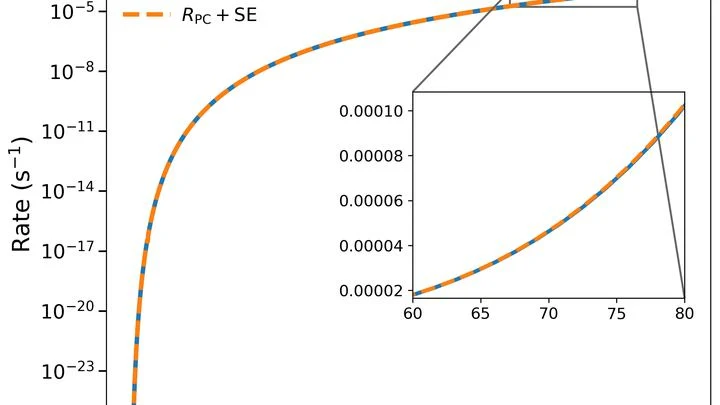
In diamond quantum devices, there's a tiny defect — the nitrogen-vacancy center (a nitrogen atom plus a vacancy where a carbon atom should be). It acts as a switch that spontaneously flips back and forth: it can carry an extra electron or not, and this determines whether it emits light or not.
Two neutron stars (the remnants of dead stars, compressed to the size of a city but weighing as much as the Sun) spiral around each other and eventually collide. At that moment, something between a black hole and a super-powered magnet is born: a field billions of times stronger than that of the most powerful MRI machine.
An archaeologist holds in their hands not a clay shard but an actual star — a living snapshot of the era when the universe was just learning to produce anything heavier than lithium. That is exactly the kind of find astronomers describe in a new study. They spotted four dim stars so ancient and pristine in composition that their matter is barely diluted by the 'cosmic dust' of later generations.
There is something wildly generous about a garden where the first flowers don't just bloom but immediately scatter their seeds far beyond the fence. Something similar was happening in the young universe.
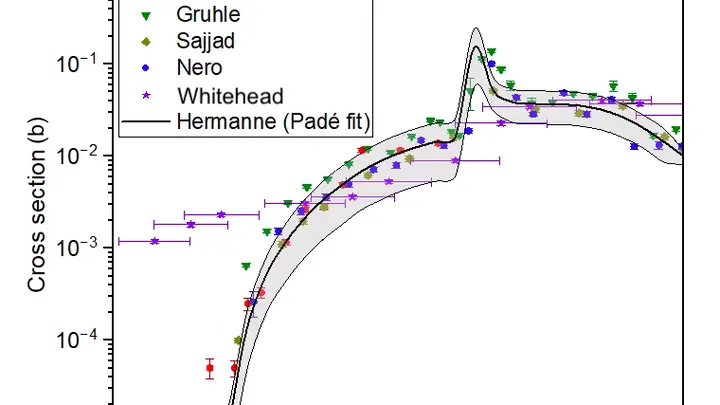
Inside the Sun, invisible nuclear transformations occur every second. One of them is the birth of boron-8: a beryllium-7 nucleus captures a passing proton and momentarily becomes a new element. This step kicks off a chain that ends with the emission of a neutrino — a particle capable of passing straight through Earth.
Deep inside a dying star, just before it goes supernova, nuclear reactions determine which chemical elements will be scattered across the cosmos. One such reaction is the collision of an oxygen nucleus with a proton, producing a nitrogen nucleus and an alpha particle (a helium nucleus).
In April 2023, Japanese satellites detected a super-intense X-ray burst on the neutron star MAXI J1752–457. The star cooled down in 4 days — five times faster than usual. Like someone cracked open a cosmic window.
In the first minutes after the Big Bang, the Universe was like a blazing hot stove. On it, according to the 'recipe' of the standard theory, hydrogen, helium, and a bit of lithium were supposed to cook. But telescopes see only a third of the lithium that this recipe calls for.
For two atomic nuclei to fuse, they must overcome their fierce electric repulsion — like trying to bring two angry bulls together. Normally, only monstrous energy does the trick, as in stellar cores, where Hans Bethe explained fusion back in the 1930s.
In the dense swarm of old stars known as the globular cluster M15, astronomers have spotted not just stars but layers of time. Some stars were born earlier, others later, and their chemical composition reveals their origin with the precision of an archaeologist reading the strata of an ancient settlement.
In 2017, the LIGO and Virgo detectors caught gravitational waves from the merger of two neutron stars. A kilonova flared: a brilliant cosmic explosion thought to forge the heaviest elements in the periodic table. Gold in jewelry, platinum in catalysts, europium in smartphone screens: all of it, according to a beautiful legend, came to us from such catastrophes.
In the stream of charged particles flying toward us from the depths of the Galaxy, iron turned out to be the odd one out. The ATIC-2 instrument, lifted on a balloon over Antarctica, compared how the fraction of nuclei from sulfur to chromium relative to iron changes with energy.