Record Gamma-Ray Burst: 7 Hours of Invisible Light ✛
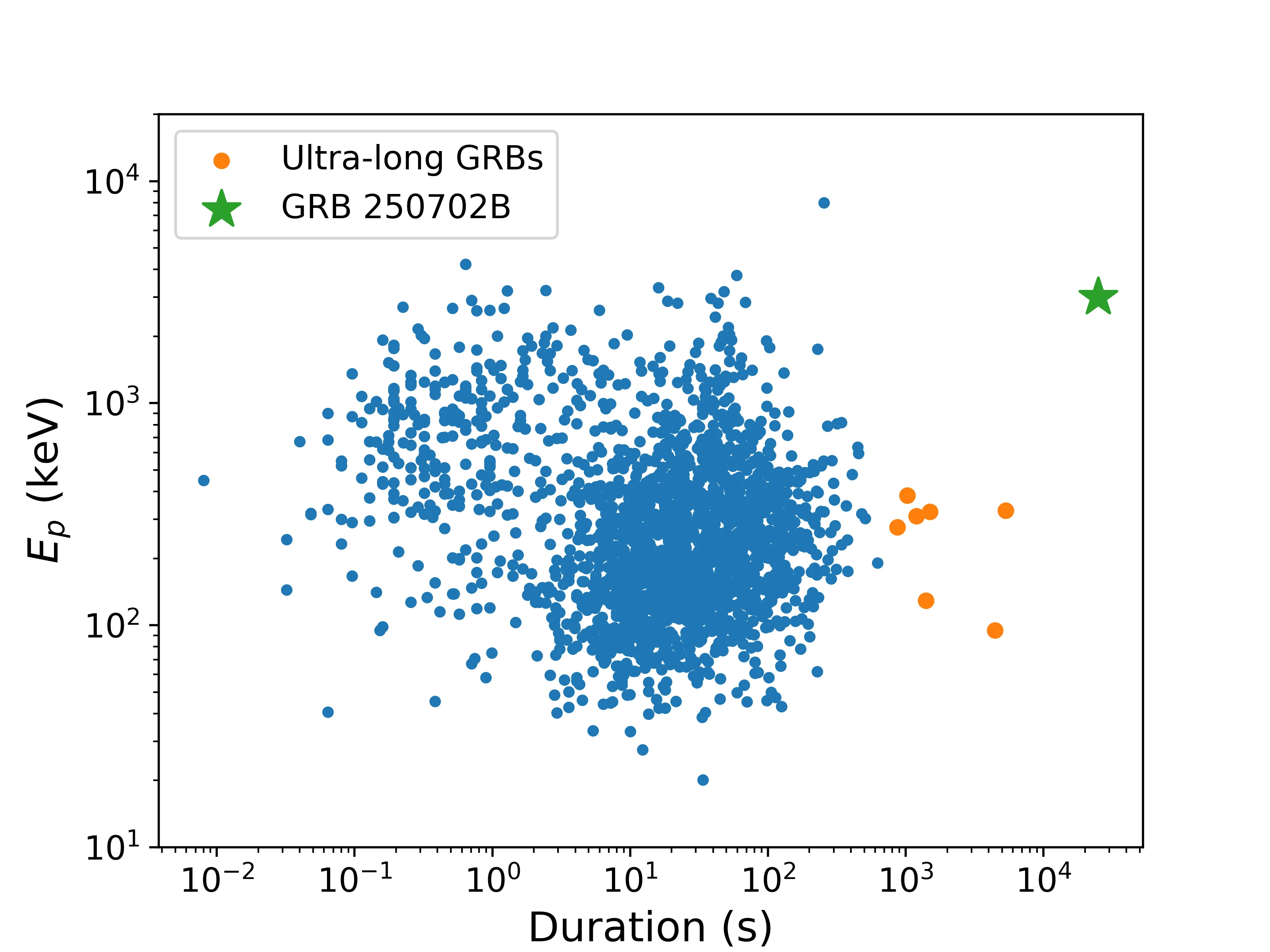
A cosmic searchlight blazed for almost 7 hours — usually these flashes die out in seconds. Astronomers recorded the record-breaking gamma-ray burst GRB 250702B: its beam, made of the most energetic radiation, flickered and carried colossal energy. The source was a superheated jet, accelerated to nearly the speed of light, as if the searchlight were powered by a titanic accelerator. But old models couldn't explain such a long runtime. The solution came from a 'helium merger' scenario: a black hole plunged into a star almost entirely composed of helium and depleted of hydrogen. Once inside, the hole spun up the star and started devouring it from within, blasting out energy — the searchlight switched on at full blast. The star perished not in an ordinary stellar explosion (supernova), but with monstrous gamma radiation, simultaneously creating gravitational waves — ripples in space itself. The discovery links ultra-long bursts with the mightiest explosions of massive stars and shows that helium stars can swell before death. An unexpected twist: a black hole the size of a city powered a searchlight that outshone an entire galaxy.
The burst’s energy was so enormous that for those 7 hours, it outshone all the stars in its galaxy combined.