Megan Masterson

5 articles · 30 co-authors · latest: 2026-07-06
329 citations · h-index 9 · 31 papersData: Semantic Scholar

We have retold 5 papers by this author. 2 of them with a full read. most often about: gamma-ray burst, stellar evolution, black hole. 30 co-authors across our retellings.

Links in the knowledge graph
Black Hole Dives into a Star: Record-Breaking Gamma-Ray Burst
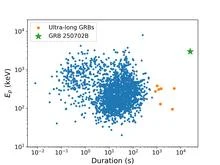
For seven hours straight, a space gamma-ray telescope registered flares that refused to end. That is how the story of GRB 250702B began: the longest gamma-ray burst ever observed. Typical bursts last seconds, rarely minutes. This one stretched to 25,000 seconds, beating the previous record by a factor of two.
Stellar2026-01-091 minarXiv:2601.05774express
The Quiet Death of a Star
In 2014, astronomers spotted a massive yellow star in the Andromeda galaxy. By 2022, it had vanished without a trace — without the usual blinding explosion of a supernova. It was as if someone simply switched off the light.
High Energy2026-04-092 minarXiv:2604.08686express
Dust Remembers Stellar Explosions
A massive star's explosion is bright but brief. The flash itself lasts weeks, but the dust it heats around it glows in infrared for years. It's like a camera flash illuminating a room, then hot dust particles lingering in the air — only on a cosmic scale.
High Energy2026-04-172 minarXiv:2604.16688express
Black Hole's Heartbeat Steadies
At the heart of galaxy 1ES 1927+654, a black hole behaves like a lighthouse with a faulty mechanism. Every six and a half minutes, it releases a burst of X-ray light, a rhythm astronomers have been tracking since 2022. At first, the beacon's tempo wandered — speeding up and slowing down, with intervals ranging from one beat every eighteen minutes to one every seven.
The Pulse of a Black Hole: Birth of a Jet in X-ray Echo
For years, silence reigned in the heart of galaxy 1ES 1927+654: the accreting gas merely whispered in X-rays, leaking slow winds. But in 2022–2025, the picture changed dramatically. Spectra taken by XMM-Newton and Swift lit up with emission lines — a narrow peak at 0.56 keV, likely from OVII oxygen, a broader feature near 1 keV, and a powerful iron band in the 6–7 keV region.