Black Hole Dives into a Star: Record-Breaking Gamma-Ray Burst ✛
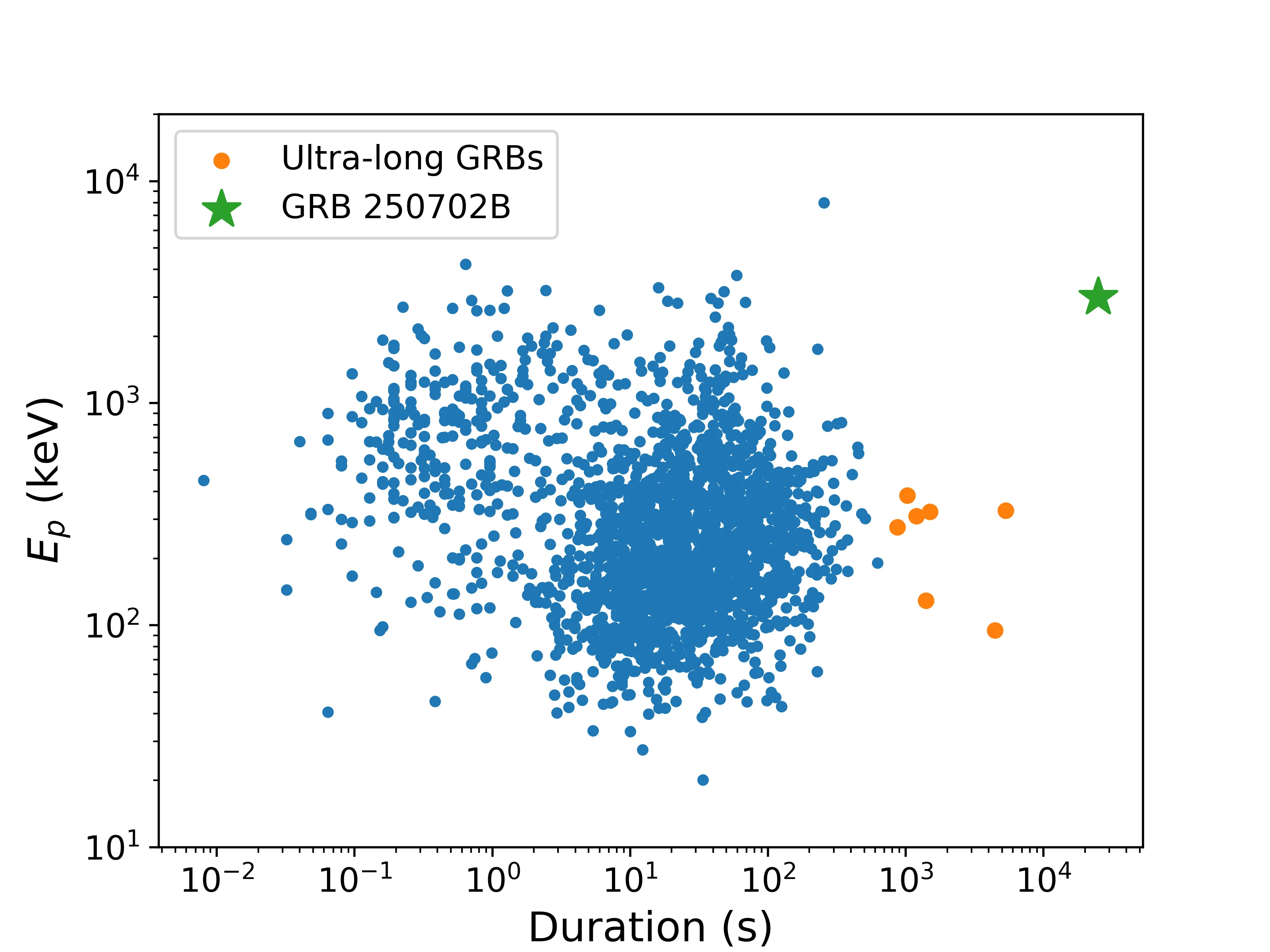
For seven hours straight, a space gamma-ray telescope registered flares that refused to end. That is how the story of GRB 250702B began: the longest gamma-ray burst ever observed. Typical bursts last seconds, rarely minutes. This one stretched to 25,000 seconds, beating the previous record by a factor of two. But the strangest part: within this slow river of radiation hid fast whirlpools, with brightness changing in fractions of a second, as if a rapid engine were running inside a leisurely process.
Astrophysicists know two main scenarios for gamma-ray bursts. Short bursts come from neutron star mergers. Long ones come from the collapse of a massive star's core into a black hole, the so-called collapsar. But neither can power a jet for more than a few thousand seconds: a single star simply lacks the angular momentum to keep an accretion disk spinning for long. And tidal disruption of a star by a black hole produces too smooth a variability. GRB 250702B fit neither scheme.
The answer came from a model that no one had applied to ultra-long bursts before. A stellar-mass black hole, like a swimmer, dives into a helium star, one that has already shed its hydrogen envelope. As it falls, it makes the star orbit around it, and this orbital angular momentum becomes fuel for prolonged accretion. The black hole's compactness explains the fast variability, and the high photon energy, up to 5 MeV, points to a powerful jet. Everything fits.
Previously, it was unclear what object could power a gamma-ray burst lasting more than a few thousand seconds. Now it is clear: the record-breaking GRB 250702B is explained by a black hole falling into a helium star. The orbital angular momentum provides long-lasting accretion, and the black hole's compactness provides fast variability. This discovery makes helium mergers a new class of gamma-ray burst progenitors. The model predicts that such events should be accompanied by weak supernovae with low nickel-56 yields, and their population should follow star formation. Future surveys, such as LSST, will be able to test these predictions.
GRB 250702B lasted about 7 hours, longer than a flight from Moscow to New York. Yet individual flares within it changed in fractions of a second, as if a fast engine were running inside a slow process.
A black hole merging with a star echoes the plot of the movie Interstellar, where the black hole Gargantua interacts with surrounding matter, but here the scale is stellar, not supermassive.