Which Stars Can Give Birth to Life? The Answer's in the Color express
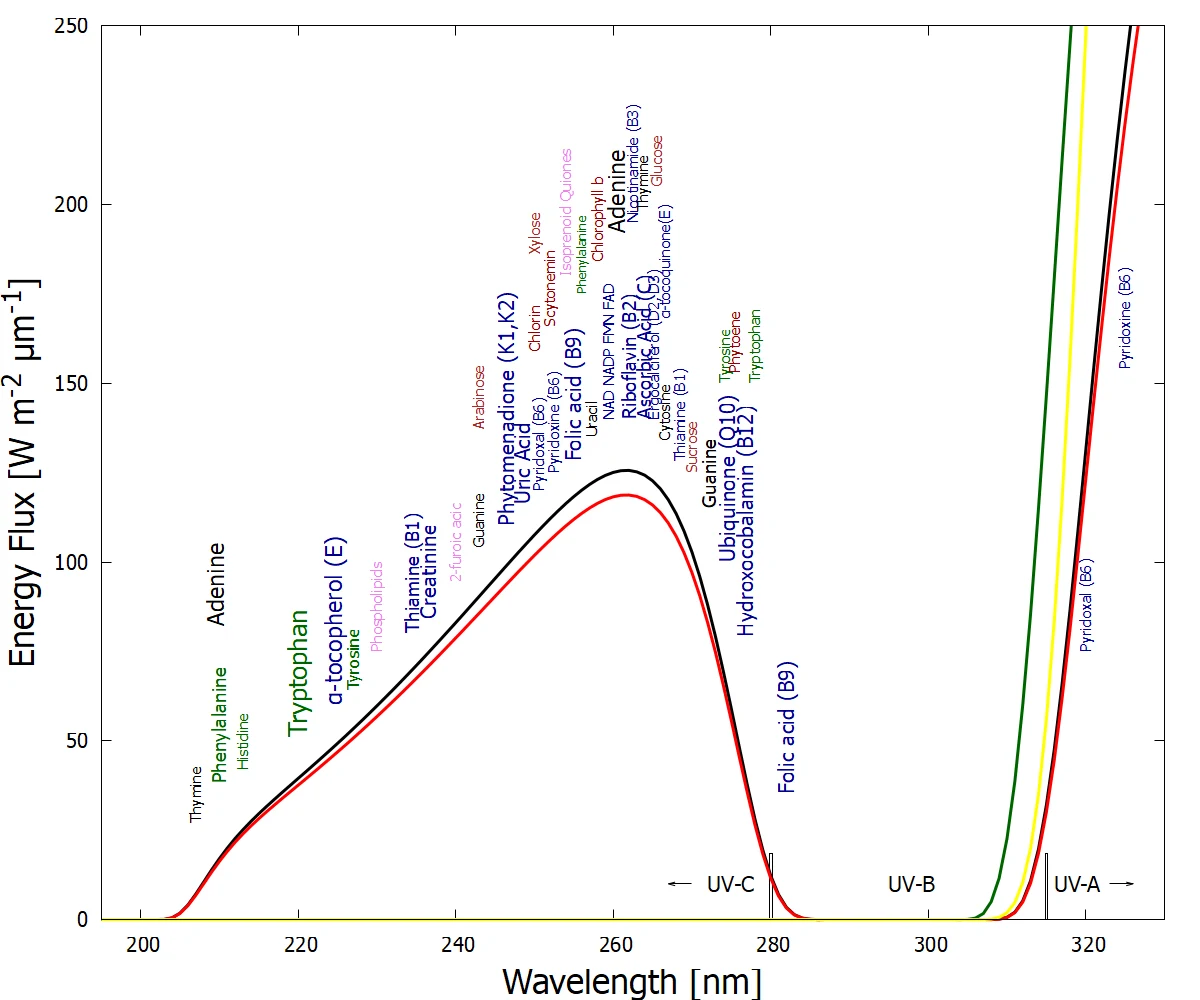
Life began with molecules akin to natural sunscreen — based on carbon, they soaked up the mild ultraviolet of the young Sun and turned it into heat. This way of dissipating energy wasn’t just heating: it made molecules self-organize, like chefs kneading structured dough out of a chaos of ingredients. But ultraviolet is a finicky tool. Soft light gently joined atoms; hard light snapped fledgling bonds.
Astronomers compared the rainbow fingerprints of starlight and found that only F, G, and massive K stars hit the ideal balance. But for intelligence to emerge, only G-type will do: that’s our Sun. Red dwarfs, which are the most abundant in the Galaxy, offer merely a smoldering warmth: their planets are likely barren. Now the search for habitable worlds zeroes in on yellow stars, and a telltale sign could be an ocean's unusual darkening in the ultraviolet.
Original abstract
as written by the authors arXiv:2511.08624
The thermodynamic dissipation theory for the origin of life asserts a thermodynamic imperative for the origin of life, suggesting that the fundamental molecules of life originated as self-organized molecular photon dissipative structures (chromophores or pigments) that proliferated over the ocean surface to absorb and dissipate into heat the Archean solar soft UV-C (205-285 nm) and UV-B light ($$<$$320 nm) of our G-type star. Shorter wavelength hard UV-C light ($$<$$205 nm) may, depending on atmospheric conditions, have reached Earth's surface and ionized and dissociated or otherwise degraded these carbon-based pigment molecules (as probably occurred on Mars after losing most of its atmosphere). Here we assess the possibility for an abiogenesis of life similar to ours through molecular photon dissipative structuring on planets similar to early Earth but orbiting different star types at distances normalized to the solar constant. Emission spectra of star types are analyzed to determine the ratio of integrated photon fluxes in the soft UV-C wavelength (dissipative structuring) to hard UV-C wavelength (degradation) regions. Our analysis suggests that star types favorable to the dissipative structuring of life, potentially evolving towards complex life forms such as bacteria, are only the F, G and high mass K-types, with intelligent life only possible on G-type stars. Low mass K and M-type stars are highly unlikely to harbor life. Biosignatures related to the thermodynamic imperative of photon dissipation are proposed.
About 20% of sunlike stars in the Galaxy may host planets with a suitable ultraviolet climate: that’s billions of chances for life.
Sci-fi writers love to populate planets around red dwarfs (like in Interstellar), but the new model shows: their light isn’t enough to ‘knead the molecular dough’ of life.