Simple

The Muon Magnetism Mystery ⚡ экспресс

Original: "Muon magnetic anomaly: experimental status and prospects"
· Dinko Pocanic
The muon's magnetic axis veers from predictions, as if invisible currents flow through the void.
Abstract

Imagine a spinning top that doesn't spin quite as the laws of physics predict. That's roughly how a muon behaves — a particle whose magnetic properties slightly differ from theoretical calculations. Scientists have found discrepancies between measurements and theory, and now the new MUonE experiment at CERN will try to figure out why. What lies behind this anomaly — new physics or a mistake in the calculations?

Links in the knowledge graph 1

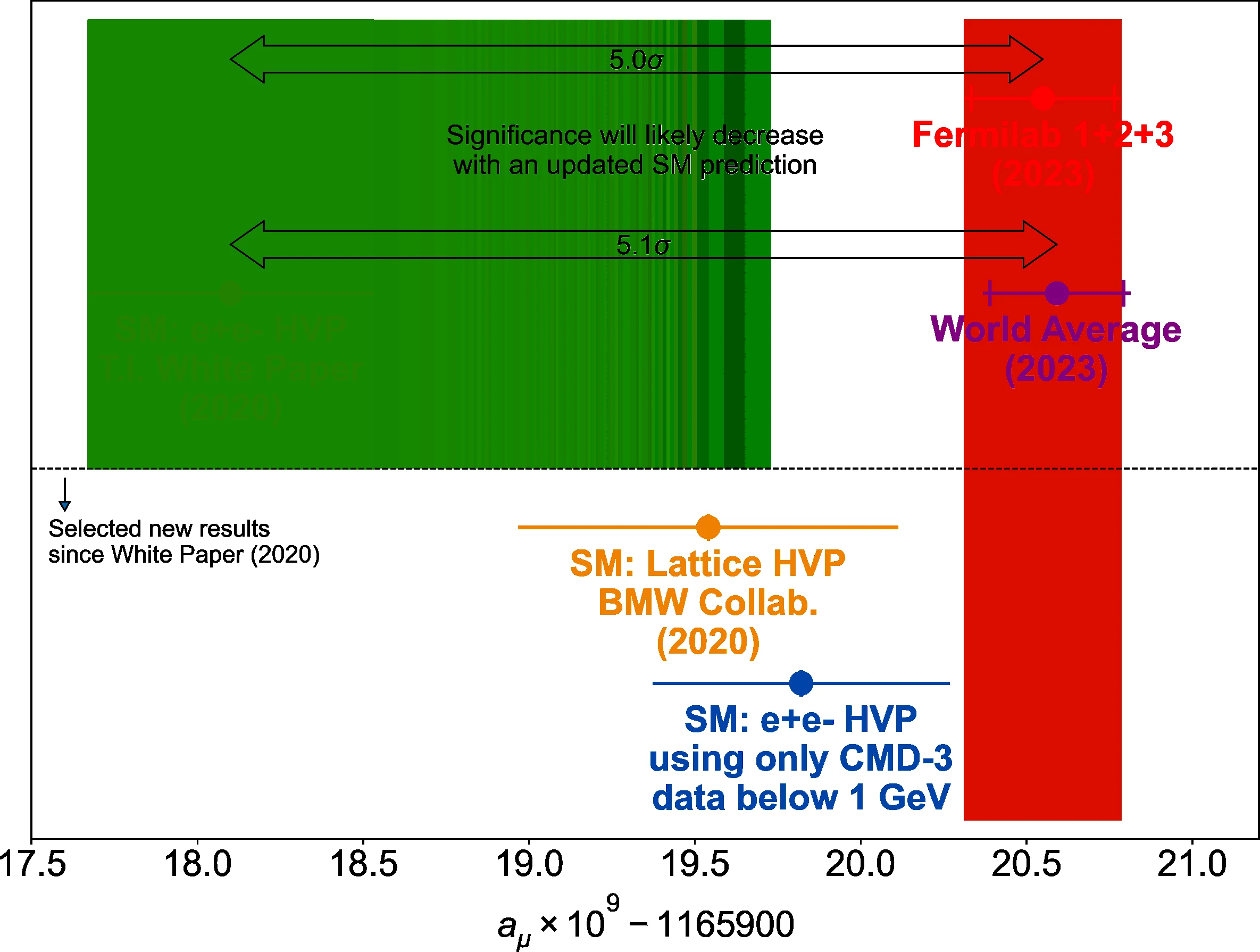
The muon is a tiny spinning top, twirling in the turbulent sea of the vacuum. Its magnetic axis points slightly away from what the Standard Model predicts. The deviation is just a couple of parts per million, but for physicists, it's a full-blown mystery.

The vacuum is not a dead calm. It trembles constantly, spawning pairs of ghost particles that vanish an instant later. This ripple, like an invisible surf, subtly alters the muon's spin. Calculating this effect directly was the challenge taken on by Richard Feynman and Julian Schwinger while developing the theory of light and matter.

The new MUonE experiment will be the first to measure this ripple directly: it will collide muons with electrons and track the bending of their paths. This will let us check whether particles of dark matter hide in this ripple, or echoes of forces from the Big Bang era. By the way, the same cosmic muons that fly through us have already peered inside Egyptian pyramids — and now they'll help us examine the very fabric of emptiness.

🎯 Muons constantly bombard Earth from space: about one muon passes through your palm every second.

🎬 In sci-fi, anomalies open portals to other worlds — the muon mystery could be a doorway to new particles and forces.

a_\mu = (g-2)/2
a_μ is the anomalous magnetic moment; g is the gyromagnetic ratio (showing how many times stronger the particle's actual magnetic field is compared to what you'd expect from a simple spinning charge).
Scientists
Alan GuthAndrei LindeGeorges LemaîtreJames PeeblesAdam RiessBrian Schmidt
Tags
Standard Model dark matter big bang
Laws
Friedmann equationsHubble's lawgravitational lensingNoether's theoremEinstein field equationsPlanck's law
Original: arXiv:2512.02209 · CC BY 4.0 · bridge42worlds