In the quantum world, you cannot simultaneously know exactly where a particle is and how fast it is moving. If we try to measure the position more precisely, the speed becomes more and more blurred, and vice versa. It's like trying to photograph a hovering hummingbird: to freeze the motion, you need a short exposure, but then the image will be dark and fuzzy. Or conversely, you can take a bright image with a long exposure, but the wings will blur. Nature seems to play hide-and-seek with us: the more you learn about one, the less about the other.
History
Werner Heisenberg formulated the principle in 1927 while working in Copenhagen under the guidance of Niels Bohr. Initially, he reasoned in terms of a thought microscope, showing that measuring the position of an electron by scattering a gamma ray inevitably introduces uncertainty in momentum. Later, mathematical rigor was provided by Hermann Weyl and Earle Kennard, who derived the inequality from commutation relations. Bohr generalized the principle to the idea of complementarity. Over time, the inequality was generalized to other pairs of quantities, such as angular momentum projection and angle.
How it works
The principle always works, but it manifests significantly for microparticles, where Planck's constant is not negligible. In the macroworld, the product of uncertainties is usually tiny compared to the sizes of bodies and their momenta, so we do not notice the limitations. In quantum technologies, for example, in a scanning tunneling microscope, it determines resolution. The principle also limits the precision of simultaneous measurement of signal and phase in quantum optics. The energy-time relation explains the creation of virtual particles: they can exist by 'borrowing' energy from the vacuum for a time inversely proportional to that energy.
Fun fact
The uncertainty principle prevents electrons from falling onto the atomic nucleus! If an electron 'sat' on the nucleus, its position would become very precise, and its momentum would be huge, and it would instantly fly out. So atoms are stable precisely because of quantum uncertainty.
Two dancers on the same stage mirror each other's moves even when a curtain separates them. In the quantum world, such pairs are called entangled, and physicists have spent half a century probing how far this connection reaches. Until now, all tests with massive particles concerned their internal properties, such as spin, but not their motion itself.
A hunter sets snares in the woods. They know the animal's habits but not whether it will ever show up. In much the same way, physicists set up detectors in hopes of catching particles of dark matter — the invisible substance thought to make up most of the Universe's mass.
A new study offers hunters an unusual tool: not a trap, but a measuring tape.
The quantum vacuum is not empty: it is permeated by entanglement linking distant regions. But when physicists tried to compute this entanglement, it turned out to be infinite. The culprit: particles with very low energy that can smear out over arbitrarily large volumes. They are like waves with no shores to contain them.
Imagine an old theater in the damp fog. On the stage, a scattering of actors, but only one is caught by the spotlight beam, made to freeze in the bright patch. The rest billow in the dim light, ready to dissolve at any moment.
Searching for the global minimum in the Sherrington–Kirkpatrick spin glass model resembles climbing a glacier, where every crevasse is a treacherous local optimum, and the true bottom lies buried beneath a chaos of ice blocks. A classical climber, trudging along the gradient, would almost certainly freeze in the nearest crevice.
Photographing hummingbird wings with an ordinary camera gives a blurry smudge. For a sharp picture, you take many rapid shots from different angles and piece them together: that's how a quantum 'snapshot' is made. In the lab, scientists 'feel' the vibrations of a tiny mirror with a laser beam.
Quantum entanglement — a phenomenon where the states of two or more particles become interconnected regardless of the distance between them — usually links intrinsic properties such as spin or polarization. However, a new experiment has for the first time realized entanglement of the positions of two atoms in space.
Quantum matter rarely treats us to the spectacle of self-motion. Where the classical world teems with starling murmurations, fish schools, and bustling bacteria, quantum thermodynamics long remained serene.
In nuclear physics, the belief long reigned that two neutrons cannot form a bound state — they attract too weakly and immediately fly apart. However, on the surface of neutron-rich nuclei, where the matter density drops to a thousandth of normal nuclear density, the situation changes dramatically.
A regular object moves along a predictable path, like a ball. In the quantum world, a particle is smeared into a probability cloud. To find order in this fog, scientists have recast Schrödinger's equation in the language of flowing water.
The river of time may not be a smooth flow but a sequence of minuscule steps, like a stop-motion film shot with an unimaginably fast camera. In 1964, Yu. A. Golfand suggested that time moves not continuously but in tiny jumps, and derived an equation that predicted an inevitable increase in disorder (entropy).
Atomic nuclei are rarely perfect spheres. More often, they resemble a slightly squashed ball — the electric charge inside is unevenly distributed, and protons may shift a bit, creating a tiny 'pear-shaped' bulge.
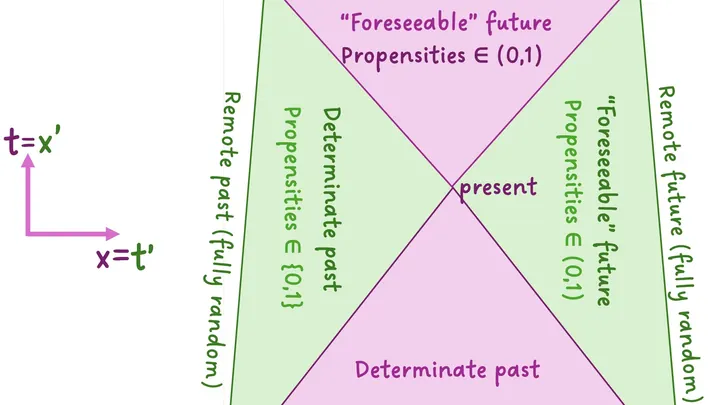
Light cones are not about light; they are boundaries in spacetime that separate causes from effects. These cones are not rigid: a massive object curves them, like a heavy ball pressing into a stretched sheet.
You can zoom into a high-resolution photo for a long time — until suddenly a smooth face dissolves into individual pixels. Something similar, according to a new study, happens to spacetime itself. The authors propose that tiny intervals of length are not pre-existing 'parts' of the universe but results of measurements.
The quantum world plays a strange game with causality. If in everyday life salt is always added to soup before serving, here the ingredients end up in the bowl at the same time, and the chef doesn't remember the order. Physicists asked: can we measure this 'recipe'? The answer is no.
The quantum world is known for uncertainties: for example, you can't measure a particle's position and its speed at the same time. But new research shows that in a 'fuzzy' spacetime, even probability itself — the measure of chance — loses sharpness. A foggy compass doesn't give an exact direction: its needle wavers.
The quantum world is usually drawn with points, but real instruments only see blurry spots. Heisenberg and von Neumann long suspected: precision is unattainable.
In 1867, James Clerk Maxwell proposed an image that still stirs physicists today. Two compartments of gas are separated by a door. Molecules dart about chaotically: fast and slow. A tiny gatekeeper opens the door only for fast ones, letting them through to one side, and slow ones to the other. The hot compartment gets hotter, the cold one colder.
Two particles behave like a pair of unusual dice: thrown at opposite ends of the universe, they always land on the same face. Physicist John Stewart Bell calculated: if the dice had hidden rules, the frequency of matches would have a strict limit.
Four tiny puddles, and in them ripple droplets of a superfluid. These droplets are atoms cooled to near absolute zero and paired up like little magnets. When the whole setup rotates, the fluid flows between the puddles. Simply counting how many droplets end up in each reveals the angle and angular velocity.
Throw a stone into a pond, and ripples spread across the water. Throw two stones nearby, and the ripples intersect, creating a pattern of reinforced and canceled waves. That's interference.
The Universe is like an inflating balloon. Quantum mechanics forbids measuring exactly how big it is and how fast it's inflating at the same time. This principle permeates the cosmos: a new equation states that the Universe's expansion and its size are linked by a fundamental uncertainty.
Fireflies flash in a dark forest: you see each flash, but not the flight. A quantum gas microscope can show individual cold atoms, like those fireflies. But until now, it couldn't tell you how fast they're moving.
Now scientists have found a way to fix that.
Two coins are flipped in different cities, but they always land the same way. Physicists call this entanglement: particles behave as if an invisible thread connects them. But what if the thread isn't instantaneous, just very fast — still not faster than light? Then some signal could slip between measurements, and the coincidences would be explained without any magic.
In a protoplanetary disk, a cloud of gas and dust around a young star, dust grains don't just fly in circles. They are carried by the gas flow, like sand by the wind, and in turn alter that flow. Layers emerge, sliding past each other, and at their boundaries an instability arises — waves and vortices.
The world of physics works like a music box: there's a speed knob. Turn it slowly, and the melody is strict — balls roll along trajectories (classical mechanics). Speed it up — the notes blend into a chord: a particle is in many places at once, all probabilities (quantum regime).
The secret of switching is in the parameter κ.
The diffusion equation, a mathematical tool describing how particles spread out in space, has long painted a paradoxical picture: a disturbance, like ripples on Water, instantly engulfs the entire universe. This challenged the theory of relativity, which holds that nothing can move faster than light.
According to the laws of physics, nothing can outrun light, otherwise for some observers the effect would occur before the cause. Artur Ekert and Andrzej Dragan showed that this situation creates an uncertainty resembling quantum indeterminacy.
A quantum sensor is like a telegraph line transmitting a hypersensitive message. The slightest disturbance distorts the signal. It used to be thought that accurate measurement required an error-free 'telegraphist' — a perfect error-correction system. But in practice, all elements are noisy. The new approach allows for errors at every step: in sending, verification, and reception.
The calm вода of a lake: the slightest ripple blurs the depth. In quantum sensors, noise — random jitters — generates энтропию (disorder) and kills precision. Physicists found a solution: scramble the order of events.
Spacetime at ultra-short distances resembles a digital screen: it's not smooth but made of tiny 'pixels.' This minimum length was calculated by Max Planck, and Heisenberg's uncertainty principle explains why the world cannot be continuous: precise measurement always…
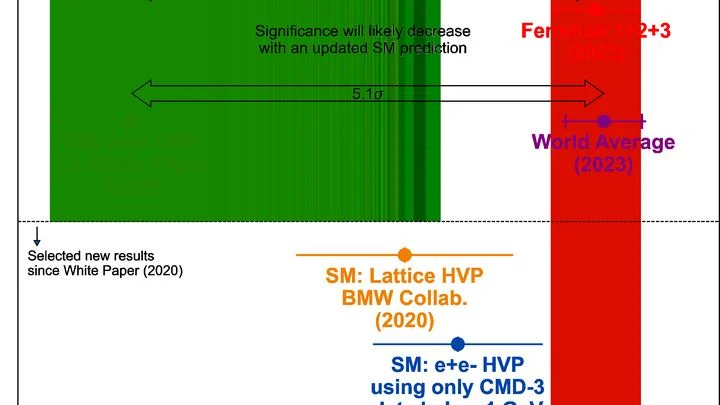
The muon is a tiny spinning top, twirling in the turbulent sea of the vacuum. Its magnetic axis points slightly away from what the Standard Model predicts. The deviation is just a couple of parts per million, but for physicists, it's a full-blown mystery.
The vacuum is not a dead calm.
In 1935, Einstein, Podolsky, and Rosen proposed a thought experiment that, in their view, exposed the incompleteness of quantum mechanics. Two particles fly apart after interacting, and measuring the momentum of one instantly gives exact knowledge of the other's momentum.