Supersolidity Is Born at the Liquid Boundary express
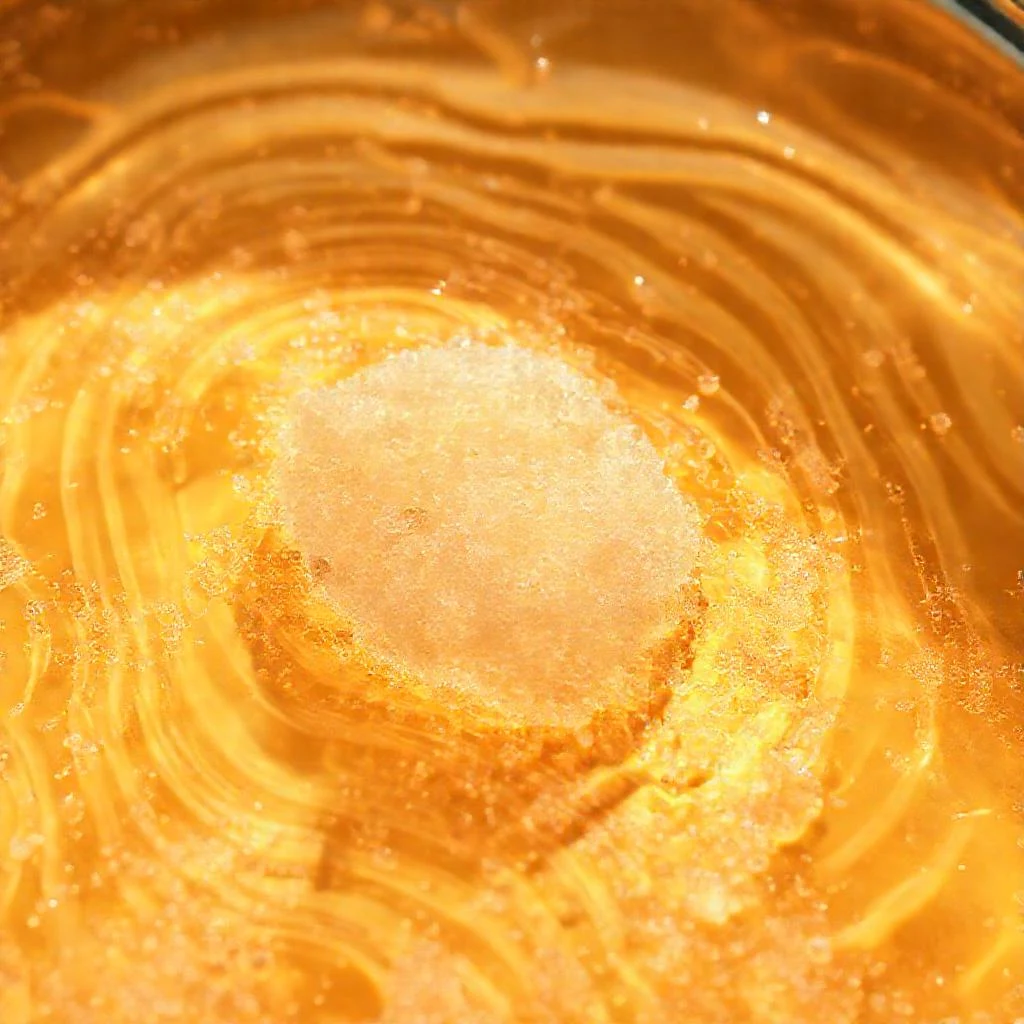
A supersolid is ice that flows. Think of a pond with a frozen crust, but beneath it, a liquid depth without friction. Usually, creating that crust means changing the liquid's properties throughout its entire volume. A team of researchers studying liquid helium found a simpler way: they made the surface vibrate with special waves, and the liquid grew its own solid 'skin.'
Those vibrations weren't just ordinary ripples: they were quantum whirlpools called rotons, whose nature was uncovered by Feynman. By coupling with the motion, they order the atoms at the boundary into a crystal. In Bose–Einstein condensates, a similar effect occurs when the wavelength matches the trap size. The result is a material whose surface holds its shape while the inside flows freely. It’s possible that similar processes harden the crust of neutron stars.
Original abstract
as written by the authors arXiv:2512.08739
Supersolidity, combining superfluid and crystalline orders, has been realized in dipolar Bose-Einstein condensates by tuning interatomic interactions. Here we show that supersolidity can also emerge from mode coupling at a superfluid-solid interface, without modifying bulk interactions and for a broad class of superfluids. Using an analytical and numerical treatment of the coupled superfluid and phonon fields, we derive the criterion for a density-modulation instability driven by interfacial coupling and dependent on dimensionality. In superfluid helium, the instability first appears at the roton mode, while in a Bose-Einstein condensate with contact interactions it occurs at the lowest accessible wave vector set by the system size. Beyond the threshold, the ground state acquires an interfacial density modulation while the bulk remains superfluid, forming a hybrid superfluid-supersolid phase. Our results identify interfacial mode coupling as a promising route to supersolidity, enabling the simultaneous exploitation of interfacial supersolid and bulk superfluid quantum properties.
The idea of supersolidity is over half a century old, but it wasn’t until 2017 that it was realized by trapping ultracold atoms in a laser cage.