The 'Chef' Black Hole That Prevents Star Birth express
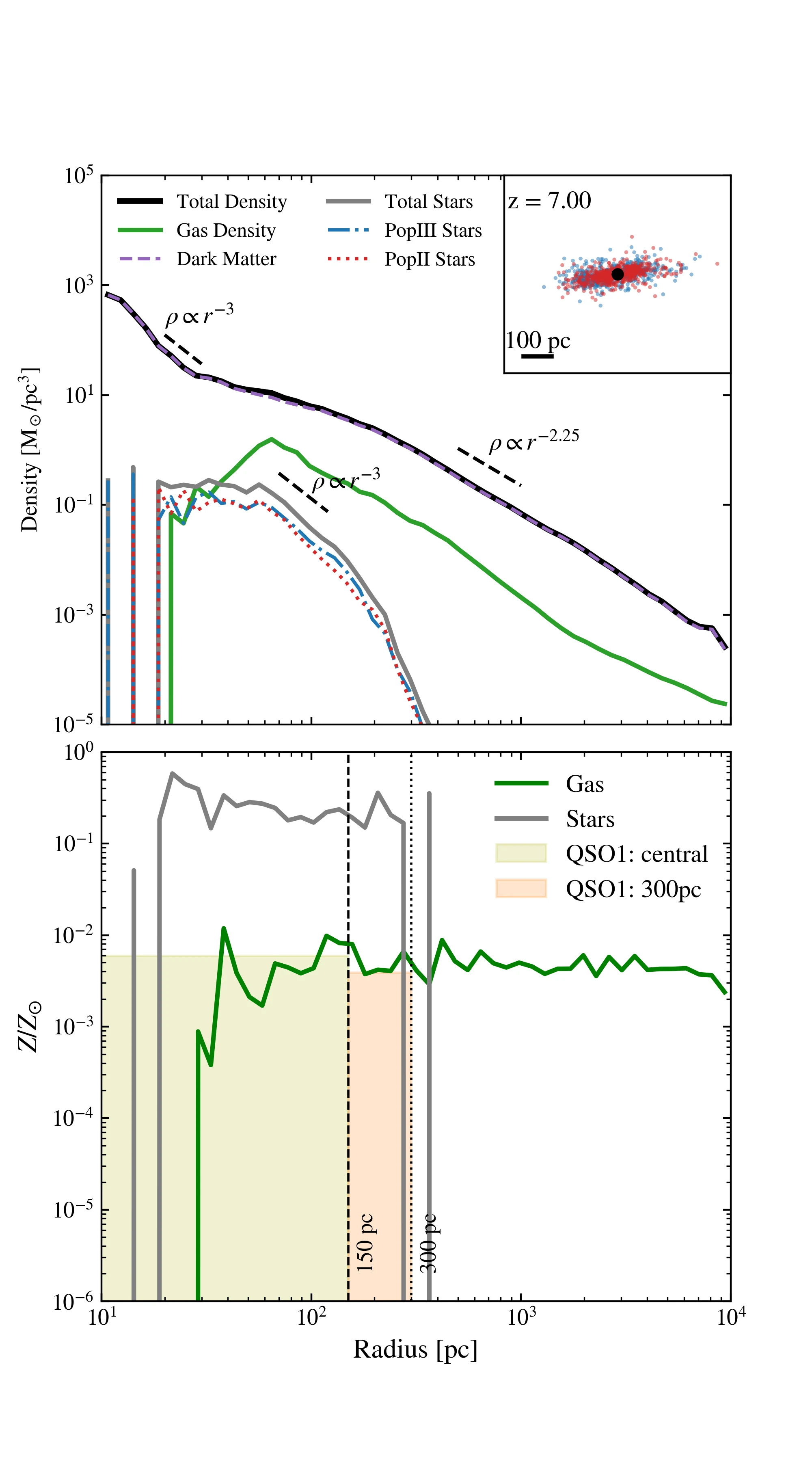
The James Webb Space Telescope spotted galaxy Abell 2744-QSO1, which has almost no heavy elements (astronomers call them metals), and its central black hole weighs hundreds of times more than all its stars combined. Standard scenarios can't explain this imbalance.
The answer may lie in a special type of black hole — one born not from a star, but from a clump of ultra-dense matter right after the Big Bang. This giant hole (about 50 million solar masses in the model) behaves like an extreme chef. It voraciously gobbles up gas, but in doing so, it heats the galaxy's 'oven' so fiercely that the stellar 'dough' can't set — stars fail to ignite. When the first stars do eventually burst to life, they quickly saturate the gas with metals. The hole then ejects this 'oversalted' batch and pulls in fresh, clean fuel from intergalactic space. The cycle repeats, leaving the galaxy almost metal-free but with a grossly overgrown black hole.
In a surprising twist, this same turbulent cooking makes the hole's surroundings dazzlingly bright — like an open oven lighting up everything around it. It was this very light that allowed Webb to spot the galaxy at the edge of the observable universe.
Original abstract
as written by the authors arXiv:2512.14066
The James Webb Space Telescope (JWST) has recently identified Abell 2744-QSO1 as a compact, metal-poor, black hole (BH) dominated galaxy at $$z\simeq 7$$. This system exhibits an extreme black-hole-to-stellar mass ratio and unusually low metallicity, posing significant challenges to BH seeding models. Motivated by these discoveries, we perform high-resolution cosmological simulations with a massive primordial black hole (PBH; $$M_{\rm BH}=5\times10^7\,M_\odot$$) seed, incorporating for the first time a fully coupled treatment of PBH accretion, BH feedback, and Population~III/II star formation and stellar feedback. Although PBHs accelerate structure formation through the seed effect, the associated strong thermal feedback from the accretion delays the onset of star formation to $$z\lesssim 10$$, producing short, bursty episodes throughout the subsequent evolution. PBH-driven outflows expel enriched gas from the nucleus, while sustained inflows from the intergalactic medium continuously replenish pristine material. This feedback-regulated cycle naturally yields low accretion rates ($$\dot{m}_{\rm BH}/\dot{m}_{\rm edd} \sim 1-10\%$$), subsolar metallicities ($$Z/Z_\odot\lesssim10^{-2}$$) and extreme $$M_{\rm BH}/M_\star$$ ratios during both the initial star-forming phase and the subsequent quenching phases, in excellent agreement with JWST observations. Our results demonstrate that massive PBHs offer a viable pathway for forming the most extreme high-redshift systems, providing a physically motivated explanation for the extraordinary properties of Abell 2744-QSO1, as a sub-class of the broader population of JWST-discovered "little red dots".
Primordial black holes were first described in detail by Stephen Hawking in the 1970s. He suggested they could be extremely tiny but would eventually evaporate.