Quantum Camera Reveals Invisible Particle Bonds express
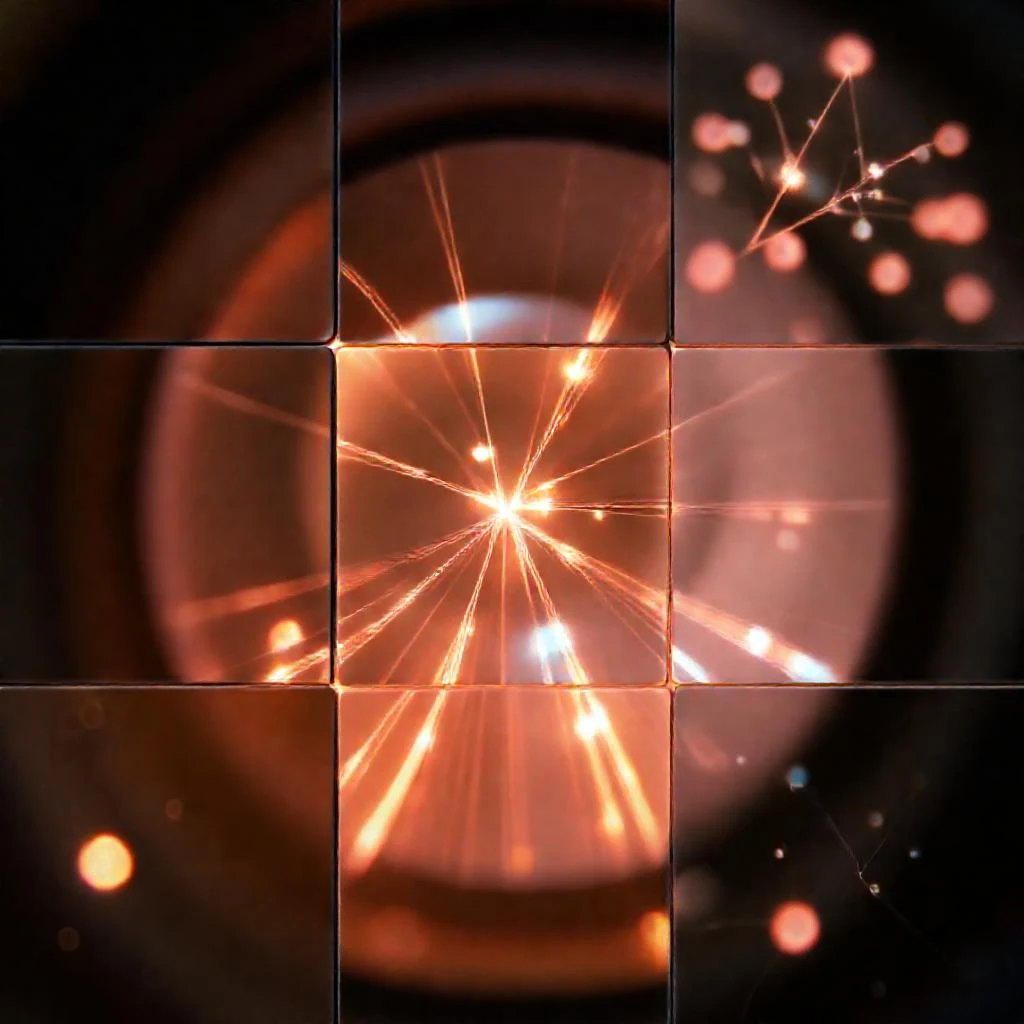
Entangled photons are like twins: what affects one instantly affects the other, even if they are separated by kilometers. Until recently, observing such a connection required detectors that counted each photon individually in pitch darkness. Physicists simplified the task by swapping them out for a regular scientific camera.
The camera worked under lighting that would have been blinding to previous detectors, like switching from night vision to broad daylight. Scientists captured entire groups of entangled pairs and applied an algorithm to subtract the sensor noise. What's more, the camera didn't need cooling, which was once considered mandatory for quantum experiments. It turned out that the twins appear at precisely matching points, and their trajectories line up perfectly.
This approach to photometry (measuring light) opens the door to affordable quantum devices. All photons travel at the speed of light, and their connection upends conventional ideas about entropy (a measure of disorder) within the Standard Model — the best theory of the micro-world. The ideas of Einstein, Schrödinger, and the experiments of Alain Aspect are now taking shape in real devices.
Fun fact: The farthest photon entanglement was demonstrated between a satellite and Earth over a distance of 1,200 km.
In science fiction, entangled particles allow faster-than-light communication, as in Orson Scott Card's "Ender's Game."