Quantum entanglement extraction refers to a set of techniques for generating pairs of entangled photons — particles of light whose quantum states are linked so that measuring one instantly affects the other, regardless of distance. The seed definition mentions generating these from vacuum or other quantum states, and the corpus titles show a rich variety of physical systems that can serve as sources: cold atomic clouds, hot vapor, trapped ions, quantum dots, optical cavities, and even sunlight. The common thread is that these systems are engineered to emit photons in correlated pairs, often through nonlinear optical processes or by exploiting the quantum properties of matter.
History
The concept of entanglement dates to the 1935 Einstein-Podolsky-Rosen paper, but the first experimental generation of entangled photons was achieved by Alain Aspect and colleagues in the early 1980s using atomic cascades. The field expanded rapidly after the development of SPDC in the late 1980s and early 1990s, which became the workhorse for entanglement sources.
How it works
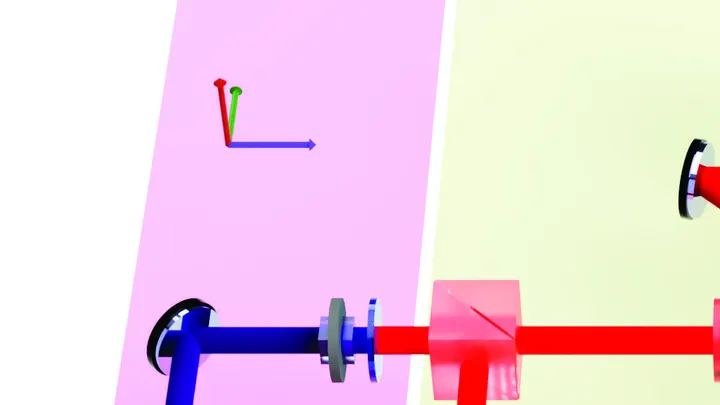
The mechanisms vary by platform. In spontaneous parametric down-conversion (SPDC), a nonlinear crystal splits a single high-energy photon into two lower-energy entangled photons. In atomic systems, a laser excites an atom or ion, which then decays through a cascade emitting two photons whose polarizations or momenta are entangled. Quantum dots can emit entangled photon pairs via the biexciton cascade, where two electrons and two holes recombine in a specific sequence. Optical cavities enhance these processes by confining light and increasing interaction times. The key is that the emission pathways are quantum-coherent, meaning the system does not 'choose' a definite outcome until measured, preserving entanglement.
In practice
Entangled photon sources are essential for quantum key distribution (secure communication), quantum teleportation experiments, and quantum computing architectures that use photonic qubits.
Fun fact
Sunlight, despite being a chaotic thermal source, can be filtered and manipulated to produce entangled photon pairs, as demonstrated in a 2022 experiment.
Light isn't just straight rays; it's electromagnetic waves that can twist through space like a pair waltzing. Physicists call their total twist orbital angular momentum, and for a long time it was thought to obey the conservation law — a fundamental principle that follows from the symmetries of nature discovered by Emmy Noether.
A drummer stays silent, but from the pauses you can tell where he didn’t hit. Similarly, physicists built an image by catching not light, but moments of absolute darkness. The picture emerged from silence.
In the experiment, they shone light from an ordinary lamp onto the object.
Two laser beams of different colors strike a crystal, and inside it, triplets of light particles are occasionally born, like three coins popping out of the same vending machine slot. For the first time, this process has been made efficient enough: 11.6 triplets per second.
The beams were green and invisible infrared.
A quantum dot the size of a virus, squeezed between mirrors, gives birth to two photons in a short flash of light. These photons fly out as a pair, and their polarizations, the directions of wave oscillation, are linked such that knowing one instantly tells you the other.
Sunlight is a turbulent stream carrying inseparable pairs of droplets. That’s what quantum entanglement looks like: two particles are so connected that a fluctuation in one instantly resonates in the other. In the past, creating such pairs required a 'calm pool' — a perfectly tuned laser beam.
A flashlight in thick fog is useless: the beam scatters, and the reflected light drowns in noise. But if you tie two photons with an invisible thread, one can pass through the fog and come back, while the other stays safe. This connection is called quantum entanglement — when two particles behave as a single whole, even when far apart.
A laser pulse enters a tiny cavity made of a transparent crystal. Inside, light bounces between mirrors, and occasionally one photon splits into a pair: one goes one way, the other goes another. One becomes the signal, and the other acts as a 'bell' announcing that a single photon is ready.
A single calcium ion hovers in a vacuum trap, held by electric fields like a pea in an invisible bowl. Around it are two mirrors forming an optical cavity: light bounces between them, amplifying the interaction with the ion.
Light from an ordinary lamp is chaos: photons scatter in all directions with no order. But if you make many atoms emit light simultaneously and in sync, you get a short, powerful flash, like applause that turns individual claps into a single burst. Such coordinated emission is called superradiance.
An ordinary laser emits photons one by one, like a faucet dripping water. But what if you need several particles of light born at the same instant? Physicists have made a cloud of cold rubidium atoms emit quadruples of photons — as if the faucet suddenly released four drops at once, each falling into its own test tube.
Entangled photons are like twins: what affects one instantly affects the other, even if they are separated by kilometers. Until recently, observing such a connection required detectors that counted each photon individually in pitch darkness. Physicists simplified the task by swapping them out for a regular scientific camera.
In 1989, John Wheeler proposed a bold idea: "it from bit," meaning everything that exists arises from information. For a long time, this remained a beautiful metaphor, but now physicists have found a concrete mechanism that turns bits into particles.
A laser on a lithium niobate crystal comes to life with a current of 40 milliamps. Its light splits into two streams, each passing through a six-millimeter waveguide, where twin photon pairs are born. One stream rotates the polarization of its twins, after which both flows merge into a common channel.
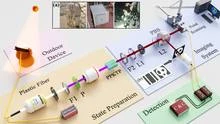
Sunlight collected by a Fresnel lens and passed through 20 meters of plastic fiber had a power of just 3 microwatts, a million times less than a typical laser pointer. That was enough to generate photon pairs correlated in position inside a nonlinear crystal. One photon from each pair passed through the object, the second was scanned by a detector, and coincidences built up the image.