A Laser the Size of an Organelle express
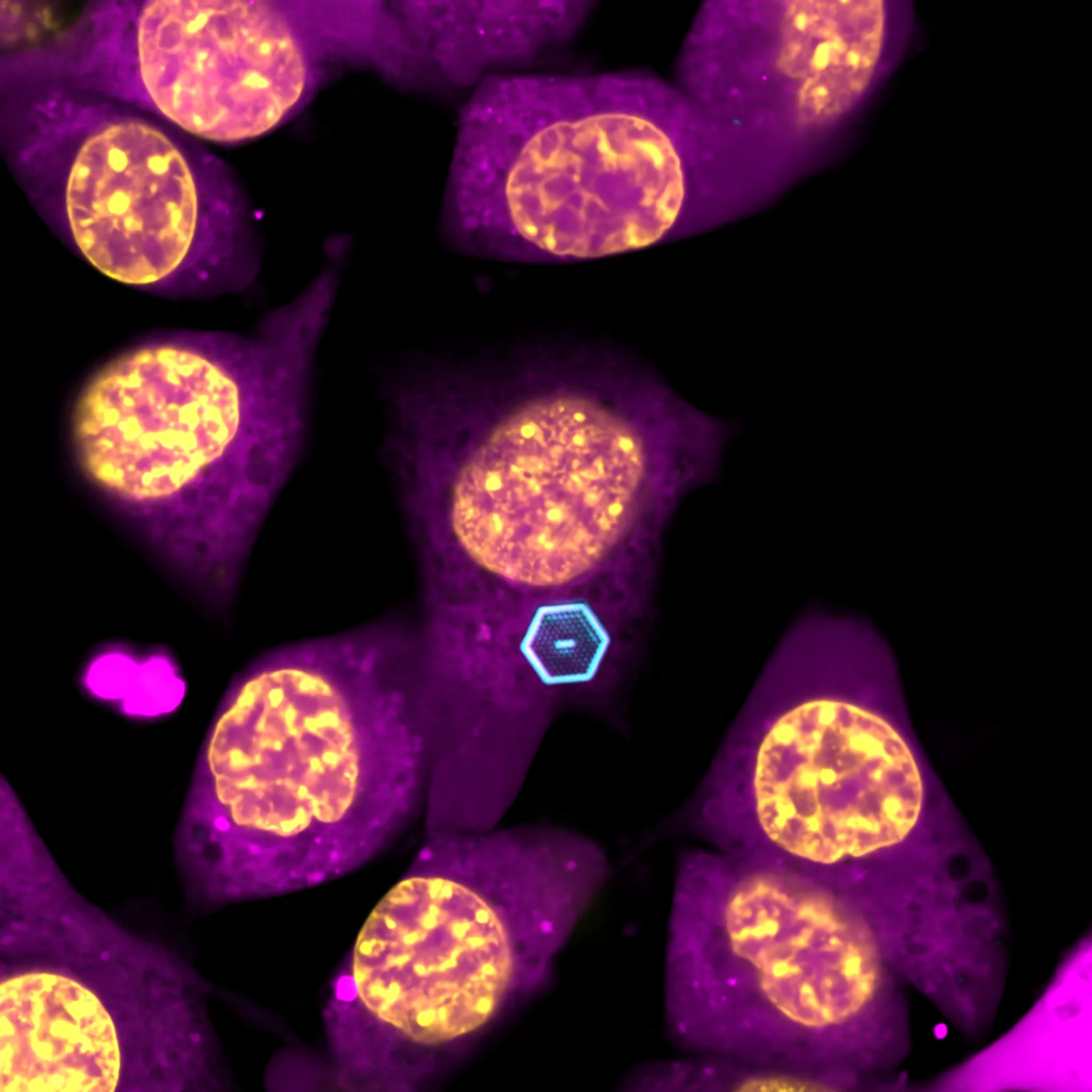
You can trap light in a cage smaller than a speck of dust. Photonic crystals are lattices that stop light from scattering and force it to run in circles. Previously, such structures were grown on a bulky substrate, making them too large for living cells. Now researchers have found the limit: how many rows of the lattice are needed for the laser to work, and they made particles that detach from the substrate and float freely.
Each particle is a hexagon with a side shorter than the thickness of a human hair. The active zone is just 30 square micrometers, like a square with a side of 5.5 microns. For comparison, a human red blood cell is about 7 microns in diameter. The particles are produced in batches of thousands, then carefully detached and introduced into living cells. Inside the cell, the laser keeps shining.
The scientists tuned the laser to emit in the near-infrared range: this light passes through biological tissue with almost no loss. The light confinement in the particle is ten times stronger than in similar devices that use the whispering-gallery effect (where light runs along the inner wall of a sphere, like sound along the dome of a cathedral). Such a tiny volume is comparable to the size of a mitochondrion or lysosome inside a cell.
In the future, chemical or plasmonic sensors could be placed on the laser's surface. Then the particle would become a sensor that reports what is happening inside a living cell — without dyes or genetic modifications. This miniature platform could also be useful for optical and quantum measurements in biology and chemistry.
The volume of light in such a laser is roughly equal to the volume of a single mitochondrion, the organelle that supplies the cell with energy.
In Michael Crichton's novel The Andromeda Strain, sensors inside the body transmit information about the organism's state, such laser particles could become a real prototype.