A Thermometer That Changes Color express
A piece of material glows blue. Heat it up, and the glow turns green, as if someone flipped a switch at a traffic light. That's how the new luminescent thermometer described in the paper works.
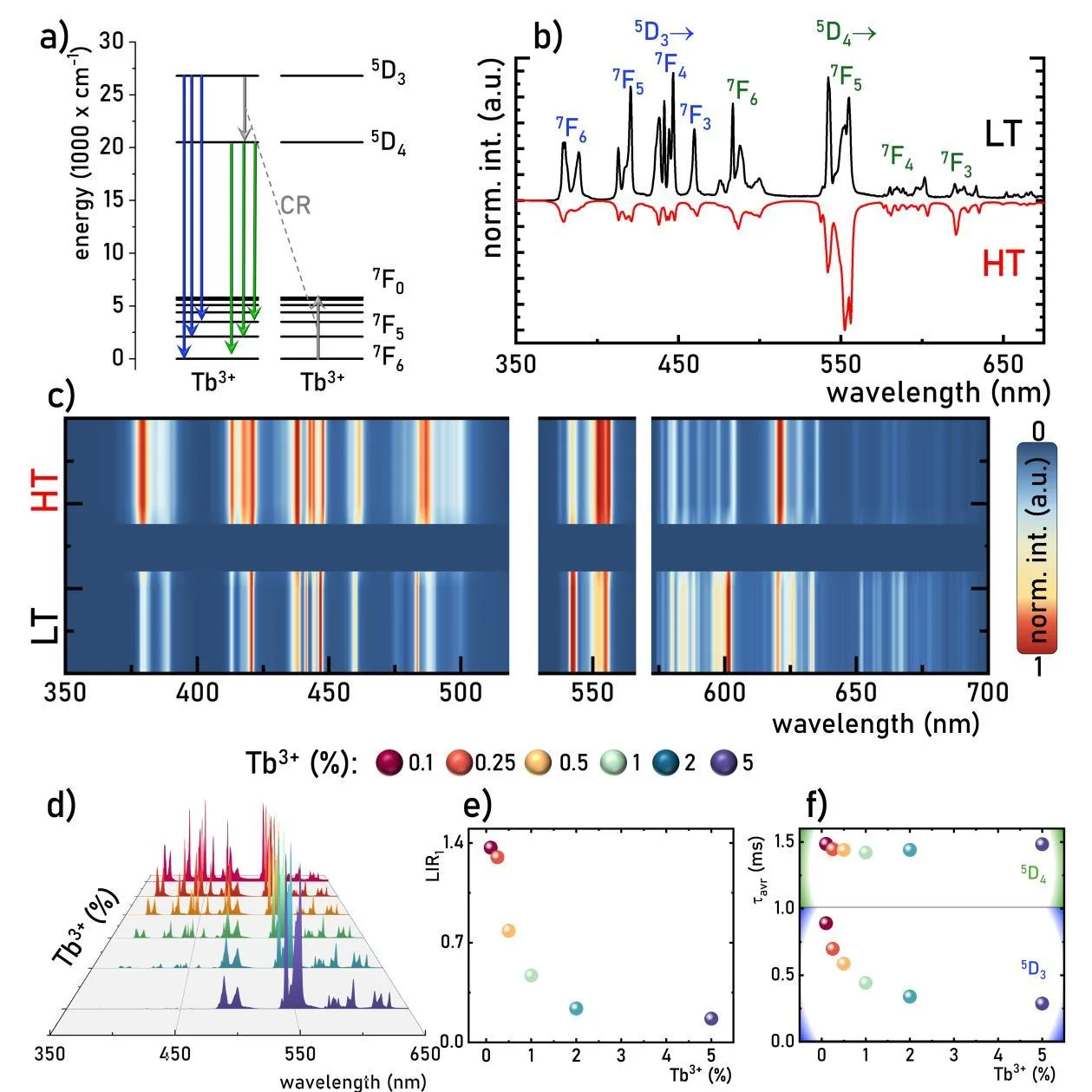
Inside the material are terbium ions — a rare-earth metal that knows how to shine. At room temperature, they emit blue light. But when heated above about 27 °C, the crystal lattice of the material slightly rearranges. The terbium ions find themselves in new positions, and a process kicks in that quenches the blue glow and switches on the green.
This material could serve as a simple, visual temperature sensor. For instance, coat a part that must not overheat and watch its color. Or capture a thermal map with an ordinary digital camera by separating the blue and green channels — no expensive infrared equipment needed.
A blue light that turns green with warmth — a simple way to see temperature with your own eyes.
Original abstract
as written by the authors arXiv:2601.13009
The development of visual luminescent thermometers capable of exhibiting pronounced color changes in response to temperature variations requires the rational design of phosphors with high spectrally selective thermal sensitivity. In this work, we present a strategy based on phase-transition-induced activation of cross-relaxation processes in LiYO2:Tb3+. The monoclinic-to-tetragonal structural phase transition modifies the point symmetry of Tb3+ ions in the host lattice, enhances the Stark effect, and enables energetic resonance required for efficient cross relaxation. Consequently, emission originating from the 5D3 excited state is rapidly quenched relative to that from the 5D4 level above approximately 300 K, resulting in a distinct temperature-dependent color change of the emitted light from blue to green. This mechanism yields exceptionally high chromaticity-coordinate-based sensitivities, reaching SRx,max = 0.40% K-1 and SRy,max=0.72% K-1 at 410 K. Furthermore, phase-transition-driven modifications of the Tb3+ emission spectral profile enable the realization of a multimode luminescent thermometer with a maximum relative sensitivity of SRmax=13% K-1. The practical applicability of this system is demonstrated through an ON-OFF luminescent thermal switch and fully filter-free, dynamic two-dimensional thermal imaging using the blue and green channels of a standard digital camera, enabling intuitive visualization, remote readout, and temperature mapping under dynamic conditions.
Terbium is named after the village of Ytterby in Sweden, where the mineral containing this element was found. Three other rare-earth metals were also discovered there: yttrium, erbium, and ytterbium.