Proteins bend the membrane the way a spoon bends the film on milk express
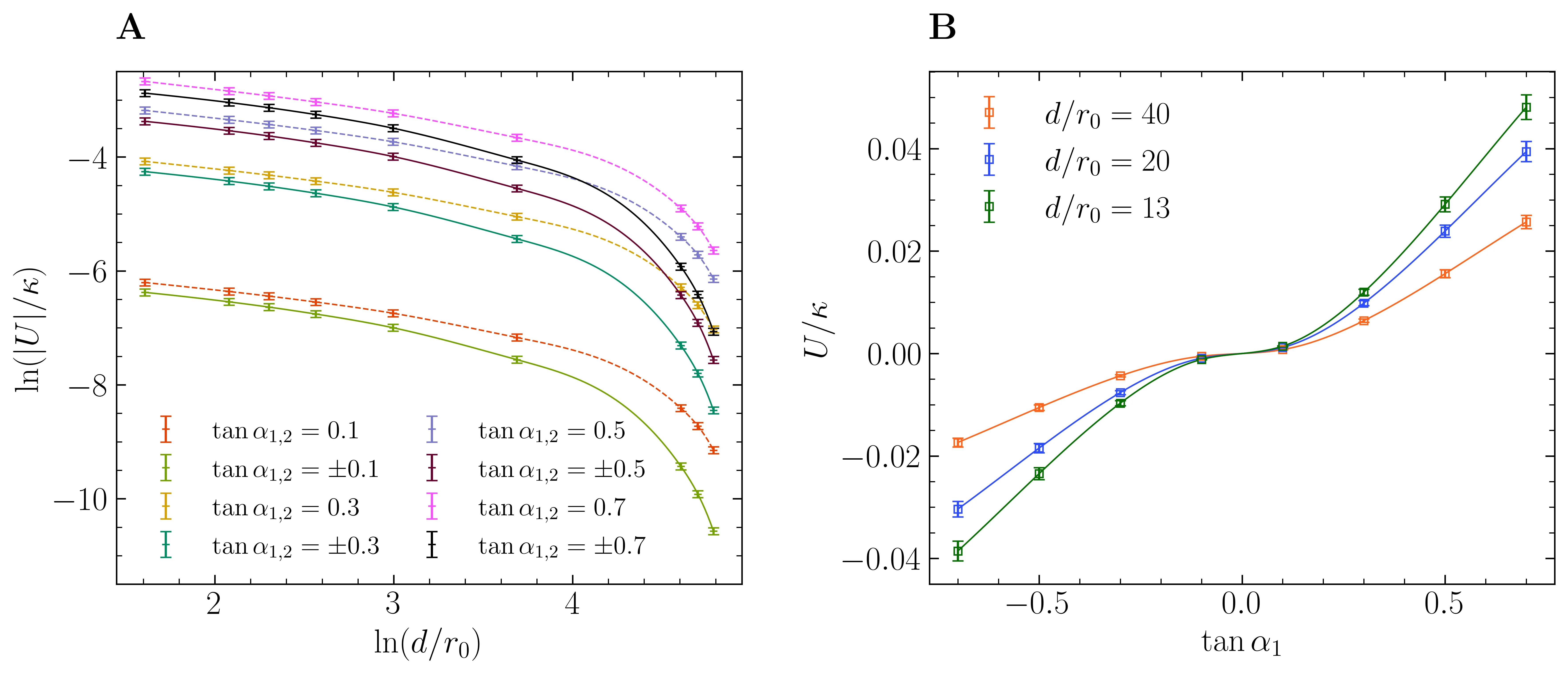
The membrane of a living cell is not a rigid shell but a pliable film with thousands of proteins embedded in it, like raisins in dough. When a protein changes shape or the cell moves, the film bends: sometimes barely noticeable, like the surface of water when a speck of dust falls on it, and sometimes strongly, like a sheet when you stretch your legs under it. Until now, calculations described only weak bends, but in a real cell, bends can be deep: during division, particle uptake, or formation of transport vesicles. The authors of the new work have for the first time tackled strong bends and found something unexpected.
They used a computer model where the membrane and proteins are divided into many small elements, like a mosaic. It turned out that the force with which the bent membrane pulls a protein up or down is not monotonic: it first increases, then decreases. This is like stretching a rubber band with a bead glued to it — the farther you pull the bead, the stronger the band resists, but at some point the band slips out from under your fingers, and the force drops. Moreover, this pattern does not depend on the protein's shape — whether it's a cone or a cylinder. For two proteins next to each other, the calculation showed: if both are tilted in the same direction, they repel; if in opposite directions, they attract. This resembles the behavior of electric charges, except here the 'charge' is the protein's tilt.
Such calculations help understand how proteins cluster on the cell surface, how the cell sorts cargo and sends it to the right compartments. All of this is the basis of life, but until now we have only seen weak shadows of these processes. Now that strong bends are calculated, the picture becomes three-dimensional.
Original abstract
as written by the authors arXiv:2601.15477
Biological membranes are dynamic surfaces whose shape and function are critically influenced by protein inclusions (PIs). While membrane deformations induced by PIs have been extensively studied in the small-deformation regime, a variety of processes involves strong membrane deformations. We investigate the interaction between lipid membranes and PIs in the large deformation (LD) regime, with the finite-element method. We develop an approximate analytical solution that captures key features of the LD regime. We show that the force exerted by the membrane on a PI displays a non-monotonic behavior with respect to the PI vertical displacement. The qualitative features of this force appear to be independent of the protein geometry. For two interacting PIs, the membrane-mediated potential exhibits sub-power-law decay with inter-protein distance, reflecting the complex nature of the elastic medium. The interaction potential shows that conical PIs with identical and opposite orientations repel and attract, respectively, confirming the analogy between PI orientation and electric charge, in the LD regime. In the presence of membrane flows, we identify a characteristic velocity that separates two regimes in which bending rigidity and viscous effects dominate, respectively, implying the onset of flow-induced deformations above such velocity threshold. Overall, our results provide quantitative predictions for membrane-protein systems in biologically relevant scenarios involving LDs, with implications for protein sorting, clustering, and membrane trafficking.
The force with which the membrane pulls on a protein can first increase and then decrease, as if the film 'gets tired' of holding the protein under strong bending.