Graphene Sandwich Accelerates Electrons express
Graphene is a carbon sheet just one atom thick, a fantastic conductor. But its surface is crinkly, like a wrinkled tablecloth that hasn't been ironed. Scientists built a 'sandwich': two of these sheets pressed together with a non-conductive spacer in between. They iron out each other's folds, like two halves of a sandwich making the surface perfectly even. Inside this atomically flat sandwich, electrons glide without a hitch.
But the real magic: in this ultrapure structure, electrons start to 'divide'. Their collective behavior creates particles with just one-third of the usual charge. It's not a trick: it's a key to the deep nature of matter and a step toward tomorrow's electronics.
Original abstract
as written by the authors arXiv:2601.16015
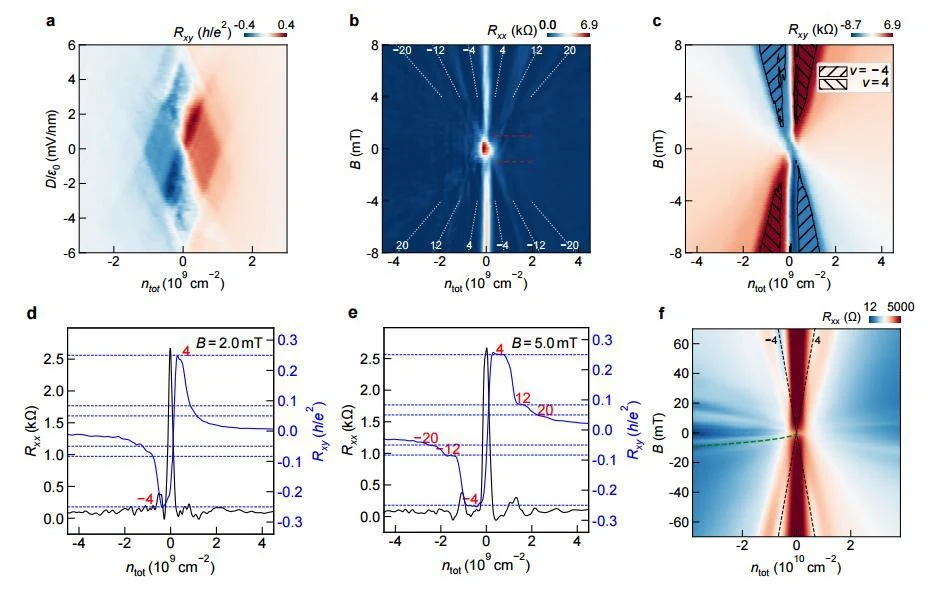
Graphene enables precise carrier-density control via gating, making it an ideal platform for studying electronic interactions. However, sample inhomogeneities often limit access to the low-density regimes where these interactions dominate. Enhancing carrier mobility is therefore crucial for exploring fundamental properties and developing device applications. Here, we demonstrate a significant reduction in external inhomogeneity using a double-layer graphene architecture separated by an ultra-thin hexagonal boron nitride layer. Mutual screening between the layers reduces scattering from random Coulomb potentials, resulting in a quantum mobility exceeding. Shubnikov de-Haas oscillations emerge at magnetic fields below 1 mT, while integer quantum Hall features are observed at 0.002T. Furthermore, we identify a fractional quantum Hall plateau at a filling factor of at 2T. These results demonstrate the platform's suitability for investigating strongly correlated electronic phases in graphene-based heterostructures.
Electrons in the graphene sandwich behave as if each split into three parts: this quantum phenomenon opens the door to particles with exotic properties.