Rui Wang

7 articles · 30 co-authors · latest: 2026-07-25
97 citations · h-index 5 · 8 papersData: Semantic Scholar

We have retold 7 papers by this author. most often about: exciton, excitonic_insulator, graphene. 30 co-authors across our retellings.

Links in the knowledge graph
Strongly Correlated2026-01-031 minarXiv:2601.01096express
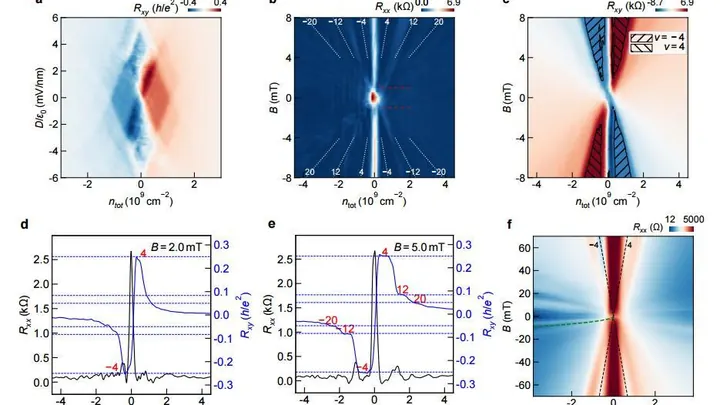
How Pairs Break in an Excitonic Insulator
Dancers hold hands and move in perfect sync. In an excitonic insulator, electrons and holes form bound pairs that condense into a single quantum state, like dance partners who never miss a step. But what happens when one of them stumbles?
Mesoscale2026-01-221 minarXiv:2601.16015express
Graphene Sandwich Accelerates Electrons
Graphene is a carbon sheet just one atom thick, a fantastic conductor. But its surface is crinkly, like a wrinkled tablecloth that hasn't been ironed. Scientists built a 'sandwich': two of these sheets pressed together with a non-conductive spacer in between. They iron out each other's folds, like two halves of a sandwich making the surface perfectly even.
Quantum Physics2026-03-282 minarXiv:2603.27231express
A Quantum Remote That Barely Generates Heat
A quantum computer is like an orchestra where each musician plays their part, but if the conductor waves the baton a bit too hard, the delicate instruments go out of tune from excess heat. Controlling qubits at 10 mK (300 times colder than your freezer) is like conducting an orchestra in an ice-cold hall where even a breath can ruin everything.
Quantum Physics2026-07-072 minarXiv:2607.06404express
Quantum Code, Carbon Copy
A quantum computer is like an orchestra without a conductor: each qubit is a musician, and the slightest slip throws off the entire symphony. To keep the music from turning into cacophony, quantum error-correcting codes were invented.
Signal Processing2026-07-162 minarXiv:2607.14701express
Magnetic Bridge Through the Earth: Relay Speeds Up Underground Communication
Radio waves, high-frequency electromagnetic oscillations, are powerless against the Earth's bulk: they attenuate, being almost completely absorbed within a couple of meters of depth. But a low-frequency magnetic field, governed by the equations of electrodynamics, behaves differently.
Nuclear Theory2026-07-212 minarXiv:2607.19220express
How Quarks Help Neutron Stars Avoid Collapsing
A handful of sand in your fist: the grains press against each other, and your hand can't squeeze any further. Ordinary matter behaves similarly. But in a neutron star, compression is billions of times stronger — atoms are crushed, electrons are squeezed into protons, and nearly all space is filled with neutrons.
Mesoscale2026-07-252 minarXiv:2607.22976express
Traveling Waves in a Quantum Ring
The ring was assembled from several different segments. In each segment, particles behave in their own way, like musicians playing different notes. The most interesting part begins at the junctions: here particles often get stuck, like an echo trapped in a narrow corridor. This phenomenon is called the skin effect — particles pile up at the boundary, like a crowd at an exit. But the authors noticed something new.