Popular

Graphene Sandwich Accelerates Electrons ⚡ экспресс

Original: "Quantum Hall Effect at 0.002T"
arXiv:2601.16015 · 2026-01-22 · CC BY 4.0 · ⏱ 1 min · Mesoscale Quantum Physics
Two graphene sheets with an insulating layer in between smooth out each other's atomic imperfections, letting electrons zip through with barely any resistance.
Abstract

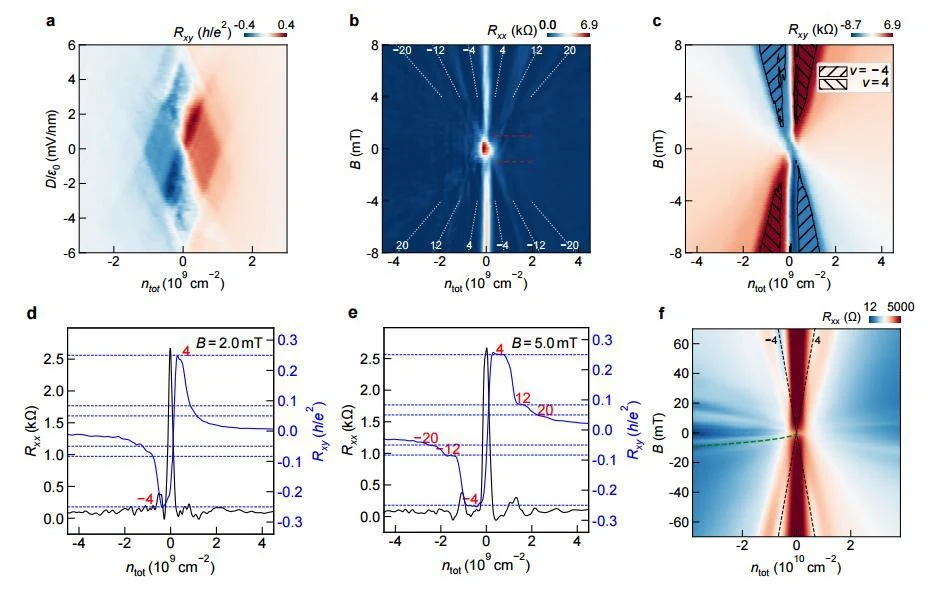
In graphene, you can precisely control electron density, but inhomogeneities hinder studying their interactions at low concentrations. By using two graphene layers with an ultra-thin insulating layer of boron nitride, scientists achieved mutual screening of charge fluctuations, dramatically boosting carrier mobility. Quantum oscillations appeared in magnetic fields weaker than 1 mT, and the integer and fractional quantum Hall effects showed up at record-low fields (0.002 T). It's like two thin blankets layered on top of each other to smooth out wrinkles, letting you see the finest details. This result opens the door to exploring exotic quantum states.

Links in the knowledge graph 1

📄 Showing the "Simple" version — "Popular" is not ready yet. Add it to favorites to help prioritize it.

Graphene is a carbon sheet just one atom thick, a fantastic conductor. But its surface is crinkly, like a wrinkled tablecloth that hasn't been ironed. Scientists built a 'sandwich': two of these sheets pressed together with a non-conductive spacer in between. They iron out each other's folds—like two halves of a sandwich making the surface perfectly even. Inside this atomically flat sandwich, electrons glide without a hitch.

Even a weak magnetic field (think fridge magnet) organizes them into neat lines—resistance changes in sharp, step-like jumps. That's the quantum Hall effect: the particles act like a well-drilled team.

But the real magic: in this ultrapure structure, electrons start to 'divide'. Their collective behavior creates particles with just one-third of the usual charge. It's not a trick—it's a key to the deep nature of matter and a step toward tomorrow's electronics.

🎯 Electrons in the graphene sandwich behave as if each split into three parts—this quantum phenomenon opens the door to particles with exotic properties.

Scientists
Fred HoyleMargaret BurbidgeWilliam Lawrence Bragg
Tags
carbon
Laws
triple-alpha process (Hoyle process)
Original: arXiv:2601.16015 · CC BY 4.0 · bridge42worlds