A Comb for Magnetic Waves express
Waves in magnets resemble the vibrations of a string: if you pluck a string, it sounds a single note, but with a strong pluck, overtones appear — sounds at multiple frequencies. In magnonics, spin waves play the role of the string, and magnonic frequency combs play the role of overtones: a series of lines spaced at equal intervals, like the teeth of a comb.
So far, such a comb has been produced via three-magnon scattering: three waves collide and generate new frequencies. The process is finicky: it requires high power and strict matching of momenta and energies, like in billiards where balls must strike at an exact angle. The authors of the new work propose a different route — stimulated generation, where the comb emerges at lower cost and can be tuned.
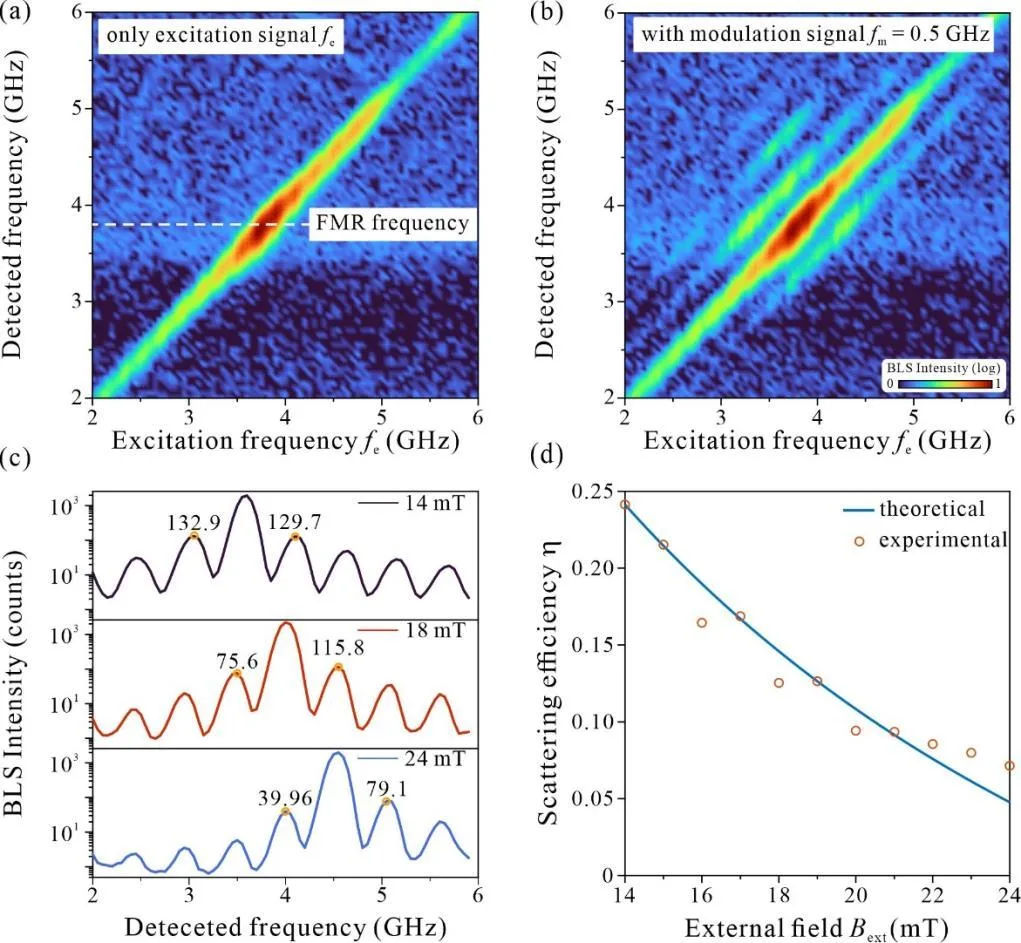
The method was verified in three ways: analytical calculations, computer simulations of micromagnetics, and a live experiment. All three confirm that the comb can be created controllably. This is an important step toward embedding magnonic combs in real devices — from sensors to signal-processing circuits, where waves of magnetization run instead of electricity.
Original abstract
as written by the authors arXiv:2601.21370
Magnonic frequency combs, characterized by a series of discrete frequency lines, have emerged as a promising frontier in magnon spintronics, with potential applications in advanced information processing and sensing technologies. Although the three-magnon scattering process is widely recognized as a fundamental mechanism for generating these combs, its experimental realization has remained challenging due to the high threshold power and strict conservation of momentum and energy. In this work, we propose a novel mechanism for the stimulated generation of magnonic frequency combs that overcomes these limitations. Our approach offers precise and efficient control over key comb properties, including spacing between spectral lines and the number of lines, marking a significant advancement in the field. We substantiate this mechanism through a robust combination of theoretical modeling, micromagnetic simulations, and experimental validation. This study not only demonstrates the feasibility of our method but also opens new pathways for integrating magnonic frequency combs into practical spintronic devices.
Magnons are quanta of spin waves, and they can carry information without moving electrons, and thus with almost no heating.