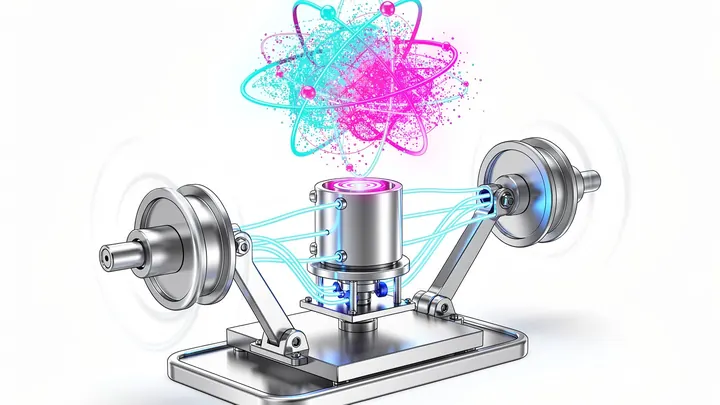
Quantum magnetic sensing refers to a class of techniques that exploit quantum mechanical properties of atoms, defects in crystals, or other quantum systems to measure magnetic fields with extraordinary precision. These sensors can detect fields far weaker than those accessible to classical magnetometers, reaching sensitivities at the level of individual electron spins or even nuclear spins. This capability opens up new windows into fields ranging from fundamental physics to medical imaging and materials science.
History
The development of quantum magnetometers began in the 1960s with superconducting quantum interference devices (SQUIDs), but the field expanded dramatically with the advent of atomic magnetometers in the 1990s and the use of NV centers in diamond in the 2000s.
How it works
The core principle is that quantum systems, such as the nitrogen-vacancy (NV) centers in diamond or cold atoms, have energy levels that shift in the presence of a magnetic field (the Zeeman effect). By preparing the system in a quantum superposition state and measuring how its quantum phase evolves, one can infer the magnetic field strength with high precision. Techniques like continuous wave or pulsed microwave spectroscopy, as well as quantum error correction schemes, are used to enhance sensitivity and suppress noise. For example, in NV centers, the spin state of the defect is read out optically, allowing for high spatial resolution and operation at room temperature.
In practice
Quantum magnetic sensors are used in brain imaging (magnetoencephalography), geological prospecting, navigation, and in fundamental physics searches for exotic particles like axions or dark matter.
Fun fact
A quantum magnetometer using NV centers in diamond can measure the magnetic field of a single neuron firing in a living brain, a feat impossible with conventional sensors.
Imagine a ladder whose rungs are tiny magnets. If neighboring magnets point in opposite directions, the ladder is "calm." But if you make them all point the same way, the whole structure becomes magnetized and "stubborn."
Scientists built such a ladder from germanium atoms — a semiconductor used to make transistors.
A radio receiver the size of a palm can measure signal power more accurately than expensive lab benches. Inside, there are no coils or antennas, just a glass head and a cloud of rubidium atoms cooled to near absolute zero.
When a building collapses, steel rebar turns into a chaotic magnetic compass. Entropy, a measure of disorder, increases, but it's this very disorder that points to voids where people might be.
A tiny defect in a boron nitride crystal behaves like a microscopic indicator bulb. Shine light on it, and it glows, with the shade shifting with temperature: the warmer it gets, the redder the glow.
Ordinary magnetic sensors lose sensitivity as they shrink. But scientists turned a tiny diamond into a light-based compass. Unlike jewelry diamonds, what matters here isn't purity but artificially created defects — these are what turn the crystal into a compass.
Trying to count people in a dark room by the sound of their breathing hits a wall of background noise — individual breaths are inaudible. Scientists working with quantum spins in solids face a similar challenge. Each spin (the electron's magnetic moment) has its own "voice," but it is drowned out by the technical noise of the instruments.
Magnetic particles are attached to the surface of the diamond by DNA strands, like puppets on strings. They constantly dance under the thermal motion of the liquid molecules. The liquid's viscosity sets the pace: in honey, the particles barely tremble; in alcohol, they dance quickly.
Earth's magnetic field, the one that swings a compass needle, is strong. The new sensor picks up fields a hundred thousand times weaker, and it needs neither liquid helium nor bulky setups. Everything fits on a circuit board, just like the one inside your smartphone.
A quantum magnetometer based on hydrogen nuclei works like noise-canceling headphones. It alternately "listens" to the field in two different ways: the noise is the same for both, but the desired signal is different. By subtracting one from the other, the device extracts the signal, reducing interference by more than 1000 times.
A power transistor made of silicon carbide operates under voltages thousands of times higher than what comes out of a wall outlet. If the field inside it becomes uneven, the device burns out. Previously, this field was invisible: it is too strong for ordinary sensors, and the device must remain under voltage.
In laboratories where atoms are cooled to near absolute zero, even a tiny change in the magnetic field throws off all the settings. Conventional sensors, Hall plates or coils with ferrite cores, sit a few centimeters away from the vacuum chamber because they themselves create interference.
A fridge magnet attracts a paperclip: we can feel that field with our hands. Now shrink that field by a billion times. Atoms inside our bodies emit such weak signals, and they are very hard to catch.
Scientists built the sensor from special molecules that themselves behave like tiny magnets.
A tiny diamond hangs in the air, held by an electric field like a speck of dust in a beam of light. Hidden inside are defects — places where a carbon atom is replaced by nitrogen, with a vacancy nearby. These defects behave like little magnets that can be flipped with laser and microwaves.
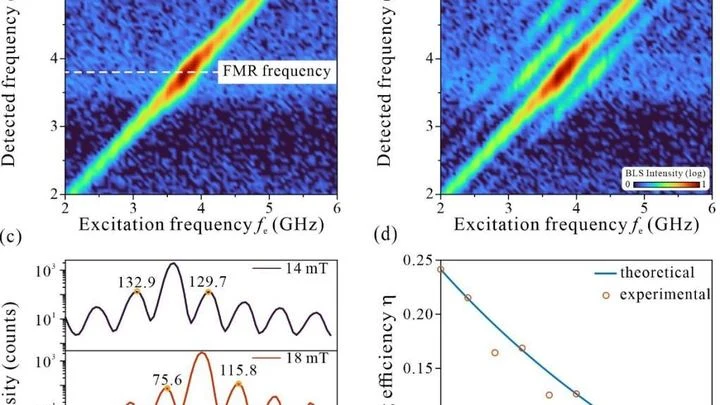
Waves in magnets resemble the vibrations of a string: if you pluck a string, it sounds a single note, but with a strong pluck, overtones appear — sounds at multiple frequencies.
A particle trapped in a light field behaves like a ball on a spring: give it a nudge and it starts to oscillate. If you suddenly stiffen the spring, the ball freezes for an instant at the very bottom, where its position is known most precisely. That's exactly the moment physicists exploited to turn a nanoparticle into an ultrasensitive accelerometer.
A tiny defect in diamond is like a microscopic ear, able to pick up the magnetic 'breath' of the heart. Such sensors work at room temperature and are no bigger than a grain of sand.
The magnetic field you want to measure is like a melody played in a noisy hall. A quantum sensor is a microphone that can pick up the faintest notes, but it also hears more than just the music: rustles, creaks, the breathing of neighbors. All of that mixes into the signal and spoils the recording.
In a dark room, a tiny diamond glows red when a green laser hits it. This glow isn't just for show: it's a signal: its brightness changes when a magnetic field is nearby. Inside the diamond sit defects — nitrogen atoms with an empty neighboring site. They act like sensitive needles that rotate under the influence of a magnet.
The tip of a tunneling microscope hovers above a surface at a distance smaller than the diameter of an atom. Usually, it feels out the topography like a finger reading a page of Braille. Now, that same tip has learned to listen to how a membrane the size of a fingernail trembles.
Inside a giant spectrometer in Karlsruhe, shaped like a huge metal barrel, scientists are catching particles that are nearly impossible to catch. Neutrinos are the ghosts of the microcosm: every second, trillions of these particles fly through your body, and you don't even notice. But they do have mass, and scientists want to measure it.
A chain of atoms on a light-guiding chip behaves like a row of pendulums on a shared support: swinging in opposite directions, they barely transfer energy to the air and freeze for a long time.
In diamond, you can embed a “spy.” Simply replace a carbon atom with nitrogen: you get a defect that responds to magnetic fields and sends a light signal.
Two great theories describe reality: one — how massive bodies cause curvature of space, the other — the Standard Model — governs elementary particles. Reconciling them remains elusive, like trying to describe an ocean storm in the language of a diamond lattice.
Among the fundamental symmetries of nature, mirror parity holds a special place. The Standard Model already knows one violation of it, in the weak interaction, but hypothetical long-range forces that don't conserve left and right could reveal a lot about dark matter.