Gas rivers feed a future star express
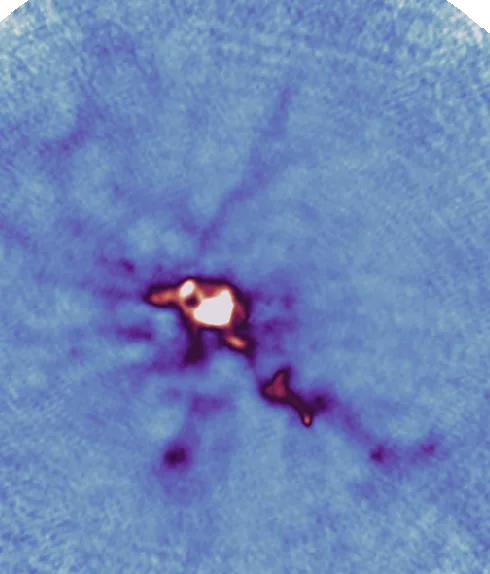
In the dark cloud G318.049+00.086, where no star has yet formed, dust and gas have arranged themselves into four long filaments. They converge into a dense central hub, like four rivers emptying into a lake. Gas flows along these filaments toward the center: the flow speed reaches 10–20 kilometers per second per parsec of length. This means that more than a thousand solar masses of material arrive at the hub every million years.
Inside the hub, astronomers found clumps — future stars. Most of them have emission profiles skewed toward the blue. Such a skew arises when the outer layers of a clump are falling inward, and we see only the near half. So these clumps are collapsing under their own gravity. But a few clumps showed a red skew: their gas is expanding instead.
This picture resembles a race where the winner is not the strongest but the one in the right place. Clumps on the filaments lose material, while the hub at the center accumulates it and will likely give birth to one or more massive stars. That's how giants are born — stars that later illuminate entire clusters.
The infall speed in this cloud is such that in a million years, a mass equal to a thousand Suns flows into the center. For comparison, our Sun will lose only a tiny fraction of its material over its entire lifetime.