Laser Draws Tiny Channels for Water express
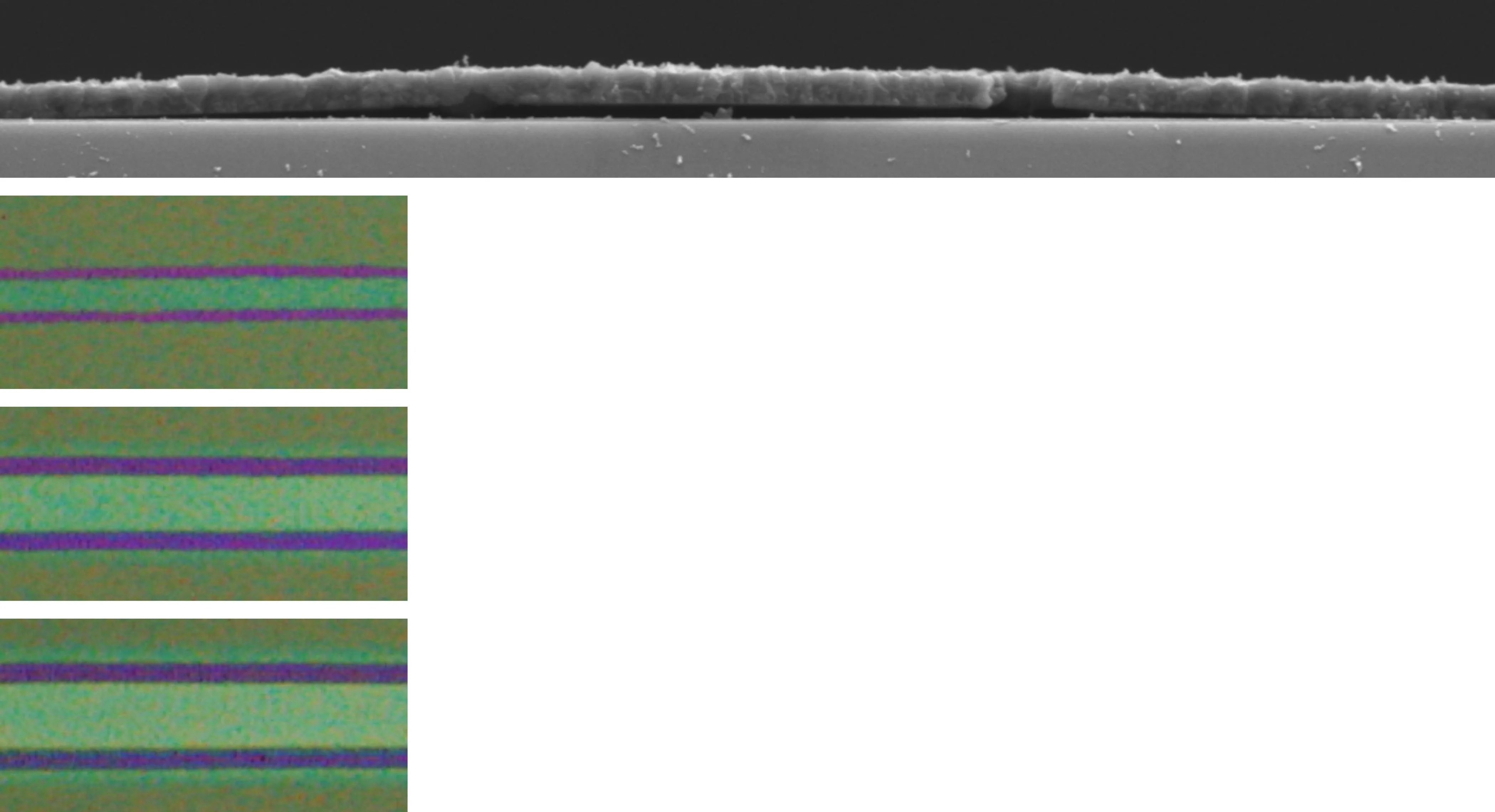
A laser beam passes through glass and touches a thin diamond film. At the point of contact, the film turns into a narrow strip that lifts slightly. We place a second strip next to it, and between them remains an empty corridor. That's the channel: its width can be fifty times its height, like a sheet of paper lying on a table.
Water flows into the channel by itself, like into blotting paper. No pump needed — the liquid creeps along the slit thanks to attraction to the walls. The channel doesn't break down even when completely filled. Through the transparent glass, you can see water moving inside: light reflects differently from filled and empty sections.
This method is like drawing with a laser on glass. Two lines, and a channel is ready between them. No complicated assembly, no gluing. This paves the way to cheap and reliable devices where liquids flow through ultra-thin flat slits.
Original abstract
as written by the authors arXiv:2602.06316
Nanochannels with high width-to-height aspect ratios are desirable for many applications, particularly those requiring optical access, but remain challenging to fabricate. In this work, the direct laser writing of such channels between diamond films and glass substrates is introduced. As previously reported, laser light can transform a portion of diamond film into a nanostrip. The strip induces delamination of the surrounding film, causing the formation of two nanochannels with triangular cross-sections. Here, it is demonstrated that nanochannels with rectangular cross-sections and width-to-height aspect ratios exceeding fifty can form between pairs of nanostrips. With atomic force microscopy, the maximum strip spacing that produces these nanochannels is investigated, and it is demonstrated that the reflectance of the channels can be measured by microspectrophotometry. The microstructure of the nanochannels, including nanostrips, and processes that occur during laser writing are inferred from transmission electron microscopy and electron energy loss spectroscopy. By fabricating a nanofluidic device and using microspectrophotometry, it is found that the nanochannels fill with water through capillary action, are resistant to clogging, and are mechanically stable against water filling. A versatile platform for producing high-aspect-ratio nanochannels that are optically accessible and fluidically functional is presented, thereby expanding opportunities for advanced applications.
Water flows into such a channel by itself, without a pump, like into a dry sponge dipped in a puddle.