Laser Draws Tiny Channels for Water express
Original: "Direct laser writing of high aspect ratio nanochannels for nanofluidics"
arXiv:2602.06316 · 2026-02-06 · CC BY 4.0 · 1 min
A beam of light turns a diamond film into a pair of strips, and water flows between them on its own.

📄 Showing the "Simple" version — "Popular" is not ready yet. Add it to favorites to help prioritize it.

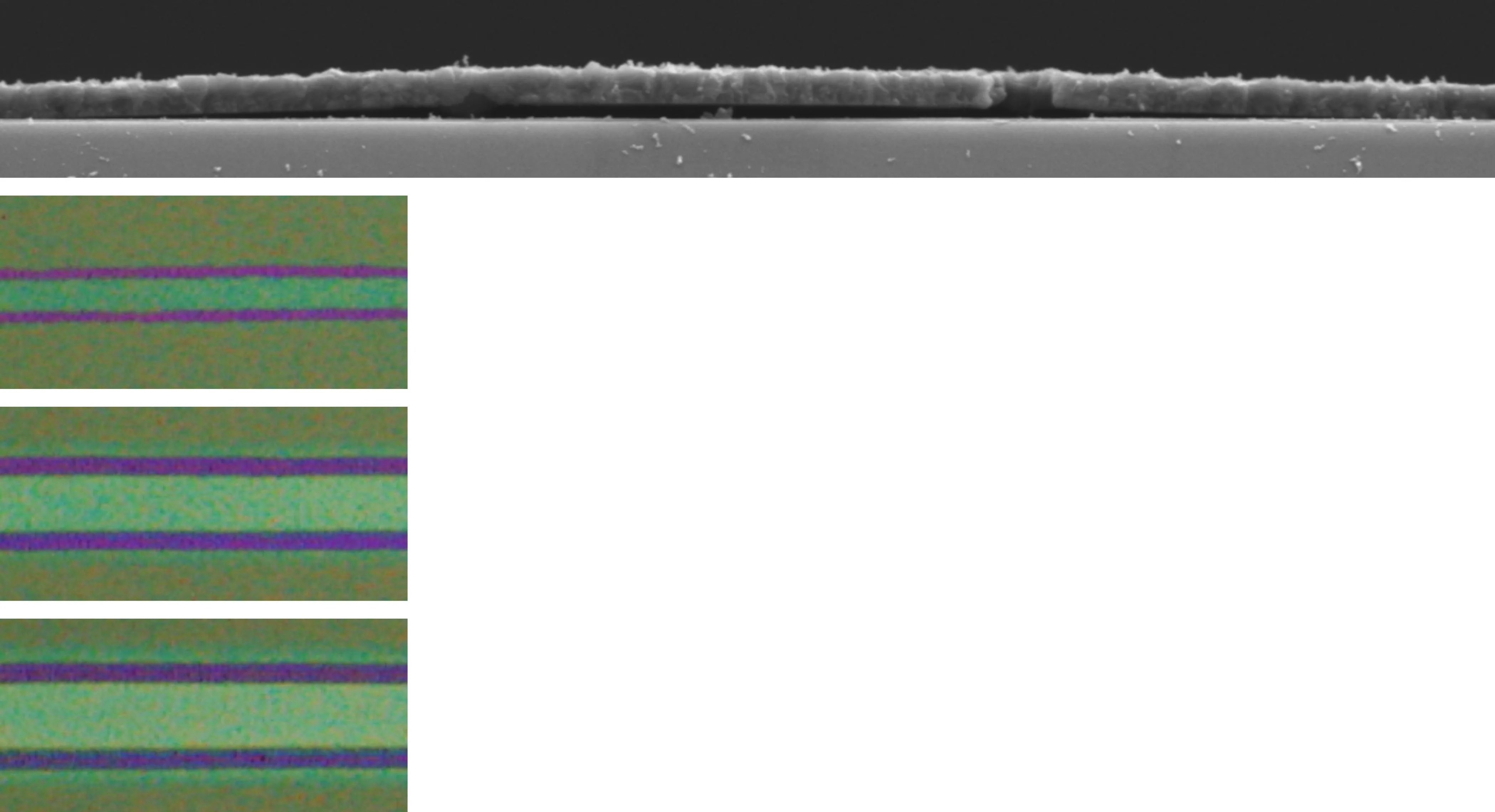
A laser beam passes through glass and touches a thin diamond film. At the point of contact, the film turns into a narrow strip that lifts slightly. We place a second strip next to it, and between them remains an empty corridor. That's the channel: its width can be fifty times its height, like a sheet of paper lying on a table.

Such a flat channel doesn't clog: dirt particles simply can't fit into a gap only tens of nanometers high — a thousand times thinner than a human hair.

Water flows into the channel by itself, like into blotting paper. No pump needed — the liquid creeps along the slit thanks to attraction to the walls. The channel doesn't break down even when completely filled. Through the transparent glass, you can see water moving inside: light reflects differently from filled and empty sections.

The diamond film isn't a luxury but protection: it's hard, chemically resistant, and transparent. So the channels can be used in optical devices and in experiments with very small volumes of liquid.

This method is like drawing with a laser on glass. Two lines, and a channel is ready between them. No complicated assembly, no gluing. This paves the way to cheap and reliable devices where liquids flow through ultra-thin flat slits.

Water flows into such a channel by itself, without a pump, like into a dry sponge dipped in a puddle.

Scientists
Daniel BernoulliLeonhard EulerArchimedesAlbert EinsteinCharles TownesDavid Wineland
Concepts
nanophotonic device nanostructure carbon nanotube aluminum nitride nanocrystal ion channel nanowire lithography mirror coating ultraviolet laser liquid crystal diamond anvil cell etching nanoelectronics laser lens silicon nitride nanomaterial electron microscopy gold nanoparticle