The Gaze's Signature: How Eyes and Hand Agree on Timing express
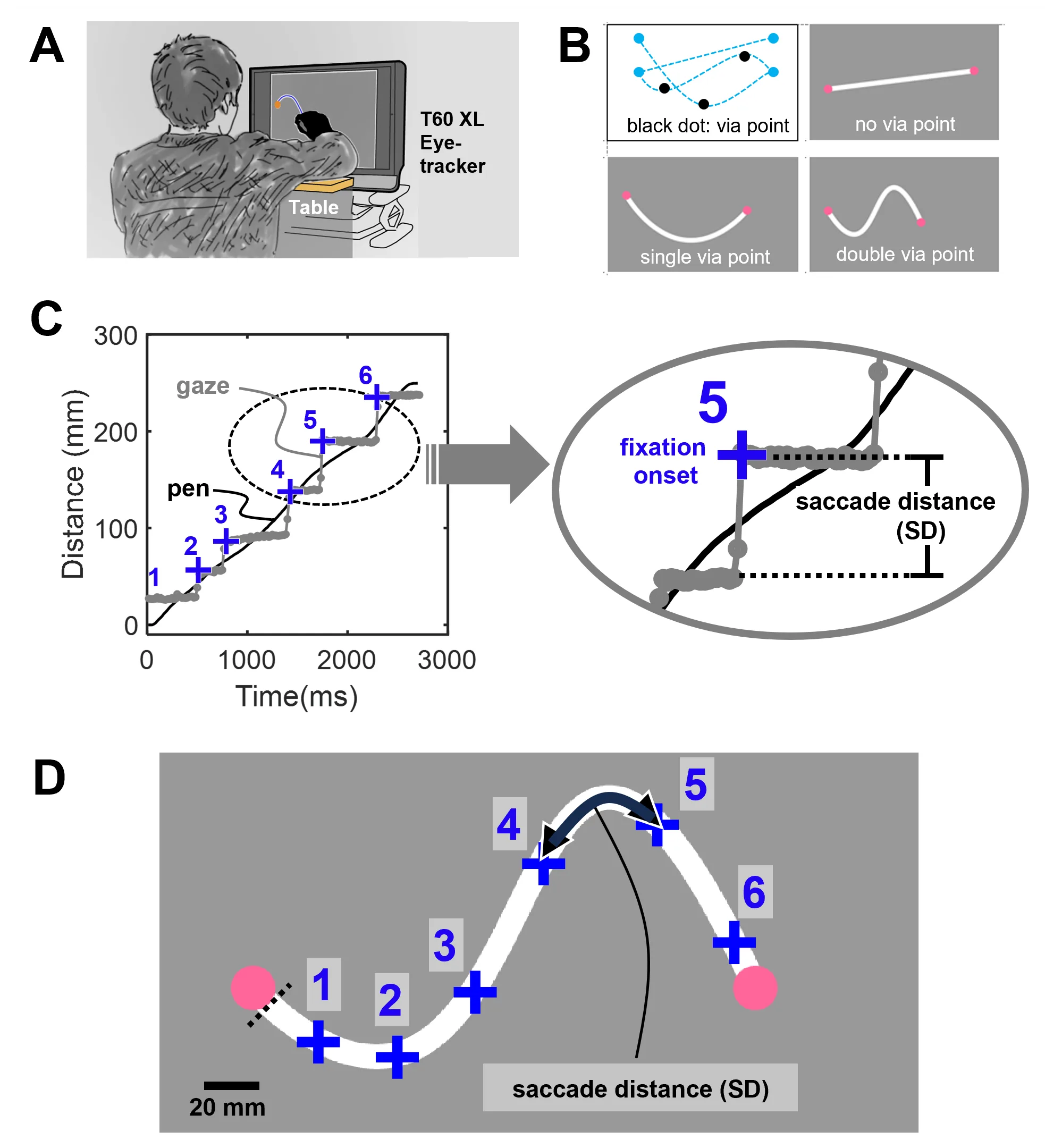
When the hand draws a line, the gaze almost always runs ahead, like a scout peeking around the corner before the column turns. But how far ahead? It turns out that each person has their own distance, and it does not change from attempt to attempt.
In the experiment, professional calligraphers and ordinary people traced a contour on a screen while instruments recorded eye and pen movements. In some, the gaze led the hand by 50 milliseconds; in others, by as much as 400. This prediction window is like a personal time zone: it is stable for each participant and coincides with the moment when the hand catches up with the gaze. The eye does not simply follow the hand; it positions itself in advance at the point where the hand will arrive with the required speed.
This means that different strategies lead to the same goal: some scan far ahead, others keep their gaze almost at the pen tip, but both can perform equally well. The brain does not seek a single correct way; it chooses the most economical one for the specific body: this is the principle of minimal intervention in motor control.
So the "gaze's signature" is not a mark of skill but a signature of the nervous system: each person has their own prediction rhythm, and it stays with them like a fingerprint.
Original abstract
as written by the authors arXiv:2602.07816
Human eye-hand coordination relies on internal forward models that predict future states and compensate for sensory delays. During line tracing, the gaze typically leads the hand through predictive saccades, yet the extent to which this predictive window reflects expertise or intrinsic individual traits remains unclear. In this study, I examined eye-hand coordination in professional calligraphers and non-experts performing a controlled line tracing task. The temporal coupling between saccade distance (SD) and pen speed (PS) revealed substantial interpersonal variability: SD-PS peak times ranged from approximately -50 to 400 ms, forming stable, participant-specific predictive windows that were consistent across trials. These predictive windows closely matched each individual's pen catch-up time, indicating that the oculomotor system stabilizes fixation in anticipation of the hand's future velocity rather than relying on reactive pursuit. Neither the spatial indices (mean gaze-pen distance, mean saccade distance) nor the temporal index (SD-PS peak time) differed between calligraphers and non-calligraphers, and none of these predictive parameters correlated with tracing accuracy. These findings suggest that diverse predictive strategies can achieve equivalent performance, consistent with the minimum intervention principle of optimal feedback control. Together, the results indicate that predictive timing in eye-hand coordination reflects a stable, idiosyncratic Predictive Protocol shaped by individual neuromotor constraints rather than by expertise or training history.
Each person has a stable personal gaze-lead interval, from 50 to 400 milliseconds, that does not change from attempt to attempt.