The Gaze's Signature: How Eyes and Hand Agree on Timing express
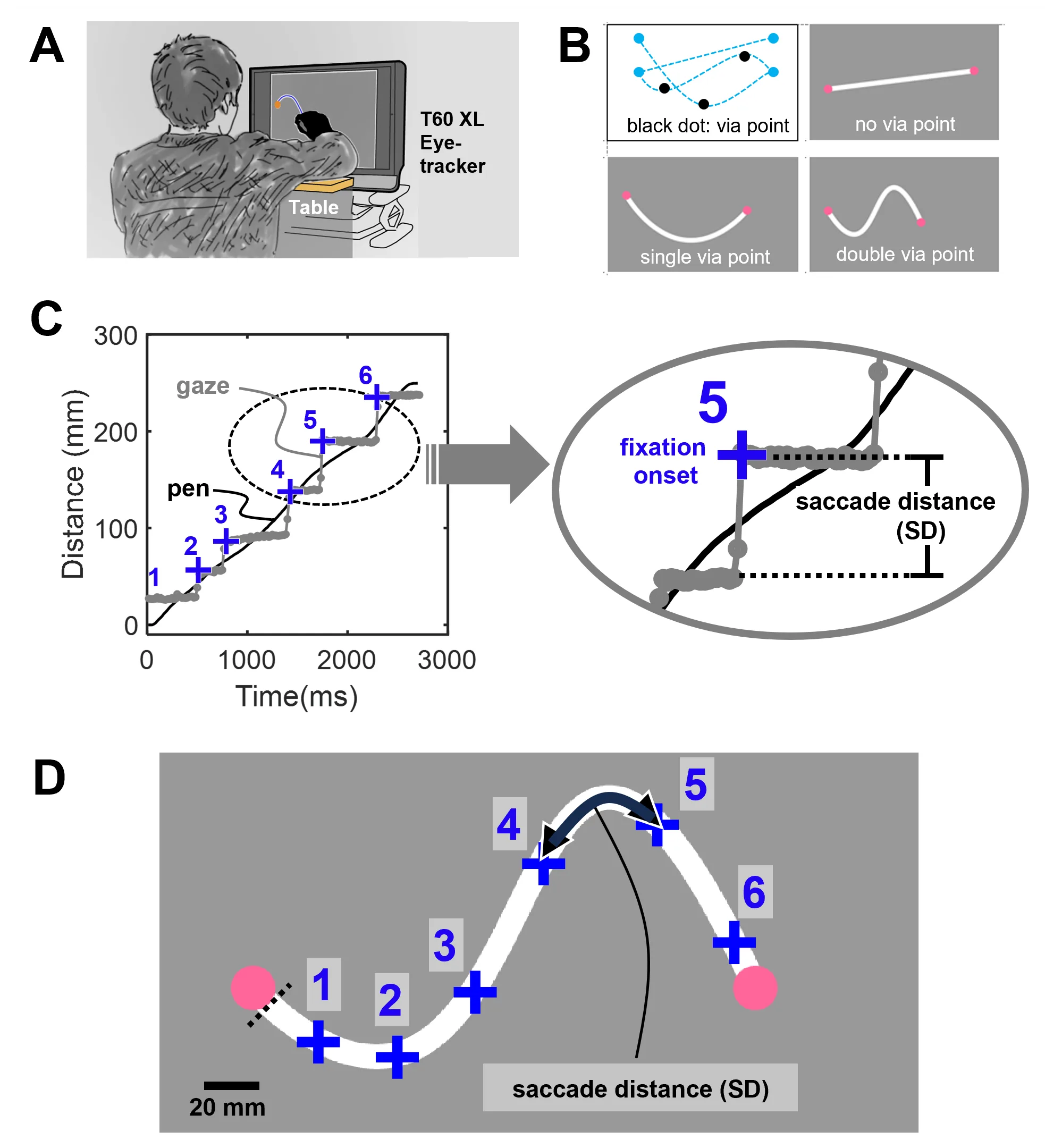
When the hand draws a line, the gaze almost always runs ahead, like a scout peeking around the corner before the column turns. But how far ahead? It turns out that each person has their own distance, and it does not change from attempt to attempt.
In the experiment, professional calligraphers and ordinary people traced a contour on a screen while instruments recorded eye and pen movements. In some, the gaze led the hand by 50 milliseconds; in others, by as much as 400. This prediction window is like a personal time zone: it is stable for each participant and coincides with the moment when the hand catches up with the gaze. The eye does not simply follow the hand; it positions itself in advance at the point where the hand will arrive with the required speed.
This means that different strategies lead to the same goal: some scan far ahead, others keep their gaze almost at the pen tip, but both can perform equally well. The brain does not seek a single correct way; it chooses the most economical one for the specific body: this is the principle of minimal intervention in motor control.
So the "gaze's signature" is not a mark of skill but a signature of the nervous system: each person has their own prediction rhythm, and it stays with them like a fingerprint.
Each person has a stable personal gaze-lead interval, from 50 to 400 milliseconds, that does not change from attempt to attempt.