Niobium Thin Films Sabotage Quantum Bits express
A quantum computer is like an orchestra where every musician must play in perfect harmony. If even one instrument is off-key, the melody falls apart. Superconducting qubits play the role of these musicians, and their "off-key" is the loss of quantum coherence. Scientists have long searched for the sources of interference, and one culprit hides in the very material the qubit is made of.
Niobium is a metal that becomes superconducting at very low temperatures, offering zero electrical resistance. It serves as the foundation for transmon qubits. But even such a metal harbors invisible inhomogeneities: tiny regions where superconductivity is disrupted, or magnetic vortices that sneak inside. These defects act like friction for quantum states: they make the qubit lose information faster.
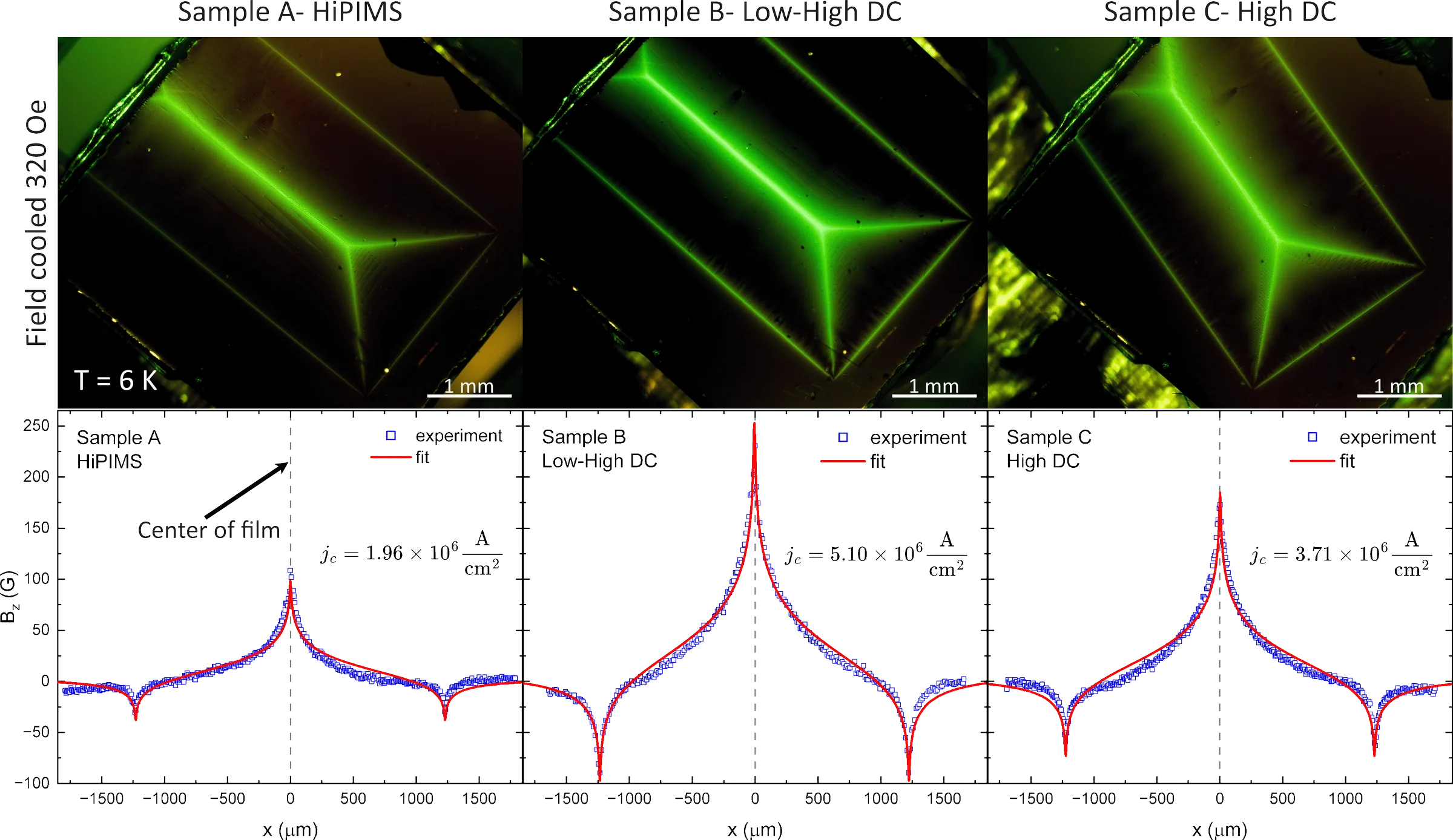
To visualize these weak spots, physicists used magneto-optical imaging. This technique "illuminates" the magnetic field with polarized light, revealing how flux penetrates the niobium film. The picture turned out to depend on how the metal was deposited. In some samples, flux entered almost uniformly, like water soaking into level sand. In others, branching avalanches occurred — flux rushed in abruptly and unevenly, like lightning during a thunderstorm.
By measuring how the magnetic field distributes across the film, the researchers calculated the critical current density — a quantity that indicates how well a superconductor carries current without loss. They compared this value with the quality of qubits made from the same films. The finding: the worse the niobium's homogeneity, the faster the qubit loses its quantum state. And the main culprit turned out to be a thin layer at the interface between niobium and the silicon substrate.
This boundary layer is like a uneven joint between two pieces of a construction set. Even if the pieces themselves are well-made, gaps and stresses arise at the seam. There, "parasitic" quantum systems take up residence, stealing energy from the qubit. Now that scientists know where to look, they can adjust the deposition conditions to make the interface cleaner and smoother. Then the orchestra of quantum bits will play in tune.
Original abstract
as written by the authors arXiv:2602.10010
Among the recognized sources of decoherence in superconducting qubits, the spatial inhomogeneity of the superconducting state and the possible presence of magnetic-flux vortices remain comparatively underexplored. Niobium is commonly used as a structural material in transmon qubits that host Josephson junctions, and excess dissipation anywhere in the transmon can become a bottleneck that limits overall quantum performance. The metal/substrate interfacial layer may simultaneously host pair-breaking loss channels (e.g., two-level systems, TLS) and control thermal transport, thereby affecting dissipation and temperature stability. Here, we use quantitative magneto-optical imaging of the magnetic-flux distribution to characterize the homogeneity of the superconducting state and the critical current density, $$j_{c}$$, in niobium films fabricated under different sputtering conditions. The imaging reveals distinct flux-penetration regimes, ranging from a nearly ideal Bean critical state to strongly nonuniform thermo-magnetic dendritic avalanches. By fitting the measured magnetic-induction profiles, we extract $$j_{c}$$ and correlate it with film physical properties and with measured qubit internal quality factors. Our results indicate that the Nb/Si interlayer can be a significant contributor to decoherence and should be considered an important factor that must be optimized.
Niobium is used not only in quantum computers but also in MRI magnets and particle accelerators — anywhere superconductivity is needed at relatively "warm" temperatures (about 9 degrees above absolute zero).
In the TV series "Devs," a quantum computer suffers from qubit instability, and the characters search for the source of interference, just like scientists tackling defects in niobium films.