How the Sound of Light Speeds Up Body Imaging express
A laser beam hits the skin, and tissues respond with a barely audible ultrasonic echo. From that echo, doctors can see blood vessels and tumors without making a single incision. But before the picture appears on the screen, the signal has to be cleaned of noise, just as a cook skims the foam off a broth to make the soup clear.
For a long time, the only tool for this cleaning was a mathematical trick that breaks the signal down into waves of different lengths, like a prism splitting white light into a rainbow. That trick is called the Fourier transform, and it works almost everywhere: from music compression to analyzing bridge vibrations. But it comes at a cost: it is slow and can distort weak signals, especially when you need a sharp image in a hurry.
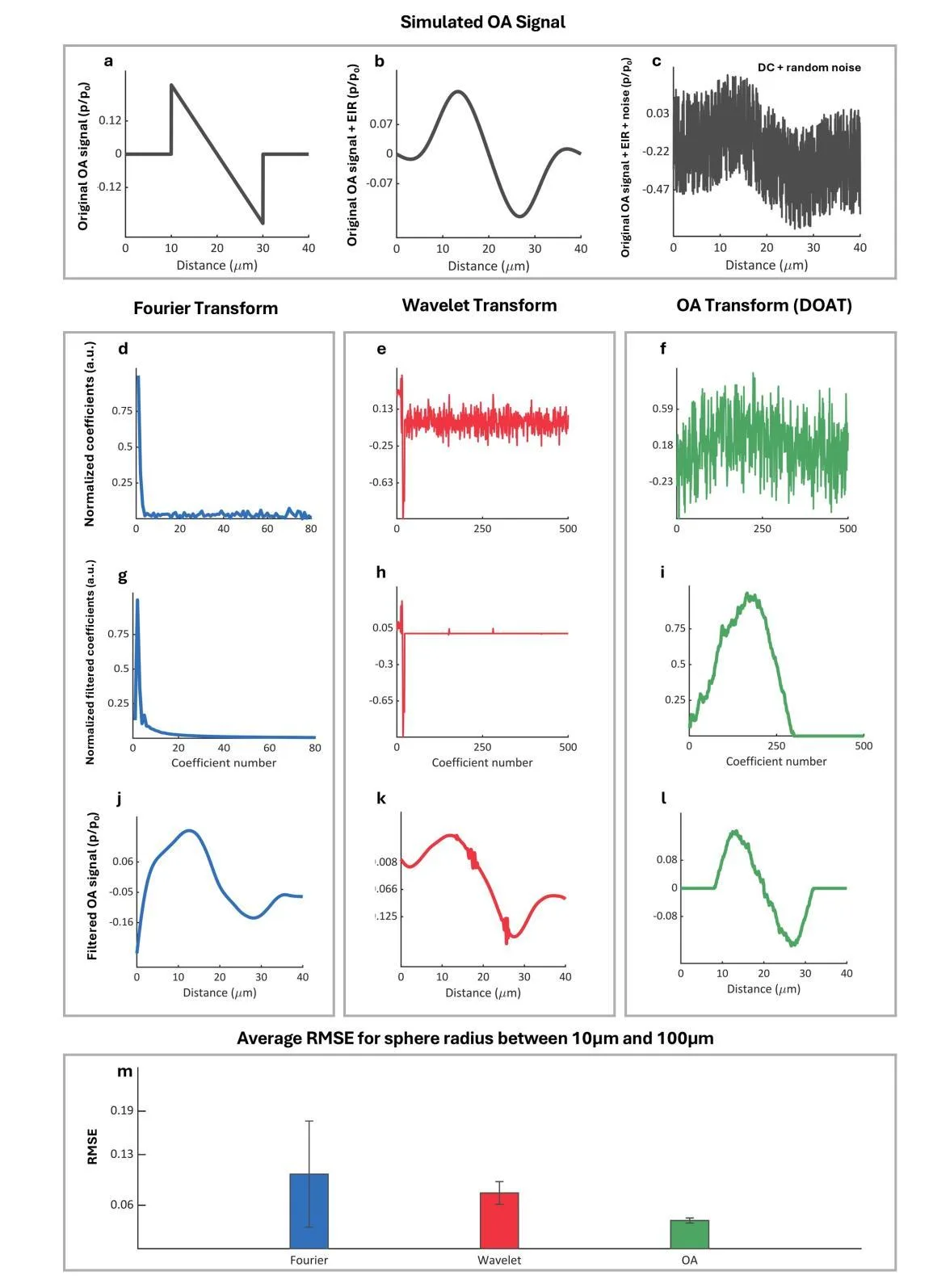
The scientists proposed a new way to clean the signal that doesn't try to fit it to a Fourier 'rainbow' but instead knows exactly how sound is born in tissues. It's like a cook who doesn't use a universal spoon to skim the foam but uses a skimmer designed specifically for that broth. The new method requires fewer computational steps and captures details more accurately — in simulations and on real recordings from devices, it outperforms Fourier and other classical approaches.
Now optoacoustic scanners can work faster and produce sharper images. That means devices will become more accessible for hospitals and even for home use, like a thermometer that shows not just temperature but also the state of blood vessels under the skin.
Original abstract
as written by the authors arXiv:2602.14803
Optoacoustic imaging technologies require fast and accurate signal pre-processing algorithms to enable widespread deployment in clinical and home-care settings. However, they still rely on the Discrete Fourier Transform (DFT) as the default tool for essential signal-conditioning operations, which imposes hard limits on both execution speed and signal-retrieval accuracy. Here, we present a new transform whose building blocks are directly inspired by the physics of optoacoustic signal generation. We compared its performance with the DFT and other classical transforms on common signal-processing tasks using both simulations and experimental datasets. Our results indicate that the proposed transform not only sets a new lower bound on computational complexity relative to the DFT, but also substantially outperforms classical transforms on basic signal-processing operations in terms of accuracy. We expect this transform to catalyze broader adoption of optoacoustic methods.
The Fourier transform is named after Joseph Fourier, who in 1807 proposed breaking down heat waves into simple components. His method was initially rejected, but now no smartphone works without it.
In the novel 'Solaris', the planet's ocean responds to human signals by creating images from their memories. Optoacoustics also 'listens' to the tissues' response to light — only instead of memories, the ocean produces a map of blood vessels.