An overtone is a higher-frequency component of a vibrating system, occurring at integer multiples of the fundamental frequency. In acoustics, overtones give musical instruments their timbre — a violin and a flute playing the same note sound different because of their distinct overtone patterns. In physics, the concept extends to quantum systems: for example, a vibrating string or a molecule has a fundamental mode and overtones at higher energies.
History
The concept of overtones has been known since antiquity in music, but the mathematical treatment began with Daniel Bernoulli in the 18th century, who solved the vibrating string problem. In quantum physics, overtones were explained by the quantization of vibrational states in the early 20th century.
How it works
When a system vibrates, it can oscillate not only at its lowest natural frequency (the fundamental) but also at multiples of that frequency. These higher modes are called overtones (the second overtone is twice the fundamental, etc.). In quantum mechanics, overtones correspond to transitions between energy levels that skip intermediate states, often appearing as weaker spectral lines at higher frequencies. They are crucial in spectroscopy because they allow probing of anharmonicities in molecular potentials.
In practice
Overtones are used in musical instrument design, in spectroscopy to study molecular structure and anharmonicity, and in laser technology where frequency doubling and tripling generate new wavelengths.
Fun fact
In the context of black holes, 'overtones' refer to the additional ringing frequencies after a merger — these were detected by LIGO and provide a test of Einstein's general relativity.
In the first fractions of a second after the Big Bang, the universe was a stage of rapid change. A stretched rubber sheet that cools quickly becomes covered with microscopic cracks. A similar process on a cosmic scale could have given rise to cosmic strings — ultra-thin but super-dense threads of energy stretching across the entire universe.
These strings are not just defects in space.
A massive aluminum cylinder weighing a ton hangs in a vacuum. A gravitational wave, a ripple in spacetime, passes through it, and the bar begins to tremble almost imperceptibly. That trembling can be heard as sound: gravitational waves turn into a phonon — a quantum of sound vibrations.
A black hole rings like a bell when something massive falls into it. This ring is gravitational waves, and its overtones tell us about the shape of the horizon.
Gravitational wave detectors work like sensitive microphones, picking up the trembling of space from distant cosmic catastrophes. When two black holes merge into one, the newborn object rings like a bell, and that ringing is a unique 'voice' of gravity.
Atomic clocks are pendulums that tick at the frequency of light. Inside a trap, an aluminum ion hangs, and a laser probes it like a tuning fork. If the laser's frequency matches the atom's natural frequency, the atom responds. The clock's rate is checked against this response.
The crystal CeB6 is like a box with a secret: inside it, electrons can occupy four nearly identical positions, like four chairs around a table. While no one is watching, the electron seems to sit on all four at once. Physicists call this hidden state quadrupolar, and it affects magnetic properties, but it is hard to see directly.
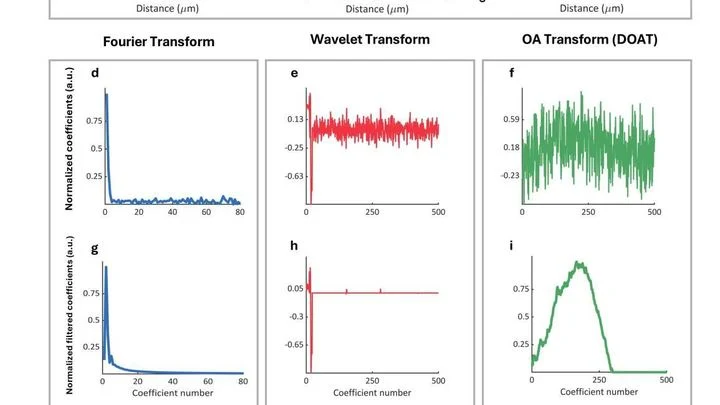
A laser beam hits the skin, and tissues respond with a barely audible ultrasonic echo. From that echo, doctors can see blood vessels and tumors without making a single incision. But before the picture appears on the screen, the signal has to be cleaned of noise, just as a cook skims the foam off a broth to make the soup clear.