Signal decomposition is the mathematical and computational practice of breaking a complex, messy signal into a sum of simpler, well-understood components. The idea is that any waveform — a sound, a light pulse, a seismic rumble, or a radiotransmission — can be represented as a combination of basic building blocks, most commonly sine and cosine waves of different frequencies and amplitudes. This is the foundation of Fourier analysis, and it is why a single mathematical operation can reveal the hidden structure in almost any kind of data.
History
The concept traces back to Joseph Fourier's 1822 work on heat conduction, where he showed that arbitrary functions could be represented as infinite sums of sines and cosines. The practical algorithm, the Fast Fourier Transform, was popularized by James Cooley and John Tukey in 1965, though earlier versions existed.
How it works
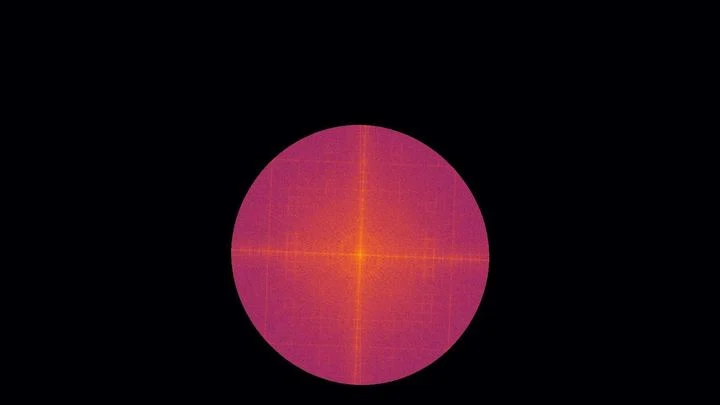
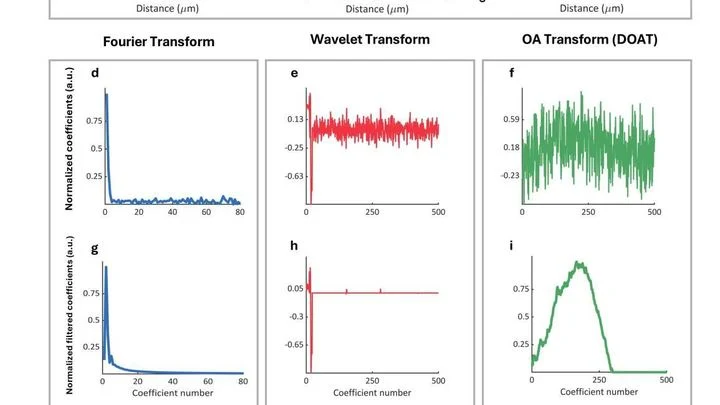
The core mechanism is the Fourier transform, which takes a signal in the time domain and converts it into a frequency spectrum. Instead of asking 'what is the value at each moment?', it asks 'how much of each frequency is present?'. The signal is effectively projected onto a set of orthogonal basis functions (sines and cosines), and the result is a list of coefficients that tell you the strength of each frequency component. More advanced decompositions, like wavelets, use localized basis functions to capture both frequency and time information simultaneously, which is useful for non-stationary signals.
In practice
It is used everywhere from audio compression (MP3) and medical imaging (MRI) to spectroscopy and seismic exploration. In the context of the listed articles, it underpins compact spectrometers, acoustic tomography of neutron stars, and noise reduction in chemical spectra.
Fun fact
The JPEG image format uses a two-dimensional version of signal decomposition (the discrete cosine transform) to compress photos by discarding high-frequency details that the human eye barely notices.
Imagine an interpreter distracted by every rustle in the hall, turning a one-hour meeting into two. That's roughly how gravitational wave detectors behaved when analyzing long signals: each turn of the Earth added noise to the calculations, and processing a day-long neutron star merger threatened to stretch into weeks.
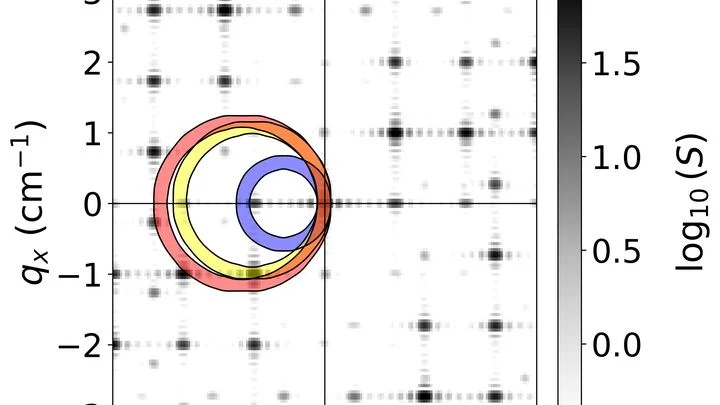
A translator at the negotiating table doesn't listen to every word; they grasp the meaning of whole phrases. Electron microscopy poses a similar challenge: you need to figure out the crystal's thickness and its tilt in the beam, and all you have is a diffraction pattern, a mosaic of thousands of bright and dark spots.
Waves on the water's surface usually break against any obstacle — a rock, a piling, an island. But what if you arrange obstacles so cleverly that the wave barely notices them? In a new study, scientists assembled a pattern of many points on the water, arranged according to special mathematical rules, and sent waves through them.
Quantum computers make mistakes. Each qubit is like a ball balanced on the tip of a pencil: a slight tremor in the hand and it rolls off. To keep the balls from falling, you need someone to notice the wobble and correct it in time.
Data analysis on the internet or sensor systems has long resembled trying to conduct an orchestra where each musician is locked in their own booth, and the conductor cannot leave the podium.
Building a light chip is like a game where you have to guide a beam through a maze of tiny mirrors and beam splitters. Each element acts like a railroad switch: it either lets light pass straight through or directs it to an adjacent track. The goal is to produce a specific light pattern at the output while using as few 'switches' as possible.
Usually, engineers spend years finding the shortest route for each task.
A protein in a cell is not a frozen sculpture. It is constantly in motion: bending, breathing, jittering. This motion, its dynamics, determines how the protein works. But peering directly into the dance is hard, and computer simulations often demand enormous computing power.
A new approach, named DynaMode, views protein motion as a musical piece.
If you clap your hands in an empty room, the echo will tell you about its size and shape. Every object (a chair, a book, a person) adds its own signature to this echo: sound reflects off it in a particular way. The authors of the paper have figured out how to completely rewrite this acoustic signature. They surrounded a region of space with a closed surface of microphones and loudspeakers.
A rock concert blares at full volume, and you're trying to catch your friend's whisper. That's roughly how radio detectors feel when they pick up signals from cosmic dust particles. A particle slams into the atmosphere and spawns an air shower, a cascade of millions of secondary particles, and this shower emits a short radio pulse.
A spectrum is like a photograph of a material's inner workings, taken with light. When a beam passes through or reflects off a sample, molecules leave characteristic dark bands, peaks, on that photograph. But if the image is overexposed or veiled in gray, making out details becomes nearly impossible.
In 1948, engineer Claude Shannon laid the foundations of information theory. The Nyquist–Shannon theorem gave the first answer: to avoid losing a signal, you need at least twice as many measurements as the fastest feature in the signal. In 2006, the method of compressed sensing relaxed this requirement.
We know about neutron stars thanks to the work of Fritz Zwicky, Subrahmanyan Chandrasekhar, and Jocelyn Bell Burnell. They are former cores, squeezed to city size: a teaspoon of their matter weighs as much as Mount Everest.
When a person breathes, air doesn't flow in a steady stream but in waves. Previously, doctors and scientists only looked at overall numbers: how much air entered per breath, what the peak flow was. But within a single breath, there are nuances — small variations that speak to the workings of nerves and muscles. The new approach breaks a breath into parts, much like a musician breaks a chord into individual notes.
A handful of coins drops onto a table. While they spin, each can land heads or tails: that's quantum uncertainty. But once they settle, the picture becomes definite, classical. That's roughly how noise destroys quantum order, turning it into ordinary disorder.
There's a lot hidden underground: water, ore, sand, clay. To figure out what's there, you don't have to dig. Just run a weak alternating current through the ground and listen to how the rock 'responds' at different frequencies. This technique is called spectral induced polarization.
Light passing through ripples on a water surface paints dancing patterns on the bottom of a pool. Engineers have used a similar idea to make light compute. They fabricated a tiny plate with a wavy relief: each ridge and groove deflects rays in its own way. When an image falls on such a surface, the light transmitted through it converges at different points behind it.
An X-ray image of a battery looks like a photo taken through frosted glass: fine details blur into a gray smudge. The culprit is the detector itself, which cannot distinguish features smaller than its pixel size. Engineers proposed getting around this barrier by illuminating the sample not with a uniform beam but with a striped pattern.
A laser beam hits the skin, and tissues respond with a barely audible ultrasonic echo. From that echo, doctors can see blood vessels and tumors without making a single incision. But before the picture appears on the screen, the signal has to be cleaned of noise, just as a cook skims the foam off a broth to make the soup clear.
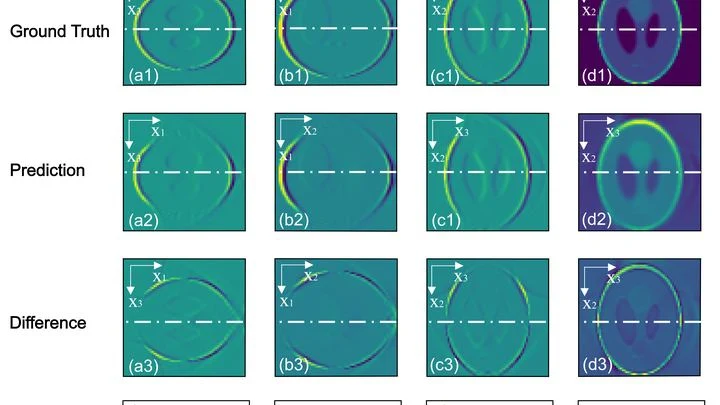
A laser hits tissue, and the tissue responds with a barely audible click — a sound wave. Sensors pick it up, and from that, an image of what's inside is built. That's how photoacoustic imaging works: light reaches deep, and sound carries the picture out.
In the new scheme, there are no sensors. Instead, several thin light beams are sent through the area where the wave has passed.