Too-Bright Flash Blinds the Camera express
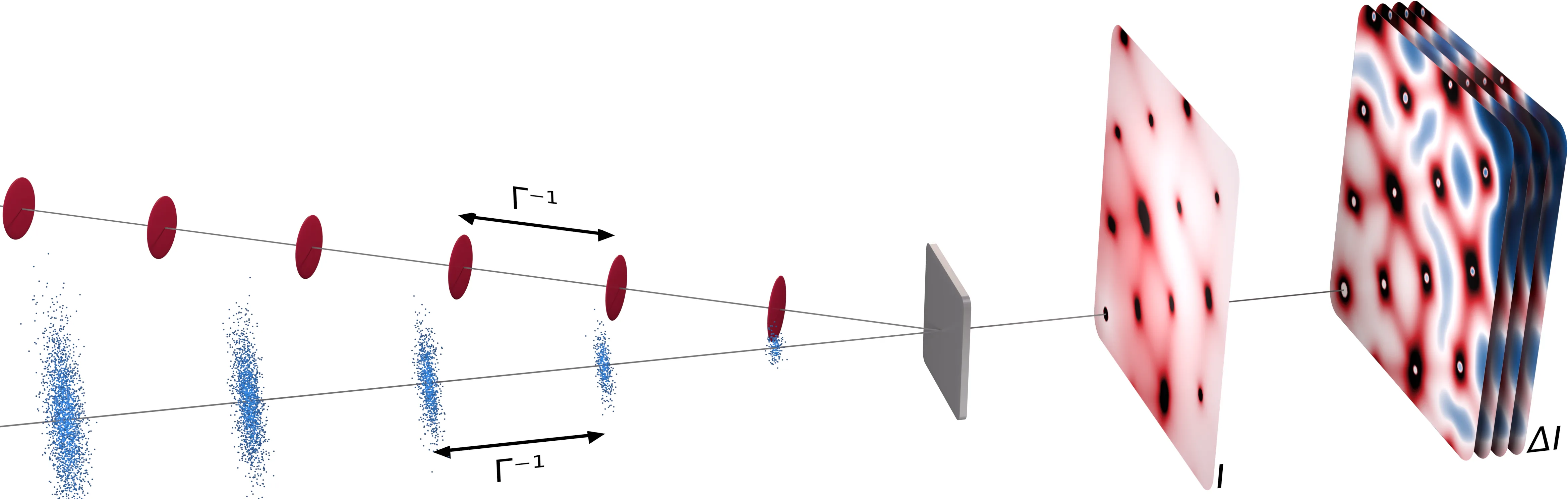
A camera that captures not light but a stream of electrons reflected off a crystal is a hybrid pixel detector. It can count every electron that hits it, generating almost no noise of its own. In normal mode, when the electron beam flows continuously, the detector works perfectly. But when electrons arrive in ultrashort bursts, a billion per millionth of a second, the detector starts to choke: two electrons hitting the same pixel almost simultaneously are counted as one.
In the new study, physicists measured how much count is lost during ultrashort electron flashes. It turned out that the losses are far more severe than with a continuous beam: already at two electrons per pixel per pulse, the detector can no longer distinguish individual particles. This imposes a hard limit on how many electrons can be sent to a sample in a single shot, especially when studying a single crystal — a material where atoms are arranged in a perfect lattice.
To avoid losing information, the scientists developed special normalization methods — ways to "subtract" distortions from the data, knowing exactly how the detector errs. They also built a complete error model that allows estimating how reliable each pixel in the image is. These techniques were tested on a large set of experimental data. As a result, even when the detector is overloaded, the picture of atomic motion can be recovered with good accuracy.
Such work is important for spectroscopy of ultrafast processes: it allows us to peer into a world where molecules change shape in billionths of a second. If detectors can learn not to go blind from bright electron flashes, we could film movies of chemical bonds breaking and forming, atoms vibrating in a lattice, and materials reacting to a pulse of light.
The hybrid pixel detectors in question were originally built for the Large Hadron Collider to track particle trails amid enormous data rates. Now they help capture ultrafast "movies" of atomic motion.