How to Tell Double Stars from Single Ones express
Two spotlights placed side by side: from a distance, their light blends into one patch, and it seems there's a single source. The same happens in space: about 10–20% of faint stars are actually close pairs of identical stars. Individually, they can't be resolved, but together they shine noticeably brighter than a single star with the same parameters.
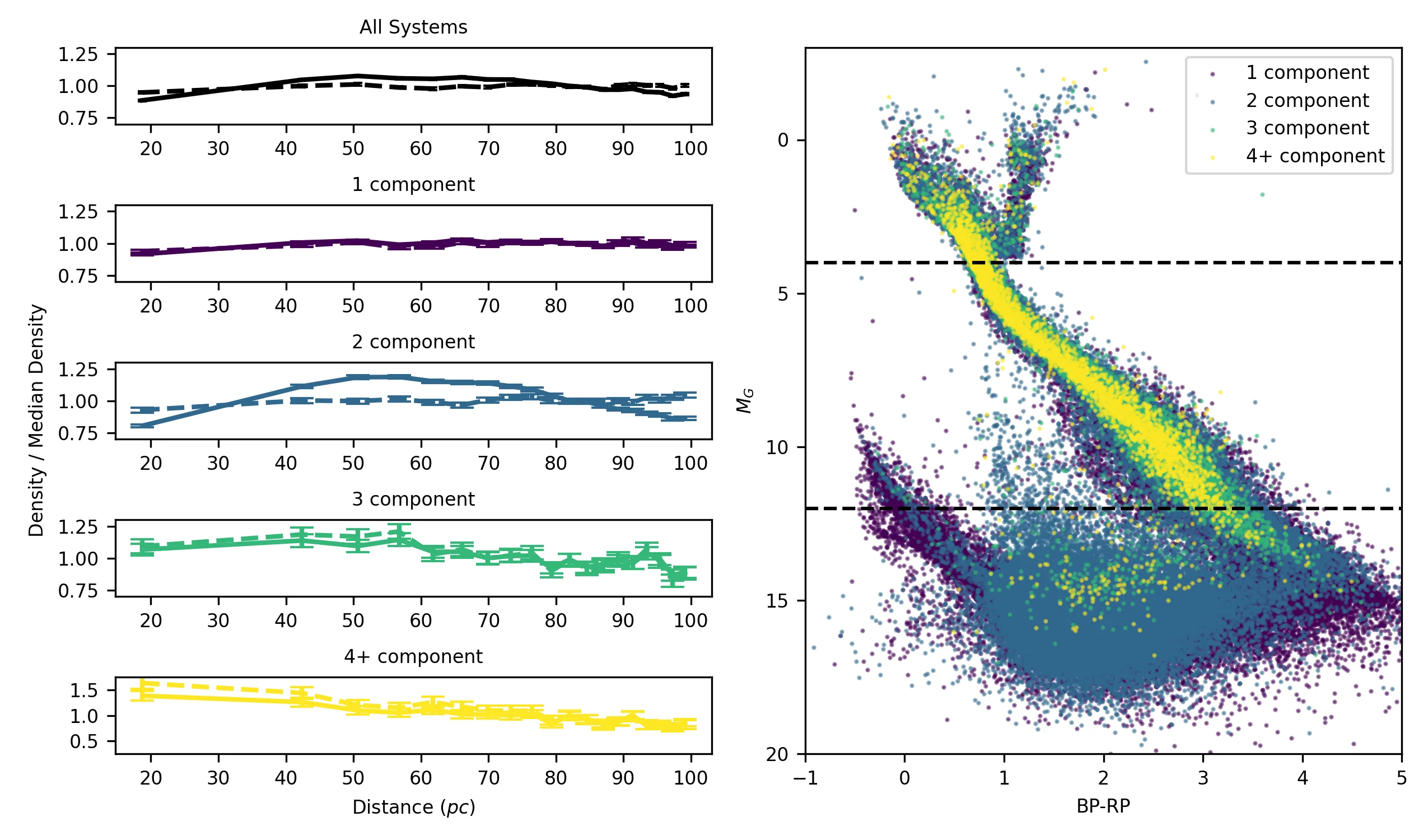
Astronomers took data from the Gaia space telescope on stars within 100 parsecs of the Sun (roughly 326 light-years). They selected those that move smoothly and show no signs of an unequal pair — leaving mostly single stars and twin pairs. Then they repeatedly trained a model to predict a star's brightness and color from its spectrum — the rainbow stripe that light leaves after being split. After each round of training, they removed stars that shone brighter than predicted: this gradually cleansed the model of hidden pairs.
In the end, the model, trained only on single stars, found about 13% 'overluminous' objects: these are unresolved binary systems. They added these to data from other surveys to assemble a comprehensive catalog of systems in the Sun's immediate neighborhood. From this, they estimated the lower limit of the binary fraction among low-mass stars: those from 0.1 to 0.7 solar masses.
Such a catalog is important not just for counting 'twins': it helps determine fundamental stellar parameters (mass, age, radius) more accurately. If you mistake a pair for a single star, all your conclusions about it will be wrong.
About a third of all stars in our Galaxy live in pairs or multiple systems, but among the lightest stars, the fraction of singles is higher.
In Liu Cixin's novel 'The Three-Body Problem,' a civilization lives in a system of three stars where orbits are unpredictable, but here we're dealing with much calmer twin pairs.