Light Faster Than Thought: Catching Particles in 33 Picoseconds express
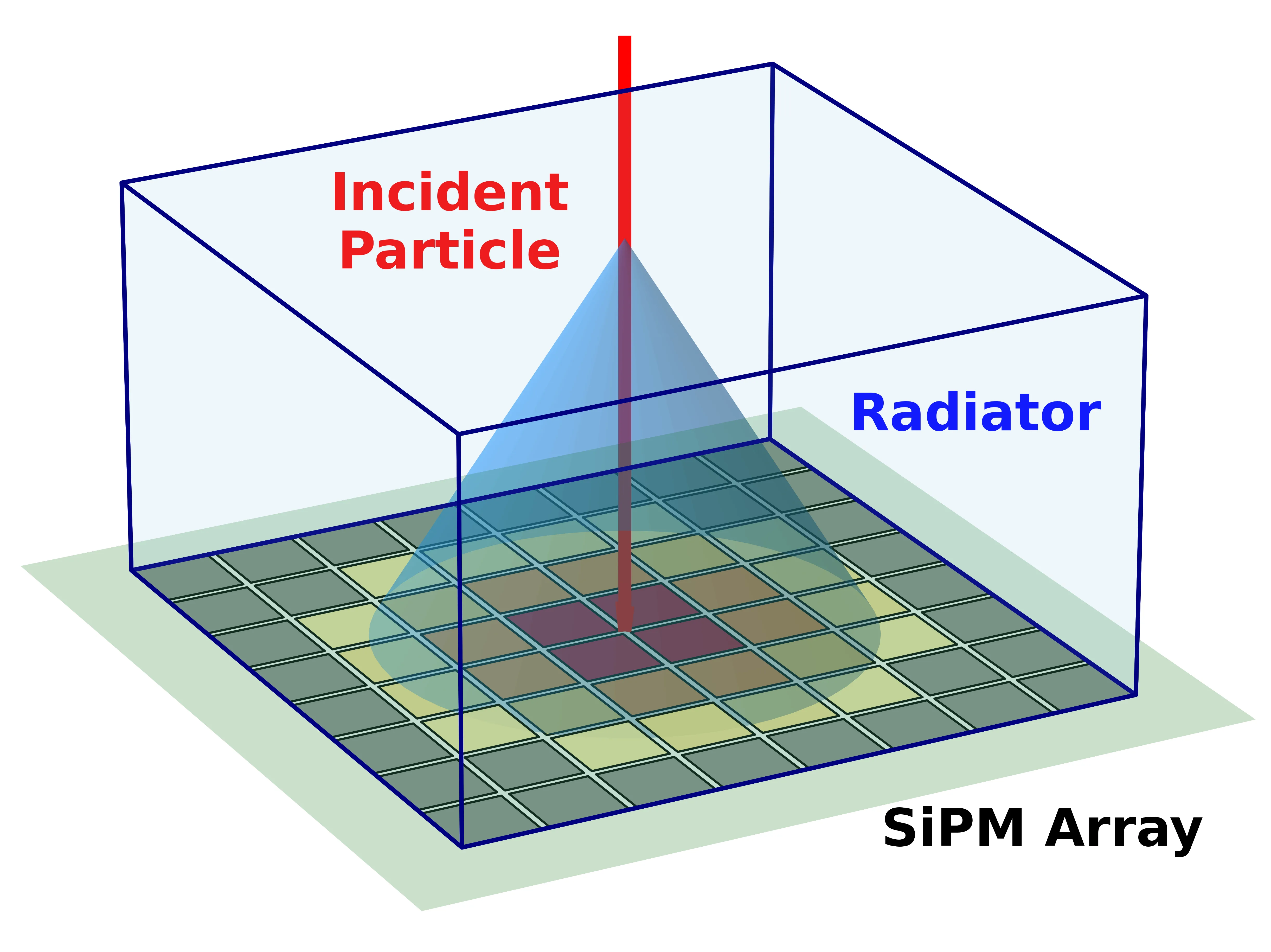
When a particle zips through a transparent material faster than light can travel through it, it leaves behind a faint blue flash, just as a jet breaking the sound barrier creates a shock wave. This Cherenkov radiation fires instantly, with no delay, making it perfect for ultra-precise timing in the world of elementary particles.
Scientists built the detector from a thin plate with a high refractive index and silicon photomultipliers — devices that convert single photons into electrical signals. They tuned the plate's thickness, shape, and how it connected to the sensors so that the flash reaches the detector by the shortest possible path. In tests at CERN's accelerator, the detector measured a particle's flight time with a precision better than 33 picoseconds — less than one trillionth of a second.
Every particle that hit the detector was registered — not a single miss. This combination of reliability and precision paves the way for new particle identification systems: in large experiments where thousands of particles are born at once, it's crucial not only to catch each one but also to instantly know what's what.
Original abstract
as written by the authors arXiv:2602.20139
The aim of this work is to develop high precision Time-of-Flight (TOF) devices based on high refractive index solid Cherenkov radiators read out by silicon photomultipliers (SiPMs). Cherenkov light is prompt and therefore ideal for reaching the intrinsic timing limits of TOF systems. By utilizing a thin, high-refractive-index radiator a nearly instantaneous signal is generated by particles exceeding the Cherenkov threshold. In order to achieve the ultimate time resolution, we carried out a rigorous optimization of the radiator material and geometry, alongside the efficiency of the optical coupling to the SiPM sensors. The key factors limiting the time resolution were characterized by comprehensive Monte Carlo simulations, subsequently validated against experimental beam test data. We assembled small-scale prototypes instrumented with various Hamamatsu SiPM arrays sensors with pitches ranging from 1.3 to 3 mm coupled with various window materials, such as fused silica and MgF2, featuring various thickness values. The prototypes were successfully tested in beam test campaigns at the CERN-PS T10 beam line. The data were collected with a complete chain of front-end and readout electronics based on either the Petiroc 2A or the Radioroc 2 interfaced to a picoTDC to measure charges and times. By comparing the time measurements with two SiPM arrays we were able to measure a time resolution better than 33.2 ps at the full system level with a charged particle detection efficiency of 100%. Our results demonstrate the expected performance benchmarks for the charged particle detection efficiency and time resolution and highlight the potential of the developed Cherenkov-based TOF detectors for next-generation particle identification systems.
You can see Cherenkov radiation in nuclear fuel pools: the water glows blue because particles travel faster than light in water.