Jellyfish Galaxies: Supersonic Winds Ignite Star Formation express
A galaxy plunges into a dense cluster like a runner into a crowd. The oncoming gas, known as the intracluster medium, strips away its own gas, stretching it into a long, glowing tail. Astronomers call these galaxies jellyfish: they have a body and flowing tentacles of stripped material. But only in a few do new stars ignite within those tentacles. Why are some jellyfish tails alive with star formation while others are just gas trails?
Astronomers took a close look at JO147, a jellyfish with weak star formation. The MeerKAT radio telescope revealed that polarized emission, a sign of an ordered magnetic field, exists only in a tenth of the tail. The galaxy's speed relative to the surrounding gas is modest: just 1.3–1.6 times the speed of sound. For comparison, a supersonic jet travels faster than sound in air, but here "sound" refers to oscillations in the cluster's hot gas.
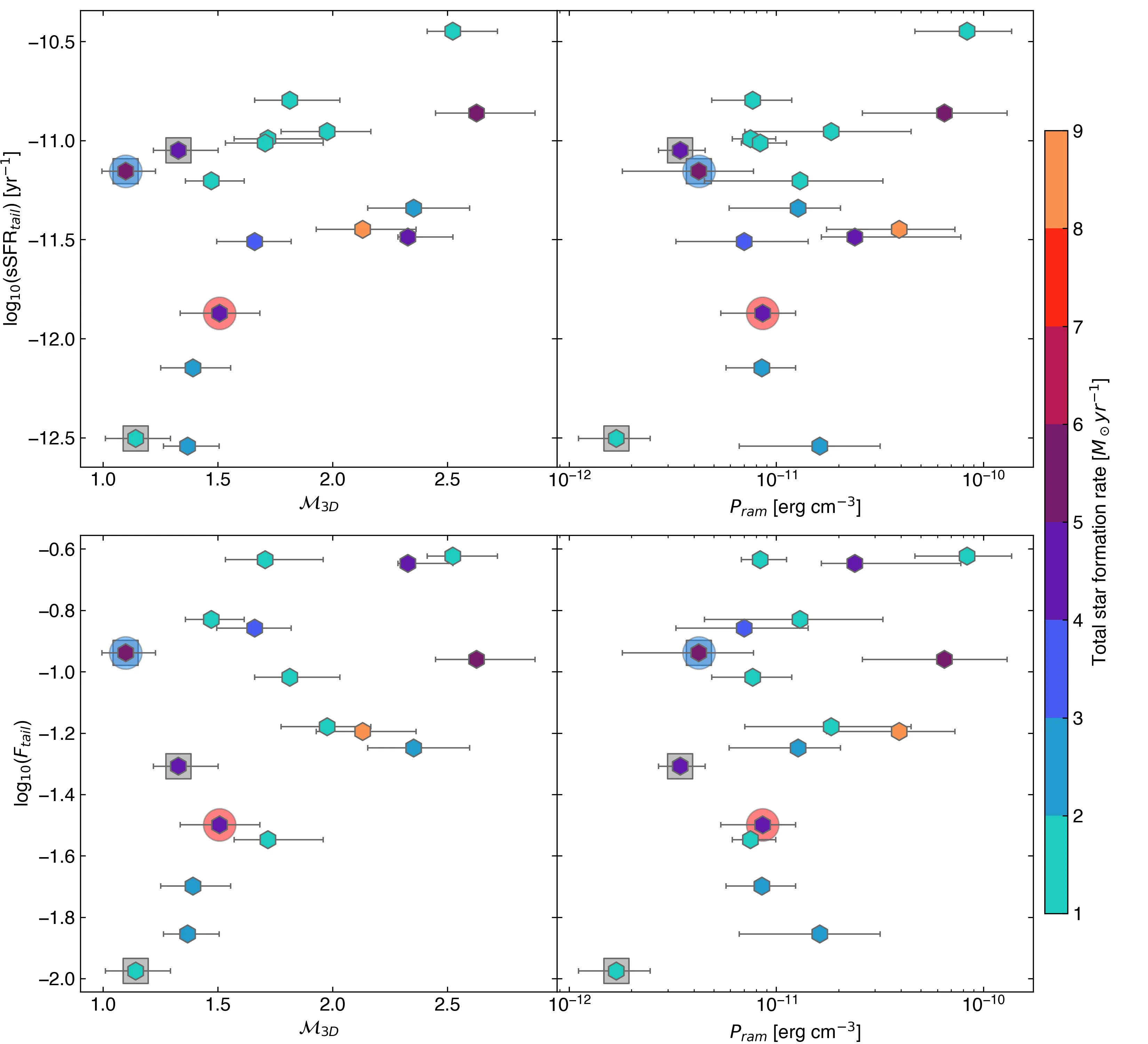
Next, the team tested this idea on 17 jellyfish from the GASP project. For each, they modeled the orbit within the cluster, accounted for gas temperature, and computed the Mach number — the ratio of the galaxy's speed to the speed of sound. It turned out that the faster the galaxy moves, the more actively stars are born in its tail. Supersonic motion is a necessary condition. The shock wave compresses the stripped gas, preventing it from dissipating, while the amplified magnetic field wraps it like a blanket, preserving fuel for new stars.
A jellyfish galaxy's tail can stretch for hundreds of thousands of light-years — several times the diameter of the Milky Way.
In Terry Goodkind's novel "Pillars of Creation," characters travel through regions where stars are born from compressed gas — similar to the processes in jellyfish galaxy tails.