A Magnet Born from Bending express
A piece of gold doesn't attract paperclips. But if you take a thin film of a gadolinium-gold-germanium alloy and start bending it, magnetic regions can appear. Scientists did this not with their hands, but with a beam of helium ions that penetrated the material through a patterned mask.
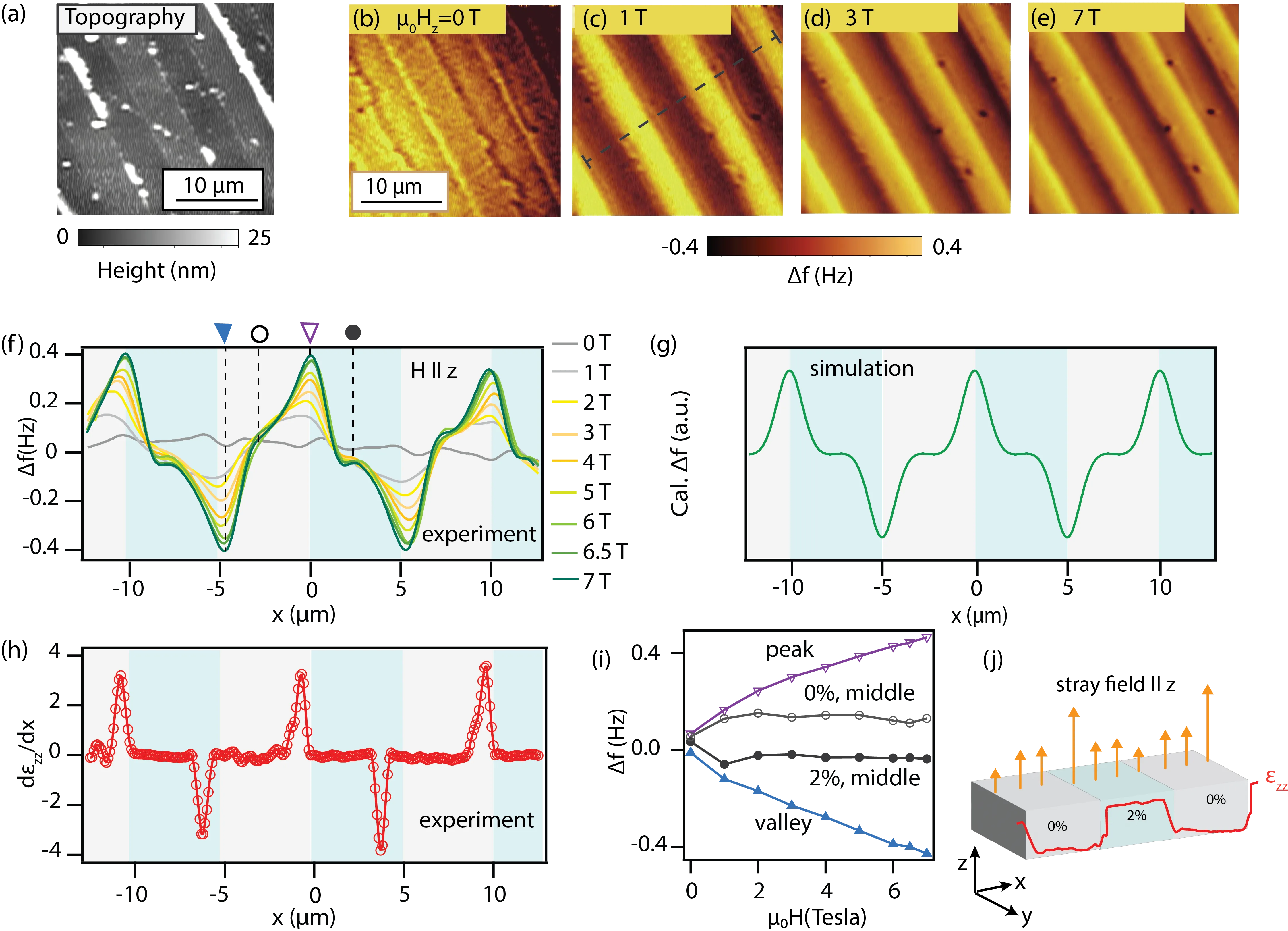
The thin layers were deposited on a substrate and then irradiated with helium through a stencil. The result was a pattern of stripes where the strain varied from edge to edge. Using a microscope sensitive to magnetic fields and an X-ray beam that reveals distances between atoms, the researchers found that magnetic regions arise precisely where the strain changes fastest.
This way of controlling magnetism could prove useful in future electronics, where tiny elements need to switch magnetic states without bulky coils.
Original abstract
as written by the authors arXiv:2602.23494
Flexomagnetism, the coupling of magnetic ordering to strain gradients, provides access to novel symmetry-broken magnetic phases that cannot be accessed via uniform strain. However, flexomagnetism is hard to understand because it is extremely difficult to control a spatially varying strain. Here, we develop a top-down strategy to pattern transverse strain gradients using helium ion implantation through a lithographically defined mask. Using epitaxial films of the antiferromagnetic nodal line semimetal GdAuGe, we demonstrate that transverse strain gradients $$\partial \varepsilon_{zz}/\partial x$$ induce near-room-temperature ferromagnetic response, compared to the retained para or antiferromagnetism for homogeneously strained GdAuGe. We spatially correlate the magnetic response with the regions of largest strain gradient, via magnetic force microscopy and nanobeam x-ray diffraction, respectively, to confirm the flexomagnetic response. Our approach opens new avenues for the precise control of magnetic phases in thin films of quantum materials via a patterned strain gradient.
At room temperature, GdAuGe is barely magnetic, but after helium irradiation, magnetic regions appear in it — all thanks to uneven stretching of the lattice, not the addition of iron or cobalt.
In the series 'The Expanse', the magnetic fields of ships are controlled by complex systems; here, the magnetic state changes with a simple bend, as if a sheet of paper becomes a magnet when you crumple it.