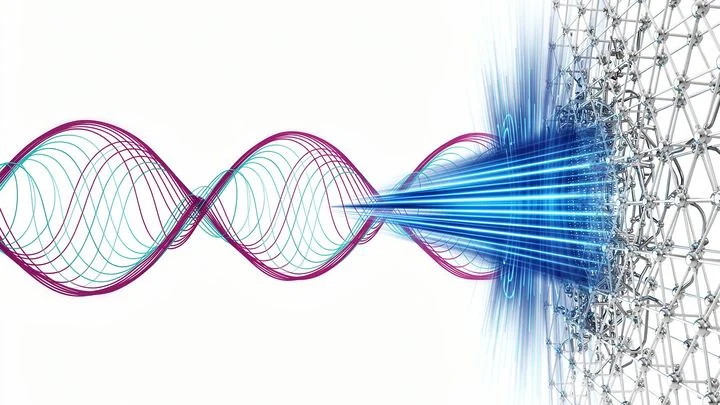
In 1845, Michael Faraday sought a connection between light and magnetism and discovered that heavy glass placed in a strong magnetic field changes the polarization of transmitted light. This became the first proof of the unity of electromagnetism. Essentially, the magnetic field makes the medium anisotropic for light — as if light were forced to go up a spiral staircase where one turn is steeper than the other.
History
Discovered by Michael Faraday in 1845 after years of trying to detect the influence of magnetism on light. Experimenting with samples of heavy flint glass (lead glass) placed between the poles of a powerful electromagnet, he noticed the rotation of the plane of polarization. This phenomenon, along with the discovery of electromagnetic induction, formed the basis of the concept of the unified nature of electricity, magnetism, and light, later developed by James Clerk Maxwell.
How it works
Used in optical isolators (valves) to prevent back-reflections in laser systems, circulators, and modulators. In astrophysics, measurement of Faraday rotation from pulsars and radio sources is used to map magnetic fields in the interstellar and intergalactic medium. Limits of applicability: limited by medium transparency and saturation in strong fields; applicable from radio to ultraviolet radiation.
In practice
Allows building optical isolators in lasers and measuring magnetic fields in the interstellar medium.
Fun fact
Faraday had been trying to find the effect for several years unsuccessfully until he took super-transparent lead glass from a chandelier. It turned out that ordinary glass gave too weak a rotation.
Rotation measure, proportional to integrated electron density times magnetic field along the line of sight — rotation measure= varies (e.g., 0.812 rad m^-2 for typicalradian per metre squared
An orchestra without a conductor can sound harmonious if the musicians feel the common rhythm. In the world of solids, phonons play that role: quanta of crystal lattice vibrations. When atoms in a substrate start moving in circles, they can transfer their rotation to a magnetic layer on top and flip its magnetization.
A microwave oven heats food, but in the lab, microwaves have done something different: they turned a superconductor into a permanent magnet. A 300-nanometer-thick film of yttrium barium copper oxide, cooled to 80 kelvin, responded to 5-gigahertz radiation.
A microwave oven heats food, but in the lab, microwaves have done something different: they turned a superconductor into a permanent magnet. A 300-nanometer-thick film of yttrium barium copper oxide, cooled to 80 kelvin, responded to 5-gigahertz radiation.
Radio waves from a distant pulsar travel through the interstellar medium, encountering invisible magnetic structures the size of the distance from the Sun to Earth. One such structure is a current sheet, where the magnetic field abruptly changes direction, like a compass needle flipping from north to south.
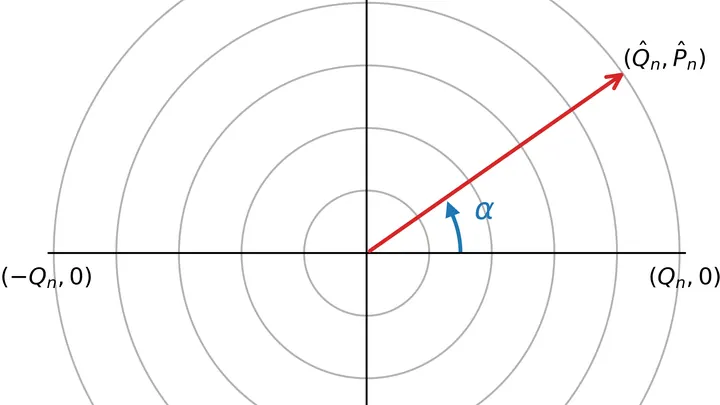
A laser beam is like a swift vortex that briefly captures a passing electron. As the particle moves through the pulse, its spin (the intrinsic rotation, like a tiny top) experiences a weak kick. After leaving the beam, the top no longer points in the same direction; it has turned a little.
Light from the hottest stage of the universe has been traveling toward us for nearly 14 billion years. This is the cosmic microwave background — a faint glow filling the entire sky.
Light from the very beginning of the cosmos has been traveling toward us for 13.8 billion years. During that time, its polarization, the direction of its oscillations, might have been twisted, like a compass needle that someone quietly nudged. Physicists call this phenomenon cosmic birefringence.
Light bends in a lens — everyone knows that. Gravitational waves passing a massive body also curve their path. But the authors of this work looked further: what happens to the wave's very "color" — its polarization, that is, the direction of oscillation?
Gravitational lensing is the deflection of…
Two hundred and eighty-nine days: that's how long one rotation of the white dwarf white dwarf WD 1532+129 takes. This is not just a record: on its surface, near the magnetic poles, scars of iron and other metals appear — silent testimony to planets it has devoured.
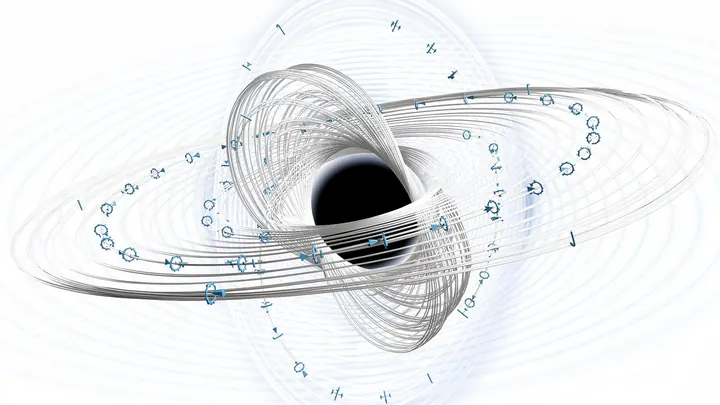
A black hole is not just a dark silhouette against the stars. Its shadow is surrounded by a thin glowing ring of photons that loop around the event horizon before escaping to an observer.
A lead sphere hangs above another lead sphere. According to the usual laws of gravitation, they attract each other exactly along the vertical — along the line connecting their centers.
Traditional electronics operates on charge, but spintronics and the nascent orbitronics dream of incorporating the particles' own rotation. At the heart of this lies the Edelstein effect: a current flowing in materials with Rashba spin-orbit coupling generates spin polarization.
A massive star doesn’t simply fade away — it blows up as a supernova, leaving behind an expanding remnant and a wildly spinning neutron star — a pulsar. In this cosmic storm, astonishing patterns emerge, and the 'Nimbus'–'Thunder' system is a dazzling illustration.
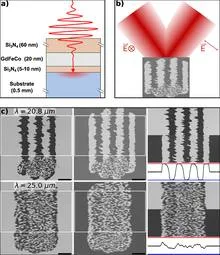
A neat stack of atomic layers lies on a substrate. An invisible beam of terahertz light shines down on it, with a magnetic field applied from the side. After reflection, the beam's polarization rotates slightly.
A dead star with a magnetic field billions of times stronger than Earth's is a magnetar. Its crust cracks, sending a powerful X-ray burst into space. But some of that light doesn't reach us in its usual form. In an ultra-strong field, photons can turn into gravitational waves — the trembling of space itself.
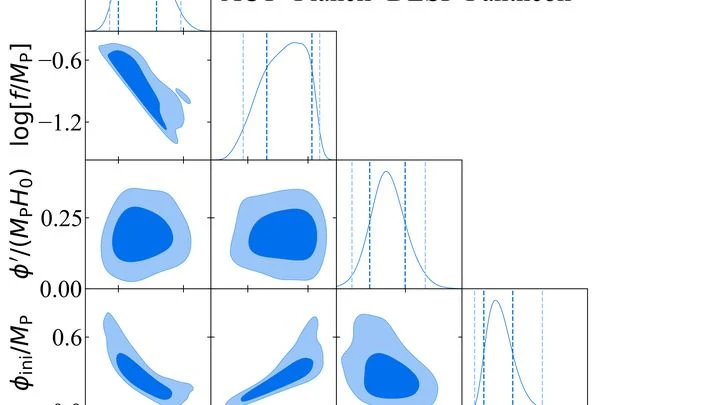
The oldest light in the universe has been traveling toward us for nearly 14 billion years. It was born when the cosmos first became transparent, and since then its plane of oscillation has been rotating ever so slightly. The cause is an invisible ocean permeating all of space: the dark energy field that makes the universe expand faster and faster.
Light loves symmetry: in an open channel, it flows equally both ways. To steer it one way, physicists often use magnets. A new approach does without, using rotation — just the speed of a vinyl record — and interference from two atoms. Rotation changes the “pitch” of light for different directions, just as a siren’s tone shifts when a car approaches or recedes.
Throw a ball almost parallel to a wall — it will slide along it before bouncing off. The same happens with a light beam: when reflected at a shallow angle, it shifts by microns. This Goos–Hänchen shift was long considered a mere amusing paradox.
Two electrically charged spheres attract each other with a certain force. If you replace their charges with magnetic poles, a spring scale shows exactly the same force. Black holes, it turns out, behave the same way — except instead of springs, the fabric of spacetime itself does the work.
Two ultra-thin sheets, each just one atom thick, are placed on top of each other and slightly rotated. Like two sheets of colored tracing paper: while they lie flat, the picture is one thing, but give them a twist and a moiré pattern appears. Here, though, the pattern isn't visible to the eye, but it completely changes how the material handles light.
Neutron stars are the ultra-dense remnants of stars, where matter is compressed to the limit described by Subrahmanyan Chandrasekhar. Magnetars are a type of neutron star with a magnetic field a quadrillion times stronger than Earth's.
A flashlight beam glides over uneven glass. The glass is massive galaxy clusters, and the flashlight is ancient light born shortly after the big bang. Passing by such clusters, light doesn't just bend around them like water around a rock. Its path shifts slightly sideways, and the amount of shift depends on how the light is 'twisted'—right or left.
A pebble tossed into a pond sends ripples spreading in all directions. Now imagine the pond itself suddenly turning into jelly — instantly, faster than the wave can complete a single crest. Some ripples would keep spreading but change their spacing, while others would unexpectedly turn around and run back toward the point of impact, as if time were flowing backward for them.
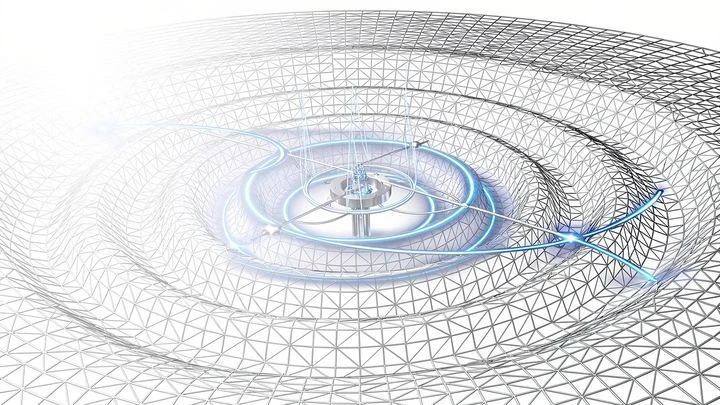
The Universe speaks two fundamental languages — gravity and light. Under normal conditions, they do not mix: gravitational waves glide through matter without a trace, while photons dance in mirror labyrinths.
When two black holes merge, they shake the very fabric of spacetime. The newborn giant doesn't settle instantly (it rings like a cosmic bell, emitting a characteristic pattern of damped gravitational waves) the so-called ringdown.
A juggler tosses clubs while sitting on a spinning chair. If he starts spinning the clubs all in one direction, the chair will rotate the opposite way — otherwise, the conservation of angular momentum would be violated.
Radio waves from a gamma-ray burst — the cataclysmic death of a massive star whose flash briefly outshines an entire galaxy — reach Earth polarized. This means their electric field oscillates predominantly in a single plane, like a compass needle frozen in a magnetic field.
A distant lighthouse flashes for an instant brighter than an entire galaxy. This is a fast radio burst — a mysterious signal from deep space. Some repeat, and astronomers have noticed a peculiarity: these bursts show rapid changes in polarization — a property indicating how the radio wave is twisted in space.
Light, like a shaken rope, oscillates in a specific plane. Astronomers and engineers often rotate images using a three-mirror system, the so-called K-mirror, but this inadvertently rotates the plane of oscillation as well. For precise measurements, that's a problem.
Layers of a thin material rotated relative to each other resemble stacked grids. Where the lines intersect, a new pattern emerges — a moiré. In this pattern, electrons move differently than in a regular crystal and can form unexpected states.
In the new study, researchers took two layers of molybdenum telluride and twisted them by 4.8 degrees.
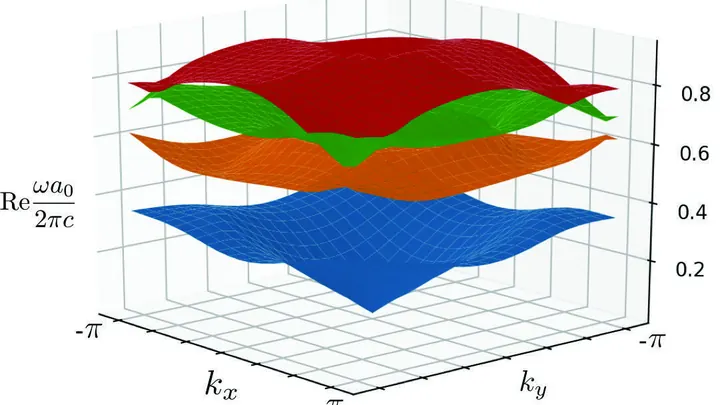
Light, discovered by Maxwell, behaves differently in different media. In a new study, researchers simulated a two-dimensional crystal that absorbs light and has magnetic properties. In it, light waves behave like passengers on a one-way escalator: they relentlessly move toward edges and corners, where they accumulate.
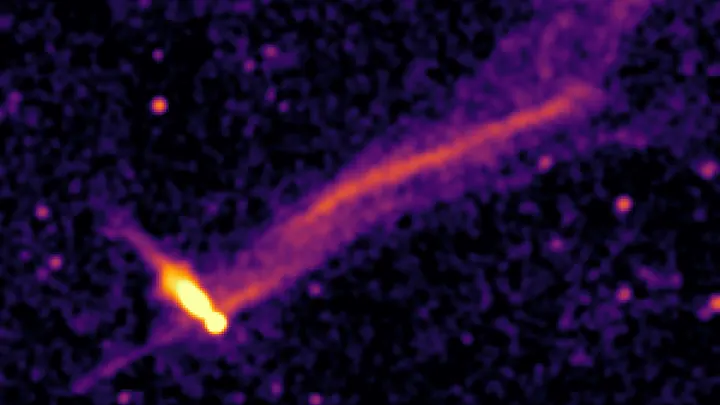
Deep in space, a rapidly spinning neutron star, a pulsar nicknamed the Lighthouse, speeds through tenuous gas. Like a motorboat cutting through water, it leaves a glowing trail of charged particles behind. In X-rays, this trail appears as a bright tail and a thin filament stretching over many light-years.
A sheet of graphene, a carbon lattice just one atom thick, under a powerful laser beam behaves like a road where a toll barrier suddenly appears. Electrons that were freely racing through the material suddenly hit a forbidden zone: an energy gap they cannot leap across. This was predicted theoretically before, but no one had ever seen it directly.
A barium titanate crystal is like a crowd where everyone holds a pointer. Normally, the pointers face in random directions, but when you apply an electric field, they all snap to point the same way. This ordered state is called ferroelectric: it stores information the way a compass needle stores direction.
You can make a light beam look like a flower with several petals. If you send such a beam through a cloud of cold rubidium atoms and switch on a magnetic field, the petals start to rotate. The angle of rotation is directly linked to the field's strength.
Light travels across a room, bouncing off mirrors and walls. The emptiness in between seems perfectly neutral: it doesn't hinder the beam or curve its path. But what if, at the deepest foundations of the world, emptiness is more complex? Physicists have long suspected that the symmetry of space might break at tiny scales, and then light would behave differently.
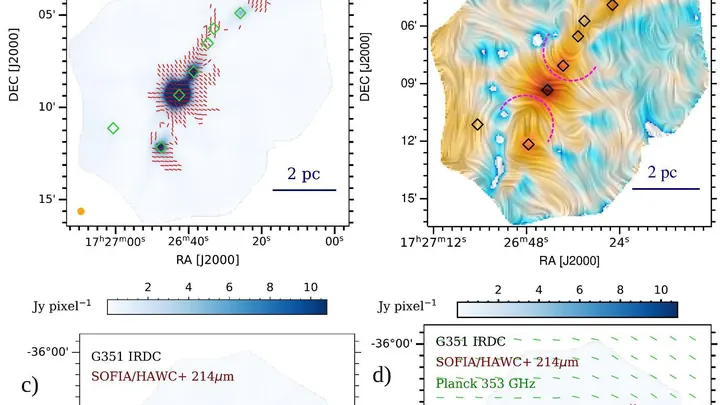
In the dark cloud G351, where new stars are about to emerge from gas and dust, the magnetic field has bent into an hourglass shape. Such a shape is a sign that the field is not just watching star birth from the sidelines but is actively taking part.
Scientists used the SOFIA telescope, mounted on an airplane, to see the dust in the cloud.
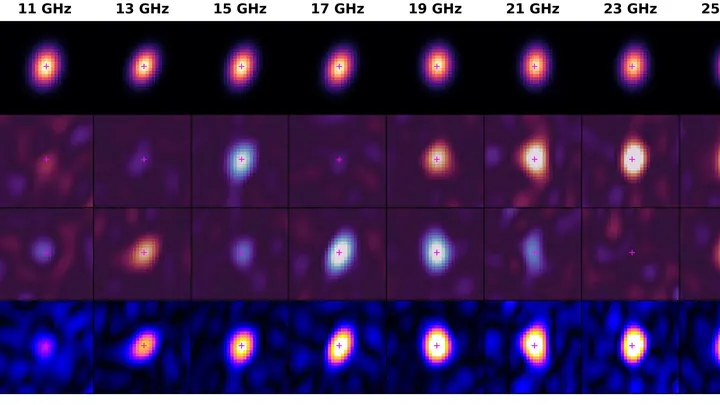
Radio waves passing through magnetized gas have their polarization slightly rotated, like a compass needle deflecting near a magnet. This rotation, called the Faraday effect, revealed the invisible environment around the supermassive black hole in galaxy NGC 1275.
Laser light is like a perfectly aligned row of soldiers on parade: all waves oscillate in the same plane. Such light is called polarized. In a new study, physicists have for the first time produced polarized gamma rays by colliding electrons with a powerful laser pulse.