Moiré patternmagnetism refers to the emergence of magnetic properties in stacked or twisted two-dimensional materials, most famously in graphene. When two atomic layers are overlaid with a slight rotational mismatch, the resulting interference pattern—the moiré pattern—creates a periodic potential that dramatically alters the electronic behavior. In certain configurations, this leads to correlated insulating states and, under specific conditions, ferromagnetic or antiferromagnetic order, even in materials that are not intrinsically magnetic.
History
The concept gained prominence after the 2018 discovery of superconductivity in twisted bilayer graphene by Pablo Jarillo-Herrero's group at MIT, which was quickly followed by observations of correlated insulating states and, later, magnetism in similar systems.
How it works
The twist between layers creates a long-wavelength modulation of the interlayer coupling. Electrons become localized in regions where the local stacking matches certain high-symmetry configurations, forming narrow electronic bands. When these bands are partially filled, strong electron-electron interactions dominate, and the system can spontaneously develop spin polarization—magnetic order—without any magnetic atoms. The exact magnetic ground state depends on the twist angle, doping, and applied electric fields.
In practice
Moiré materials offer a highly tunable platform for studying fundamental magnetism and superconductivity, and they are candidates for future quantum devices such as spin qubits and magnetic sensors.
Fun fact
The twist angle in these systems is so precise that a change of just 0.1 degree can completely destroy the magnetic or superconducting state.
A door lock with two different keys: one turns easily, the other demands noticeable effort. That is how two layers of hexagonal boron nitride behave when twisted relative to each other. This material consists of boron and nitrogen atoms arranged in a hexagonal lattice, and its layers can sit in different registries, like two identical grids shifted by different angles.
A sheet of paper left on a wet table warps and lifts its edges. No one controls that motion, but it follows the same laws as plant growth: some areas of the sheet shrink more than others, and the flat form becomes three-dimensional. Engineers have long dreamed of taming this process so that a flat blank folds itself into a desired sculpture. In the new work, that trick succeeded with accuracy down to one percent.
A deck of cards in which each card is slightly rotated cannot lie flat: the backs and faces will never align. But if the cards are flexible, they will start to adjust, shifting by fractions of a millimeter to find the perfect match. Something similar happens inside crystals when two thick layers of MoS2 or MoS2 with WS2 are stacked with a twist of 1–2 degrees.
A highway where opposing flows are separated not just onto different sides, but onto two independent roads: each with its own entrance and exit. Something similar happens to electrons in a new type of topological insulator described by the authors of the study.
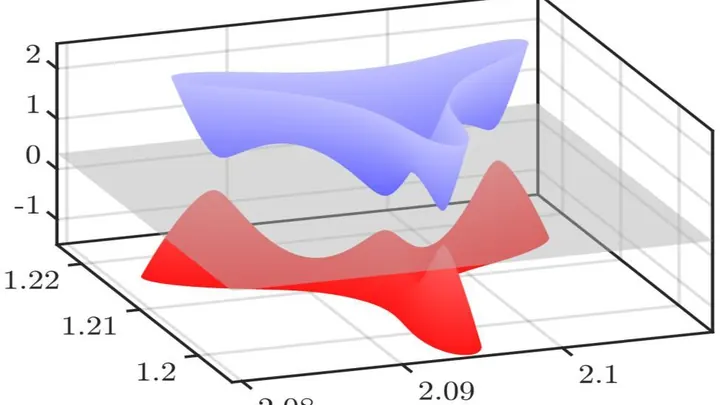
Usually, light does not turn an insulator into a conductor: that requires powerful laser pulses that break the material's structure. But in twisted bilayer graphene at the magic angle, things are different.
Moiré patterns are familiar to everyone. Two combs with different spacing, placed on top of each other, show dark fringes. Something similar has emerged in time. Physicists took a cloud of Rydberg atoms, particles with unusually large electron orbits, and illuminated it with two lasers.
Inside a crystal, an invisible ballet unfolds: the magnetic moments of atoms, like dancers, sometimes align in unison, sometimes scatter in antiphase. The choreography is dictated by quantum exchange — music sensitive to the geometry of bonds.
A sheet of paper with square grid, one with diamond grid, and one with honeycomb — three different universes for an ant. Change the sheet, and the rules of movement change. That's roughly how electrons experience the crystal lattice: geometry dictates whether they become little magnets, superconductors, or something else. In ordinary materials, the lattice is as rigid as if engraved.
Each electron is a tiny magnet. In a single-atom-thick layer of iron chloride, they all align in the same direction, like dancers in a perfectly synchronized routine. Nature usually avoids such order (that's high entropy), but quantum forces compel them to comply.
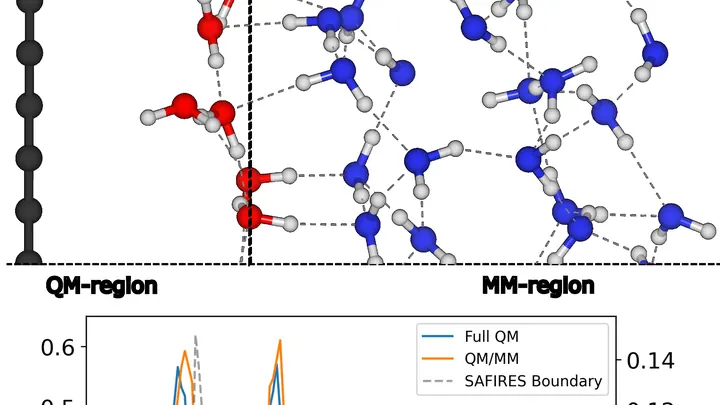
Imagine a huge swimming pool. In one corner, a chemical reaction is underway that needs to be calculated with jeweler-like precision. But the surrounding water is not just decoration: its molecules jostle, attract, and influence the reaction. How do you account for this endless dance of particles without drowning in calculations?
Imagine a line of people holding hands but facing in opposite directions: some look north, others south. That's how a p-wave magnet is arranged. Electrons in it align their magnetic moments (spins) not randomly but in a strict wave-like pattern.
A stack of magnetic plates, each magnetized opposite to its neighbor, is like a layered sandwich where electrons move as a single organism. The whole material starts mimicking an axion — a ghost particle that physicists suspect might be dark matter.
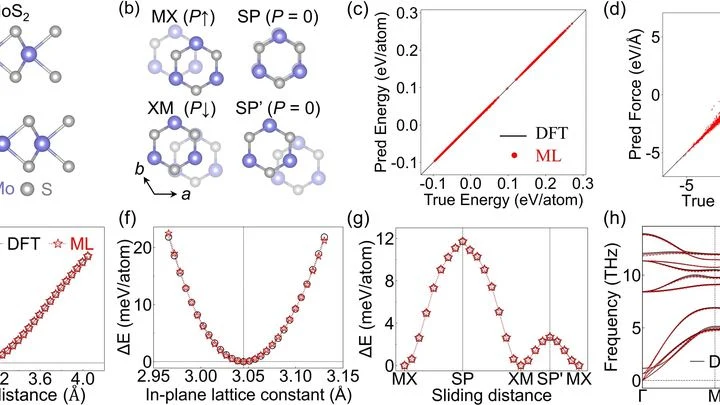
Two sheets of paper stacked together start to creep ever so slightly over each other when heated. That's roughly how layers of molybdenum disulfide, a material one atom thick, behave. At room temperature, they spontaneously slide at a speed of about one meter per second.
Ruthenium oxide has long been regarded as a textbook altermagnet — a material where magnetic moments of neighboring atoms point in opposite directions but do not fully cancel due to the crystal's special symmetry. New measurements show that inside the crystal, there is no magnetism at all. All the magnetic action is confined to the surface.
A fridge magnet stays put because the tiny atomic arrows inside it all point in the same direction. But when those arrows start to argue (some pulling left, others right, and some spinning like tops) you get magnetic frustration. That disorder gives rise to whimsical patterns: stripes, spirals, vortices.
A sheet of graphene one atom thick hangs in the air like a taut bedsheet. Heat waves, vibrations of atoms that physicists call phonons, ripple across it. Previously, it was thought that these waves quickly scatter due to strong interactions, and heat transfer is poor.
A sheet of graphene one atom thick is like a flexible metal mesh through which electrons zip almost unimpeded. Stack two such sheets with a slight twist, and the material's properties change dramatically: it can become an insulator that blocks current.
The crystal changes its internal geometry like a building frame that slightly twists during an earthquake. In the manganese-gallium alloy (Mn₃Ga), at around 485 Kelvin (about 212°C), a magnetic transition occurs: the atoms align into an antiferromagnetic order, where neighboring magnetic…
A crystal does not grow as a single whole but like a city of neighborhoods — grains. In each neighborhood, atoms are arranged in their own way, and the boundaries between them are like streets.
The crystal CeB6 is like a box with a secret: inside it, electrons can occupy four nearly identical positions, like four chairs around a table. While no one is watching, the electron seems to sit on all four at once. Physicists call this hidden state quadrupolar, and it affects magnetic properties, but it is hard to see directly.
Two layers of a magnetic material, rotated relative to each other by fractions of a degree, like two slightly offset screens on a window. In their normal state, they don't produce anything special, but at a certain twist angle, an unexpected effect emerges.
Magnetic moments in a crystal are like compass needles fixed at lattice sites. In the normal state, they line up in neat order, but if an electromagnetic wave strikes the crystal, the needles start to sway, like wheat stalks in the wind. These oscillations are called magnons, and they carry energy without the atoms themselves moving.
An ordinary superconductor expels magnetic fields, but this ring does the opposite: it creates a magnetic field inside itself. The ring is made of Fe(Te,Se) — a compound of iron, tellurium, and selenium that loses its electrical resistance at very low temperatures.
In a solid, atoms vibrate, transmitting sound. Sometimes this wave doesn't run straight but curls into a spiral, like a corkscrew entering a cork. In ordinary crystals, such 'sound vortices' are known, but in magnetic materials they had long eluded detection.
According to theories beyond the Standard Model, our best description of elementary particles and their interactions, pairs of magnetic monopoles were born in the first instants after the Big Bang. These hypothetical particles carry only one magnetic pole—'north' or 'south'—unlike familiar magnets where poles are inseparable.
Altermagnets resemble a ballroom where couples spin in opposite directions: the hall itself is still, but inside, ordered motion seethes. Similarly, electron spins (the direction of their rotation) in these materials form intricate patterns without creating an overall magnetism.
An ordinary superconductor loses resistance when cooled, and current flows through it without loss. But in ultrathin films, things are different: the material fluctuates between normal and superconducting states, and in this transition zone, strange resistance waves emerge. Resistance rises and falls as if someone were turning a volume knob.
A piece of gold doesn't attract paperclips. But if you take a thin film of a gadolinium-gold-germanium alloy and start bending it, magnetic regions can appear. Scientists did this not with their hands, but with a beam of helium ions that penetrated the material through a patterned mask.
A magnet that stacks up like a pile of pancakes: that's how the material CrSBr is structured. At low temperatures, each layer is magnetized, but neighboring layers point in opposite directions, and their magnetic fields cancel each other out. This order is called antiferromagnetic, and it's fragile: just a slight warming demagnetizes the layers.
The crystal Ca2RuO4 resembles a stack of thin sheets. Inside each sheet, the electron spins are arranged in strict order, like rows of soldiers on a parade ground. The bonds between the sheets are weak, and their sign can be flipped by slightly pulling the crystal apart.
Twisted layers of atoms in a material form a pattern of tiny regions, domains, each of which can be electrified in one of two directions, like a compass needle pointing north or south. Previously, such materials were studied only as a whole, measuring thousands of domains at once, and their collective behavior was like a choir where individual voices are not heard.
The crystal CeRh₂As₂ behaves like a switch: cool it down and it becomes a superconductor, then bring a magnet close and it abruptly jumps to another superconducting state. Such behavior is rare: most superconductors have only one state, but here there are two, separated by a sharp boundary.
A tiny magnet made of layers of sulfur, chromium, and bromine sits on a microscope stage. Inside it, like unexpected guests, sit erbium atoms — a rare-earth metal. These atoms can glow when hit with a laser, and their light tells us what's happening around them.
When cooled to -272°C, the Fe₄Nb₂O₉ crystal turns into a magnetic pattern where atomic arrows don't line up in a single row but fan out. It's like a crowd frozen in place, but each person looks in their own direction rather than at the back of the neighbor's head.
The crystal of RbMn6Bi5 resembles a five-story building of manganese atoms, where the residents on each floor form a pentagon. At room temperature, the magnetic moments of the atoms fluctuate chaotically, like compass needles during a magnetic storm.
The crystal was cooled to minus 228 degrees Celsius, and a pattern emerged on its surface, like frost on a window. But it's not moisture that draws it; it's the magnetic field: tiny iron particles suspended in a liquid settle on magnetized regions, revealing their location. That's the method the researchers used.
The pattern turned out to be two-tiered.
An ordinary magnetic compass freezes when lightning strikes nearby. A sudden jump in the magnetic field throws the needle off. A similar problem has been hindering scientists trying to measure magnetism in strong pulsed fields: those that switch on for a thousandth of a second.
The new setup tackles this with a laser beam.
Graphene is a sheet of carbon one atom thick. If you cut it into narrow strips, you get graphene nanoribbons. Their properties depend on how the strip is cut: just as from a single piece of fabric you can sew both a smooth tablecloth and a pleated skirt.
In the new work, chemists assembled a ribbon of asymmetric shape.
The tiny magnetic arrows inside a crystal of terbium-iridium oxide behave strangely: instead of lying along their preferred axis, they stand across it. This state fully forms when cooled to 1.5 Kelvin — colder than outer space.
Researchers probed the crystal with neutrons and observed how these flipped arrows oscillate and exchange energy.
In 1903, Fritz Heusler discovered an alloy, Cu₂MnAl, that behaved like a magnet even though none of its constituent metals were magnetic. Since then, the Heusler family has grown to three thousand compounds, and among them Co₂FeGe stands out for its high Curie temperature and spintronic promise.