A Tiny Diamond Caught a Quantum Signal and Twisted express
A tiny diamond hangs in the air, held by an electric field like a speck of dust in a beam of light. Hidden inside are defects — places where a carbon atom is replaced by nitrogen, with a vacancy nearby. These defects behave like little magnets that can be flipped with laser and microwaves.
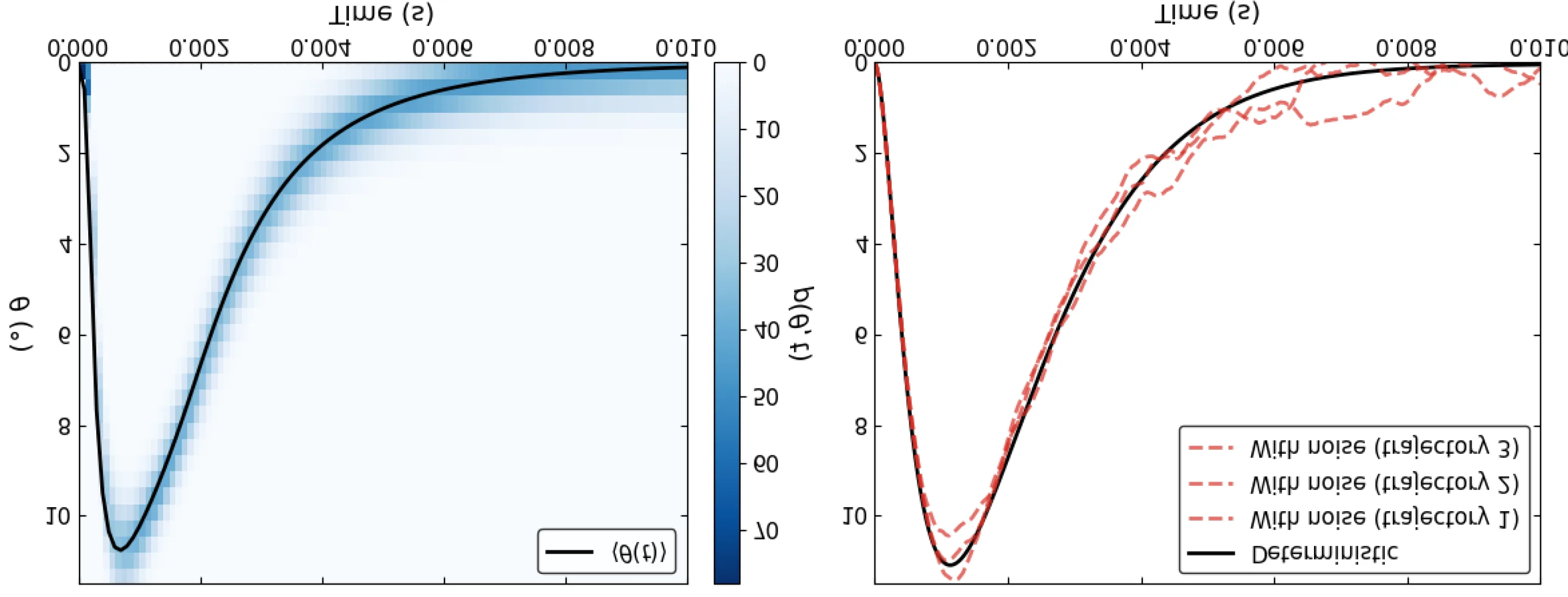
When the magnets flip, they give the diamond a slight push. The push is minuscule, like an ant blowing on a soccer ball. But the diamond is so light and so well suspended that it's enough to make it rotate. The researchers saw this rotation by tracking the deflection of a weak laser beam.
This trick lets you read a quantum state not through complex electronics but through ordinary motion. In the future, it could lead to ultra-precise sensors and, possibly, tests of whether a large object can behave like a quantum particle.
Original abstract
as written by the authors arXiv:2603.02507
Levitated macroscopic particles exhibiting quantum mechanical effects are garnering increased attention as a means for precision sensing and testing quantum mechanics. Defects in diamond, such as the nitrogen-vacancy (NV) centre possess optically-addressable spins with long coherence times at room temperature and offer an intriguing system to examine quantum spin dynamics coupled to a macroscopic classical particle. In this work, we convert the outcome of a quantum measurement on an ensemble of spins into a macroscopic rotation of the host particle via spin-mechanical coupling. Following a sequence of green laser and microwave control pulses, spin-mechanical coupling between the final qubit spin state and the host particle -- an electrically-levitated diamond -- exerts a torque on the particle that deflects a weak near-infra-red laser beam. We measure spin readout contrast in excess of 70\%, and demonstrate pulsed mechanical detection of coherent Rabi oscillations, spin-echo interferometry and $$T_1$$-induced relaxation. We directly measure with temporal resolution the particle reorientation from a 60\,attonewton-metre spin torque induced by flipping the spins. Our results open up interesting new opportunities for levitated spin-mechanical systems using pulsed control, from improved sensing to the prospect of realising macroscopic quantum superposition states.
The diamond in the experiment is smaller than a grain of sand, yet it contains a whole array of quantum magnets, like a city in a single drop.
It sounds like the sensors from Star Trek that detect the slightest changes in space.